
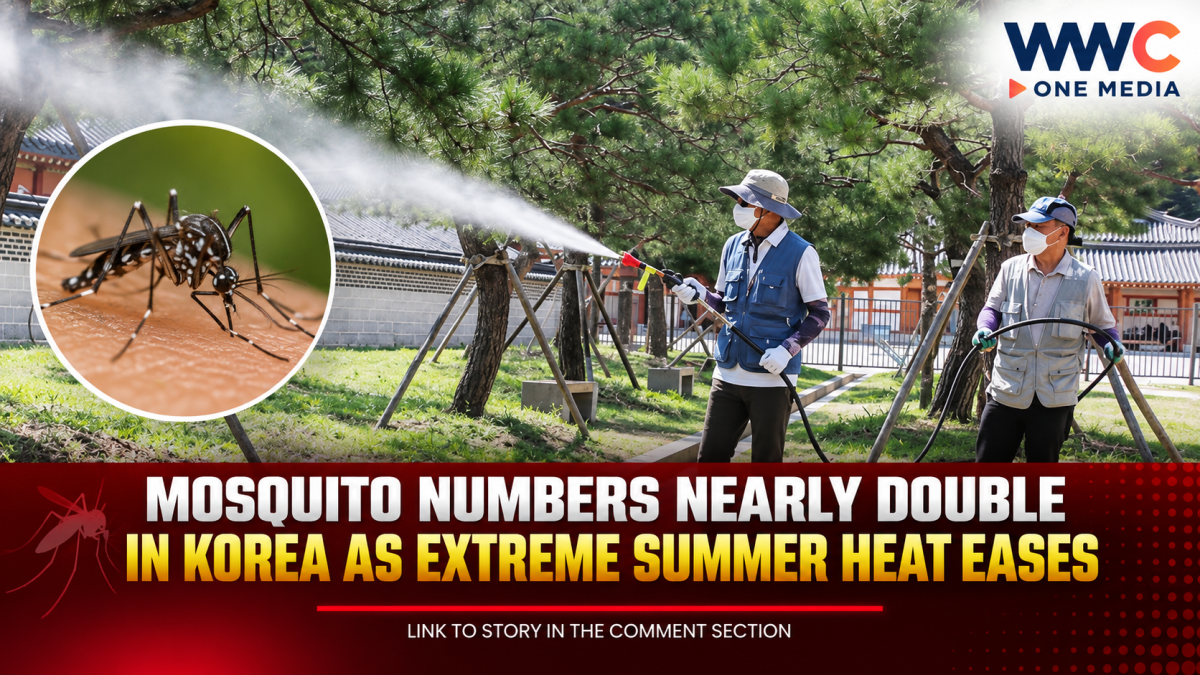
SEOUL — Mosquito activity is surging across South Korea as the scorching summer heat finally eases, with the country’s latest mosquito index nearly doubling in just one week and raising fresh concerns about mosquito-borne diseases.
The Korea Disease Control and Prevention Agency’s real-time surveillance data showed the mosquito index reaching 100.9 during the week of Aug. 24–29, up sharply from 53 the previous week. The increase of 47.9 marked one of the most dramatic weekly jumps recorded since the monitoring system began.
The unusual rise comes after an exceptionally hot summer in which extreme temperatures suppressed mosquito activity.
Why mosquitoes are returning as temperatures fall
Mosquito populations do not necessarily peak during the hottest part of summer.
According to reporting by Korea JoongAng Daily, mosquito numbers fell significantly during the most intense period of this year’s heat, then began recovering as temperatures cooled and late-summer rainfall returned.
The combination of moderately warm temperatures and increased moisture can create more favorable conditions for mosquito activity.
Seoul’s own monitoring system has shown a similar pattern. Traps at 55 monitoring locations across the capital caught 1,978 mosquitoes on a single day, the city’s highest daily count in more than a month.
September could become a peak month for bites
The resurgence is particularly notable because September can be an active period for mosquitoes in South Korea.
Data cited by Korea JoongAng Daily showed that Seoul’s monitoring traps have averaged about 67,535 mosquitoes in September over the past five years, compared with approximately 62,114 in August.
That means the easing of the heat does not necessarily signal an end to mosquito season.
Instead, cooler evenings and late-summer rain may create conditions that allow mosquito activity to rebound.
Health authorities remain alert
The increase matters because mosquitoes can transmit diseases, including Japanese encephalitis and malaria.
South Korea has previously issued nationwide alerts after mosquitoes carrying disease-causing parasites or viruses were detected.
The rise in mosquito activity therefore provides an important reminder that mosquito-borne diseases remain a public-health concern even after the most intense summer heat has passed.
Extreme heat may have temporarily suppressed mosquitoes
The 2026 pattern also highlights how unusually high temperatures can affect mosquito populations.
During the worst of the summer heat, mosquito numbers dropped sharply. Once conditions became less extreme, however, the insects began returning in significant numbers.
The Korea Herald reported that the latest AI-based real-time monitoring system recorded an index above 100 insects for the first time, underscoring how quickly mosquito activity changed as the heat wave weakened.
A warning as autumn approaches
The sudden rebound shows that the end of the summer heat does not automatically mean the end of mosquito concerns.
Instead, South Korea could see continued mosquito activity as the weather transitions toward autumn.
For residents, the development is another reminder that mosquito-borne disease prevention remains relevant beyond the peak of summer.
The heat may finally be breaking — but South Korea’s mosquito problem is only getting started again.




Leave a Reply