
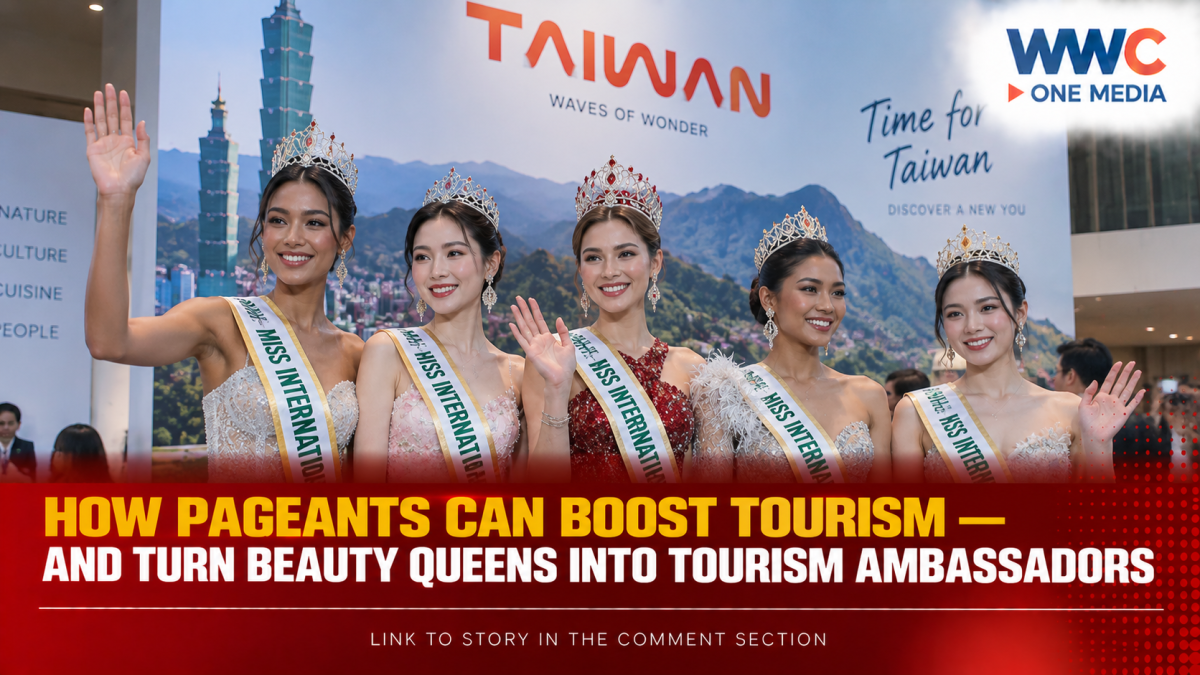
Beauty pageants are often judged by crowns, gowns and onstage performances. But behind the spectacle is another powerful industry connection: tourism.
When an international pageant comes to a city or country, contestants, organizers, production teams, media and supporters can generate demand for hotels, restaurants, transportation, shopping, attractions and other tourism services. At the same time, the event can put a destination’s landscapes, culture and hospitality in front of audiences that may never have considered visiting.
That makes pageantry an increasingly attractive tool for destination marketing and cultural promotion.
From competition to tourism showcase
Modern pageants frequently build tourism activities into their programs. Contestants may visit landmarks, participate in cultural events, wear traditional costumes, experience local food and meet community groups.
Those activities create content that can travel well beyond the actual competition.
A recent example came from Malaysia, where the 2025 Miss Tourism International World Final in Genting Highlands was presented as part of a wider tourism and cultural celebration. Contestants from different countries took part in activities that showcased Malaysian destinations and culture.
Vietnam has similarly used international pageantry as a platform for cultural promotion. Miss Multicultural World 2026, hosted for the first time in Vietnam, brought together contestants from nearly 50 countries and regions, with organizers explicitly describing the event as an opportunity to promote Vietnam, its people and culture internationally.
The economic effect goes beyond ticket sales
The tourism value of a pageant is not limited to people attending the final show.
International contestants can stay in hotels for days or weeks. Production crews need accommodation and transportation. Organizers hire venues, caterers, photographers, event workers and other suppliers.
Visitors accompanying contestants can also spend money on attractions, restaurants and retail businesses.
That means the economic activity can spread across several parts of the local tourism ecosystem.
The strongest benefits are likely when organizers deliberately connect the pageant to local tourism businesses rather than treating the competition as a single-night event.
Social media can multiply the exposure
Perhaps the biggest change in the pageant-tourism relationship is digital media.
A contestant visiting a beach, heritage district, museum, restaurant or cultural site can turn that experience into photographs, videos and social-media posts viewed by audiences around the world.
Instead of relying exclusively on conventional advertising, destinations can benefit from thousands of pieces of user-generated content surrounding the competition.
This is particularly relevant for countries such as the Philippines, where pageantry already has a large domestic following.
In July 2026, Filipino representatives Alexandra Krishna Oriño and Ma. Kathleen Monjardin won the Miss Tourism 2026 and Miss Teen Tourism Universe 2026 titles, respectively, demonstrating how tourism-focused pageants can directly connect beauty competitions with destination promotion.
Hosting can also strengthen a destination’s image
Winning a major international pageant can give a country or city a different kind of visibility.
The destination is not simply presented as a place to visit. It becomes associated with the contestant’s story, national identity, cultural heritage and international media coverage.
That can contribute to what tourism marketers call destination image — the collection of impressions people develop about a place before deciding whether to visit.
For emerging destinations, this exposure can be especially valuable.
The Philippines, for example, has repeatedly used international pageantry to place Filipino culture, hospitality and tourism destinations before global audiences. The country’s strong pageant culture also creates an established domestic audience that can amplify international events.
But a crown alone cannot guarantee more tourists
There is an important distinction between visibility and measurable tourism growth.
A pageant can generate substantial media attention without automatically producing a corresponding increase in tourist arrivals. Actual economic benefits depend on factors such as event size, audience reach, visitor spending, length of stay, tourism infrastructure and how effectively the destination converts publicity into travel demand.
There can also be significant hosting costs.
For that reason, governments and tourism agencies need to evaluate pageants like other major events: by comparing promotional value and visitor spending against public and private investment.
The opportunity is bigger when tourism comes first
The most effective model may therefore be one in which pageants are integrated into a broader tourism strategy.
Instead of simply hosting the final competition, organizers can build itineraries around local attractions, culinary experiences, heritage sites, festivals and regional destinations.
Contestants become temporary tourism ambassadors, while the pageant becomes a traveling showcase of the host country’s identity.
That approach is already visible in international competitions that combine the pageant with cultural exchanges, tourism activities and national-costume showcases.
For destinations competing for global travelers’ attention, that may be the real power of pageantry.
The crown lasts for a year. But if a pageant successfully sells a destination to millions of viewers, its tourism impact can potentially last much longer.




Leave a Reply