
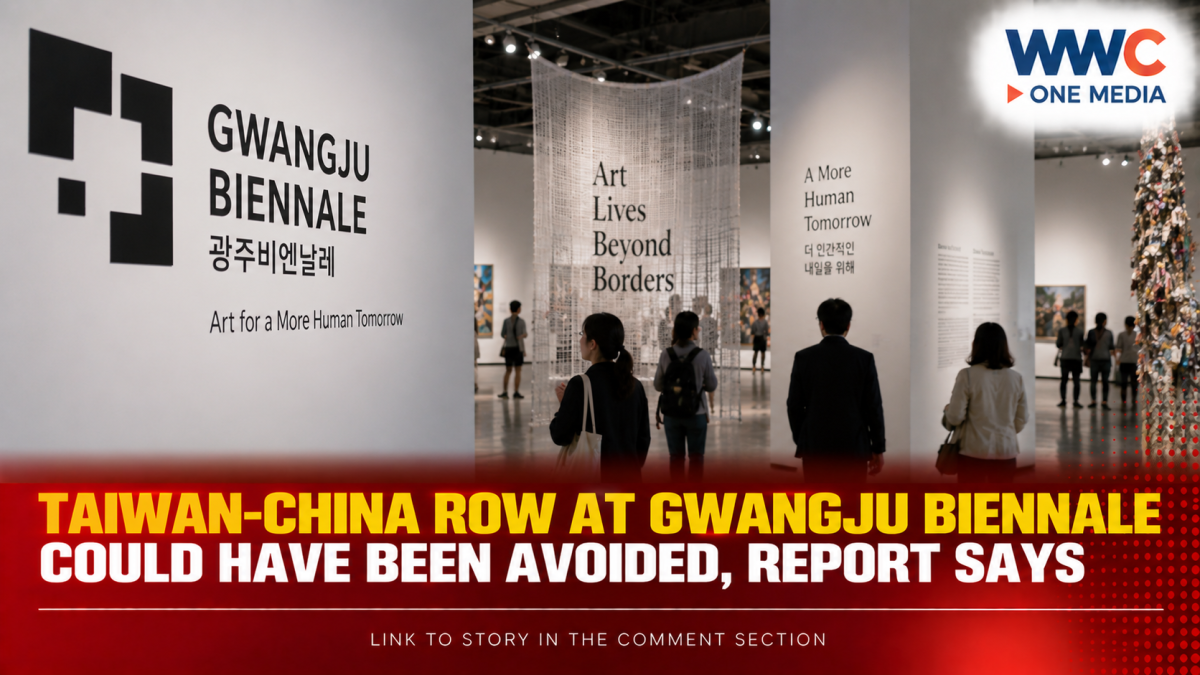
GWANGJU, South Korea — What began as a dispute over the name of a pavilion at the 2026 Gwangju Biennale escalated into a diplomatic controversy involving Taiwan, China and South Korea — and a new report argues that the confrontation could have been avoided.
The dispute ultimately resulted in Chinese artists withdrawing from the biennale after organizers approved the designation “Taiwan Pavilion” for an exhibition associated with Taiwan’s National Taiwan Museum of Fine Arts (NTMoFA).
But reporting by The Korea Times suggests that the controversy exposed deeper weaknesses in the biennale’s administrative structure, particularly its handling of international participants, institutional agreements and pavilion classifications.
How the Taiwan Pavilion controversy began
The National Taiwan Museum of Fine Arts entered the Gwangju Biennale’s Pavilion Project as an institutional participant, rather than as a national pavilion.
According to the Gwangju Biennale Foundation, NTMoFA signed its exhibition agreement on January 12, 2026. The foundation said its pavilion system distinguishes between national participants and institutional participants, with different naming and approval procedures.
The naming issue became contentious when the Taiwanese side objected to the use of the more institutional “NTMoFA Pavilion” designation.
The foundation subsequently approved the name “Taiwan Pavilion.”
That decision triggered a reaction from China, which maintains that Taiwan is part of China under its One China principle.
Chinese artists participating in the China Pavilion subsequently stopped installation work and withdrew from the exhibition.
China withdraws, while Gwangju apologizes
The controversy quickly moved beyond the art world.
Chinese Ambassador to South Korea Dai Bing expressed concern about the pavilion’s naming in communication with Gwangju’s mayor. Chinese participants then withdrew from the biennale.
The Gwangju government later reaffirmed its respect for the One China policy and apologized to China over the controversy.
At the same time, Taiwanese artists and officials had welcomed the use of the “Taiwan Pavilion” designation, creating a difficult balancing act for the organizers. Taiwan-focused reporting described the pavilion’s eventual opening as an important recognition of the Taiwanese participants’ identity.
The bigger problem: Was the system prepared?
This is where the controversy becomes more complicated.
A Korea Times report argued that the dispute exposed problems within the Gwangju Biennale Foundation’s management system.
The foundation has expanded its Pavilion Project significantly since its launch in 2018, bringing together countries, cities and cultural institutions under one international program.
But its core workforce reportedly relies heavily on short-term contracts, raising concerns about institutional memory and continuity between biennale editions. According to the report, the department responsible for pavilion administration experienced significant staff turnover before this year’s event.
That matters because international cultural events require more than exhibition planning.
They also require careful coordination of diplomatic sensitivities, naming conventions, institutional agreements and communication with governments and cultural organizations.
The Taiwan-China dispute demonstrated what can happen when those areas collide.
Gwangju Biennale says it did not censor Taiwan
The foundation has pushed back against some interpretations of the controversy.
In its official statement, the Gwangju Biennale said it did not intervene in or censor the Taiwanese exhibition’s artistic content.
It stressed that the dispute concerned the administrative classification and naming of the pavilion rather than the exhibition’s artworks or freedom of expression.
The foundation also emphasized that the Pavilion Project is separate from the biennale’s main exhibition and operates as a voluntary international cultural-exchange platform.
That distinction is important because accusations of censorship had circulated during the dispute.
The foundation’s position was that it was dealing with an administrative problem — not attempting to control the content presented by Taiwanese artists.
Why the controversy was bigger than a name
The dispute illustrates how even a seemingly administrative decision can become politically explosive when Taiwan and China are involved.
For Taiwan, the name “Taiwan Pavilion” carries obvious significance because it presents Taiwan’s cultural identity directly.
For China, the same designation can be interpreted as implying recognition of Taiwan as a separate country.
For South Korea and the Gwangju Biennale, the challenge was to maintain an international arts platform while navigating those conflicting positions.
That is why the controversy quickly became much bigger than a label on an exhibition space.
Gwangju promises reform
Following the Chinese withdrawal, Gwangju Biennale Foundation President Youn Bum-mo expressed regret over the situation and said the pavilion system needs fundamental reform.
He acknowledged that distinguishing between national and institutional pavilions could itself create confusion and said the foundation would explore ways to change the system.
The foundation now faces a difficult question: how can future editions invite governments, museums and cultural institutions from politically sensitive regions without allowing administrative decisions to trigger diplomatic disputes?
The answer may require clearer agreements before exhibitions are announced, stronger institutional continuity and more experienced international coordination.
A warning for international cultural events
The Gwangju controversy offers a lesson that extends well beyond South Korea.
Major art festivals increasingly function as international meeting points where culture, identity and diplomacy overlap.
Organizers may want art to remain separate from politics, but the identities represented inside an international exhibition can carry political meaning regardless of the organizers’ intentions.
The 2026 Gwangju Biennale has therefore become an unexpected case study in the difficulty of maintaining that separation.
The exhibition itself continues, but the controversy has already forced organizers to reconsider how the Pavilion Project is structured and managed.
What began as a dispute over the words “Taiwan Pavilion” has now become a much larger question about whether an international art institution can anticipate political sensitivities before they turn into a diplomatic crisis.
Bottom line
The Taiwan-China row at the Gwangju Biennale was not simply an unavoidable clash between Beijing and Taipei. The latest reporting indicates that unclear pavilion classifications, administrative changes, staff turnover and insufficient anticipation of diplomatic consequences contributed to the escalation.
For Gwangju, the challenge now is to turn the controversy into institutional reform — before the next politically sensitive exhibition creates another crisis.




Leave a Reply