
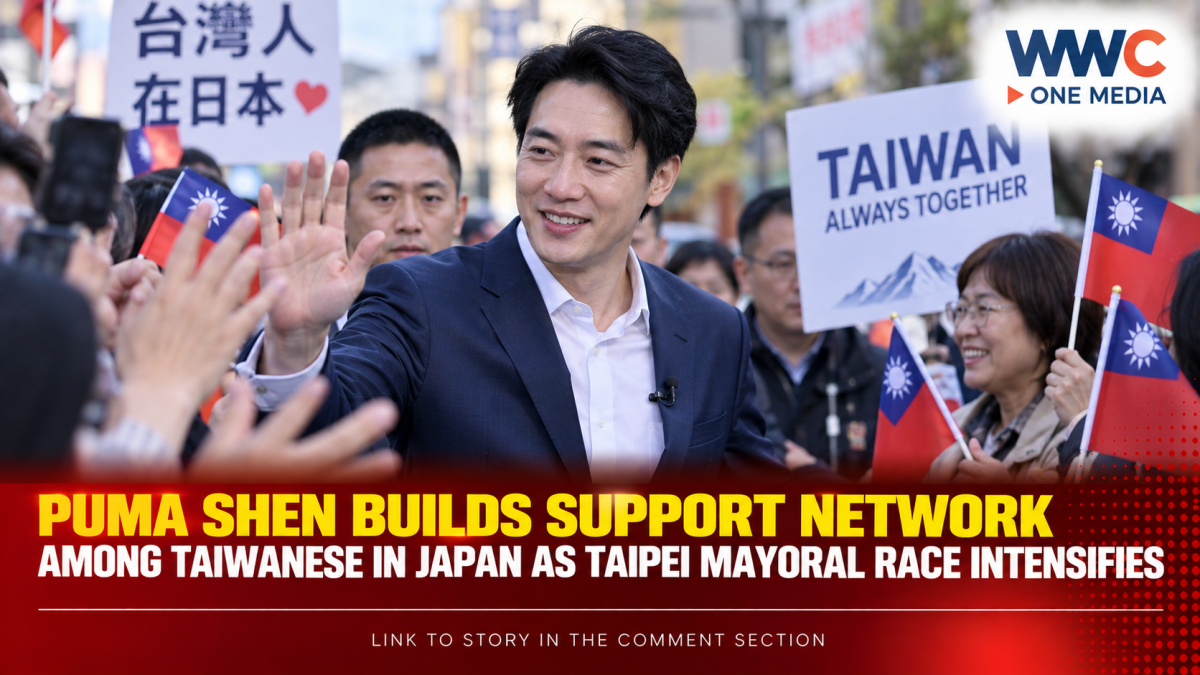
TOKYO/TAIPEI — Taiwan’s Taipei mayoral race is increasingly extending beyond the island, with Democratic Progressive Party (DPP) legislator and mayoral candidate Puma Shen (沈伯洋) using a visit to Japan to strengthen ties with Taiwanese communities and promote closer Taipei-Tokyo exchanges.
Shen met with Taiwanese supporters in Tokyo on Saturday and helped establish an overseas campaign support group, describing the move as an important milestone in his campaign for the November 28 Taipei mayoral election.
But the Japan trip is about more than election campaigning.
Shen said his visit has three major objectives: building the Japan support network, advancing parliamentary diplomacy and studying Japanese approaches to urban governance that could potentially inform future Taipei policies.
Why the Taiwanese community in Japan matters
Shen said Taiwanese living in Japan could play an important role in future exchanges between Taipei and Tokyo.
He highlighted potential cooperation involving nongovernmental organizations, residents and businesses, arguing that Taiwanese communities already established in Japan could help connect the two cities.
The approach reflects a broader effort to treat overseas Taiwanese communities not simply as electoral supporters, but as potential bridges for economic, civic and city-to-city cooperation.
Shen also pointed to the large number of Taiwanese businesses operating across different sectors in Japan, saying these connections could become useful for Taipei in the future.
Japan becomes a key part of Shen’s city-diplomacy strategy
Before leaving Taiwan on September 11, Shen said he would meet officials from Japan’s ruling Liberal Democratic Party (LDP) as part of a delegation of legislators from Taiwan’s Foreign Affairs and National Defense Committee.
He also planned to examine Japanese policies concerning urban renewal and sports, areas that could provide ideas for his Taipei mayoral campaign.
The emphasis on city diplomacy is significant because Shen is attempting to present the Taipei mayoralty as a position with an international dimension.
Rather than limiting the campaign to domestic municipal issues, he is placing greater emphasis on Taipei’s relationships with international cities and overseas Taiwanese networks.
From parliamentary diplomacy to Taipei’s future
Shen has increasingly promoted the idea that Taipei should deepen practical connections with cities and communities overseas.
Japan is particularly important because Taiwan and Japan already maintain extensive people-to-people ties involving tourism, culture, business and disaster-relief cooperation.
Those existing connections could provide a foundation for expanded city-level cooperation if Shen wins the mayoral election.
His Japan visit therefore combines campaign organization with an effort to develop a foreign-policy-style vision for Taipei — even though municipal governments do not control Taiwan’s national foreign policy.
The election battle is taking shape
The Taipei mayoral election is scheduled for November 28, 2026, and Shen is expected to face incumbent Chiang Wan-an (蔣萬安) of the Kuomintang (KMT) in what is shaping up to be one of Taiwan’s most closely watched local contests.
Taiwan News reported that six candidates had registered by September 2026, although Shen and Chiang have emerged as the principal rivals in the race.
For Shen, building networks abroad could help reinforce his image as a candidate focused on international engagement, while also giving overseas Taiwanese communities a more visible role in his political organization.
A campaign increasingly focused on international connections
The Japan visit follows Shen’s earlier efforts to connect with Taiwanese communities overseas.
His approach includes establishing campaign support groups abroad while promoting the idea that Taiwanese communities can contribute to Taipei’s international relationships.
That strategy is particularly relevant for Japan, where Taiwanese residents and businesses have already built extensive social and commercial networks.
Shen’s message is that these networks could become an asset for Taipei — not only during an election, but potentially in shaping the city’s future economic, cultural and civic relationships.
The immediate political objective is clear: win support for November’s mayoral election.
But the larger question is whether Shen can turn overseas Taiwanese networks into a lasting component of Taipei’s international strategy.
As the campaign enters its final months, his Japan outreach suggests that the battle for Taipei’s next mayor may be fought not only in the city’s neighborhoods, but also through its growing network of international connections.




Leave a Reply