
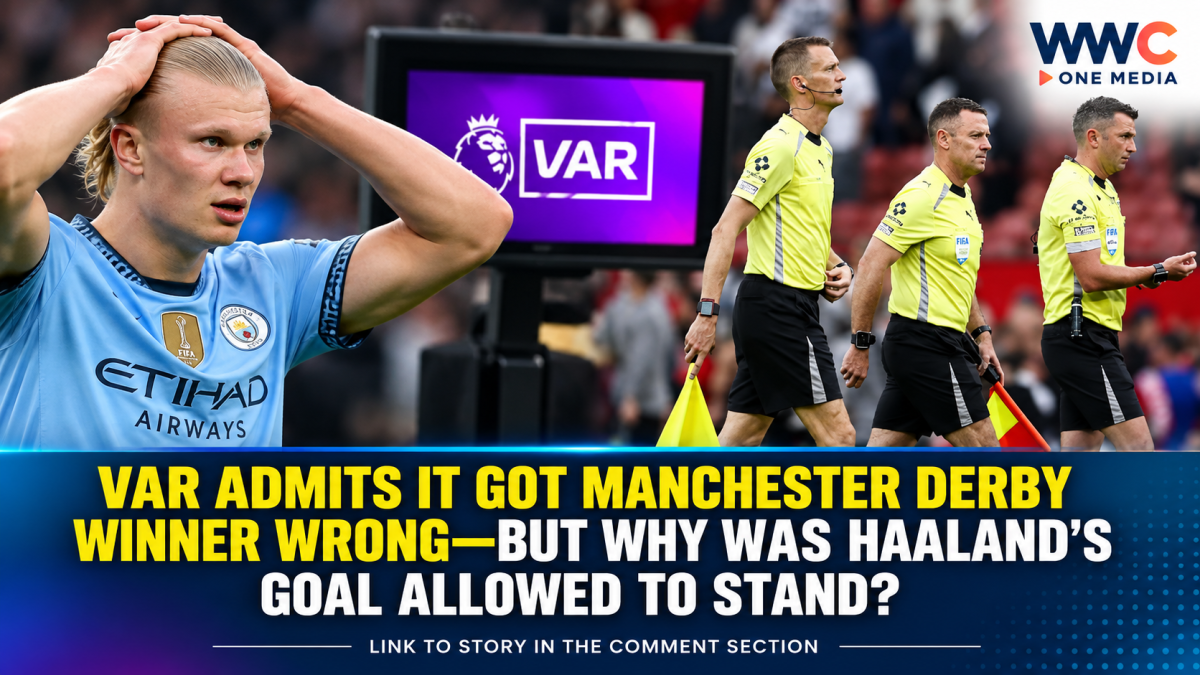
MANCHESTER — A major VAR controversy has erupted after the refereeing body admitted that a crucial decision in the Manchester derby was wrong, acknowledging that Erling Haaland’s winning goal for Manchester City should have received further on-field scrutiny.
Manchester City secured a dramatic 1-0 victory over Manchester United at Old Trafford on September 13, but the result has since been overshadowed by a stunning admission from the officials responsible for the decision.
The decisive moment came in the second half when Haaland found the net from a cross. The goal was initially ruled out for offside before VAR intervened and overturned the decision, allowing Manchester City to take the lead.
However, the referees’ body later acknowledged that VAR made an error in its assessment of the incident.
Why Was Haaland’s Goal So Controversial?
The controversy centered on another Manchester City player, Enzo Fernandez, who was in an offside position during the attacking move.
While VAR determined that Haaland himself was onside, the subsequent review failed to properly account for whether Fernandez’s position and movement affected Manchester United’s ability to defend.
According to Reuters, the refereeing body concluded that the VAR did not adequately consider Fernandez’s positional influence and that the incident should have been treated as a subjective offside decision. Officials said the situation should have resulted in an on-field review by the referee.
That admission has intensified questions over how VAR handled one of the biggest moments of the Premier League season so far.
Referees Contact Manchester United After Admitting Error
The refereeing body reportedly contacted Manchester United to acknowledge the mistake and confirmed that the incident would be reviewed.
Manchester United manager Michael Carrick had already expressed frustration after the match, questioning why VAR failed to reach what he believed was the correct decision despite having access to multiple camera angles and additional technology.
The controversy is particularly significant because the goal proved decisive.
Manchester City held on to win 1-0 despite playing with 10 men for more than an hour after Phil Foden was sent off in the first half. United also came close to scoring, with Marcus Rashford and Kobbie Mainoo hitting the woodwork, but City survived the pressure to secure the derby victory.
How Does VAR Handle Offside Decisions?
Under Premier League VAR procedures, officials review goals and other major match-changing incidents, but intervention is generally based on whether there has been a clear and obvious error.
Offside situations can become particularly complicated when a player who does not touch the ball is nevertheless judged to be interfering with an opponent or influencing play.
The Premier League’s VAR guidance explains that the system reviews key match-changing incidents, including goals, while subjective decisions can require the referee to conduct an on-field review.
That distinction is now at the center of the Manchester derby controversy.
Another Major VAR Debate for the Premier League
The latest controversy comes amid growing scrutiny of VAR and refereeing consistency in English football.
Earlier in 2026, refereeing officials also admitted that Manchester United’s Matheus Cunha had scored a goal against Nottingham Forest that should have been disallowed for handball. The incident raised similar concerns about VAR interpretation and the role of the referee when reviewing key decisions.
Manchester City manager Pep Guardiola has also previously criticized VAR, describing decision-making involving the system as unpredictable.
The Haaland incident is likely to add further pressure on football authorities to explain how VAR reviews subjective offside decisions and why a potential interference issue was not fully addressed before the goal was awarded.
The Result Will Not Change—But the Questions Remain
Despite the referees’ admission, Manchester City’s 1-0 victory is expected to stand.
But for Manchester United, the controversy leaves a difficult question hanging over one of football’s biggest fixtures:
If VAR had the technology, multiple camera angles and time to review the incident, how did it still get the Manchester derby’s decisive goal wrong?
With the refereeing body now set to review the incident, the controversy surrounding Haaland’s winner could become another defining chapter in the Premier League’s long-running debate over VAR, consistency and accountability.
Manchester City may have the three points—but the VAR debate is far from over.




Leave a Reply