
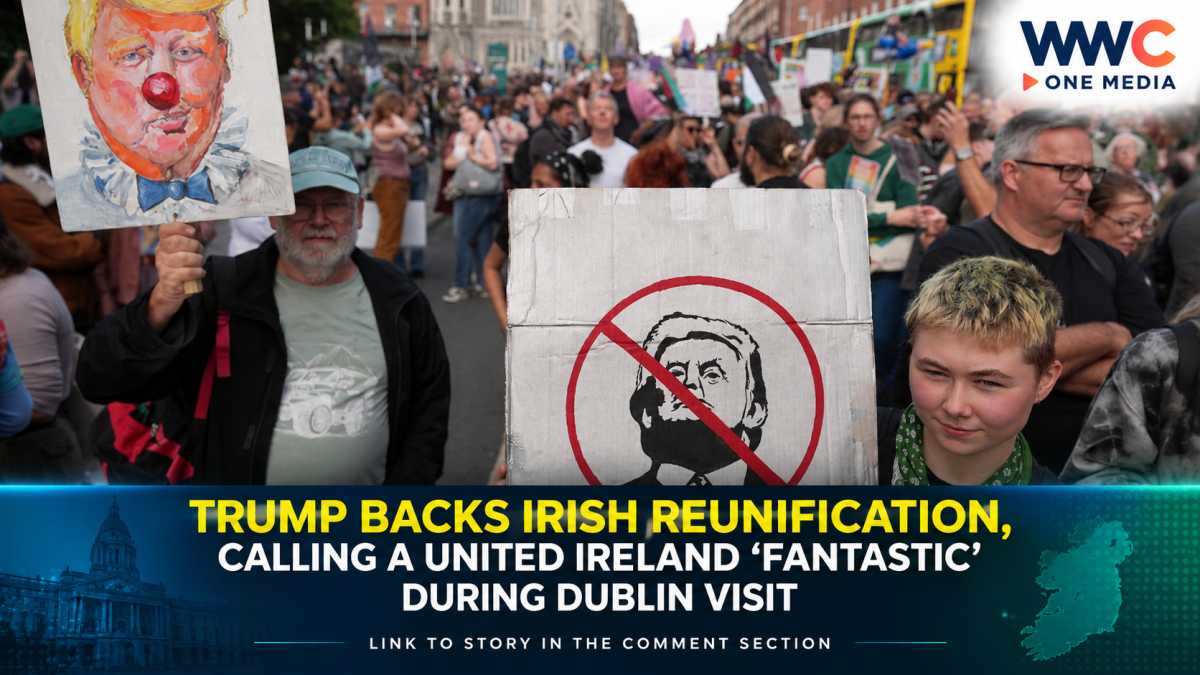
US President Donald Trump has waded into one of Ireland’s most politically sensitive issues, saying he would “love” to see Northern Ireland reunify with the Republic of Ireland and calling the prospect a “fantastic thing”.
Trump made the remarks during his visit to Dublin on Sept. 12, when he met Irish Prime Minister Micheál Martin. He said he believed Irish reunification would eventually happen, while acknowledging that the United Kingdom would have a say in the process.
“I’d love to see it unified,” Trump told reporters. “It’s going to happen eventually … I think it would be a fantastic thing.”
His comments immediately touched a political nerve because Washington has traditionally maintained a cautious and broadly neutral position on Northern Ireland’s constitutional future. Trump later repeated that he thought a united Ireland would be a “very cool thing”.
Why Irish reunification is so sensitive
Ireland has been politically divided for more than a century. The Republic of Ireland is an independent state, while Northern Ireland remains part of the United Kingdom.
The issue was at the heart of decades of violence known as the Troubles, involving Irish nationalists who wanted Northern Ireland united with Ireland and unionists who wanted it to remain within the UK.
The 1998 Good Friday Agreement largely ended the conflict and established that Northern Ireland’s constitutional status could change only with the consent of majorities in both Northern Ireland and the Republic of Ireland through referendums.
Under the agreement, however, a referendum in Northern Ireland is not automatically triggered simply because political leaders call for one. The British government has responsibility for determining whether circumstances justify holding a vote.
UK government pushes back
Trump’s comments were met with criticism from pro-British unionists and came shortly after British Prime Minister Andy Burnham said another referendum on Irish unity was currently “off the table”.
Downing Street said that position had not changed following Trump’s intervention. Burnham has argued that there is currently no sufficient evidence of majority support in Northern Ireland for leaving the UK.
DUP leader Gavin Robinson also rejected Trump’s remarks, stressing that Northern Ireland’s constitutional future should be decided by people there rather than outside politicians.
The comments were welcomed by Irish nationalists, including Sinn Féin, which has long supported a referendum on reunification.
Ireland takes a more cautious approach
Martin did not appear eager to turn Trump’s comments into an immediate political campaign. The Irish prime minister has said the reaction from some unionists was an overreaction and reiterated that any constitutional change would have to take place within the framework of the Good Friday Agreement.
Trump’s intervention therefore does not mean a referendum is imminent, nor does it change the legal process required for Northern Ireland to leave the United Kingdom.
For now, it is primarily a political statement from the US president — but one with unusual weight because of America’s historic role in supporting the Northern Ireland peace process.
Trump also raises Scotland question
Trump was also asked about Scottish independence during his Ireland visit but declined to discuss the issue, saying he would not talk about Scotland “yet”.
His comments on Ireland nevertheless mark a significant departure from the careful neutrality traditionally associated with US presidents when discussing the island’s constitutional future.
The timing also adds to the significance. Trump was in Ireland for a two-day visit that included meetings with Irish leaders and an appearance at the Irish Open at his Doonbeg golf resort.
With the question of Irish unity becoming increasingly prominent in political debate, Trump’s intervention has ensured that an already sensitive issue is once again at the centre of attention — on both sides of the Irish Sea.



Leave a Reply