
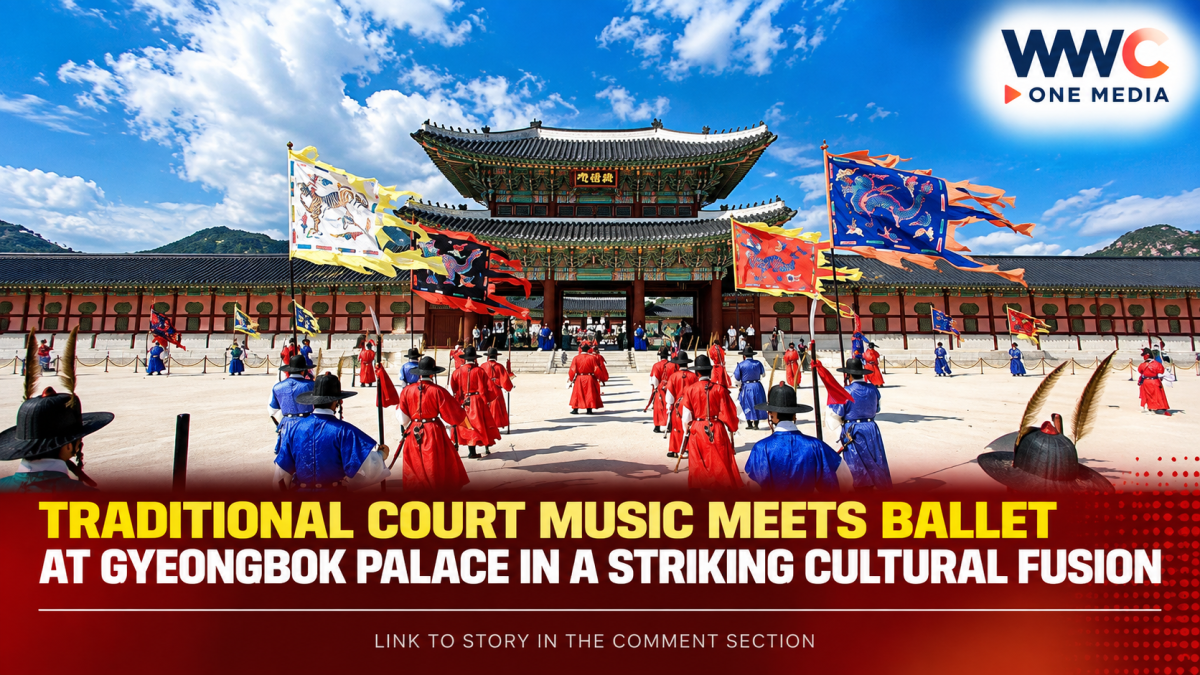
South Korea — The historic grounds of Gyeongbokgung Palace are taking on a striking new atmosphere as the graceful movements of ballet meet the centuries-old sound of Korean traditional court music.
The cultural crossover, titled “Palace Concert – Ballet × Sujecheon,” brings together Sujecheon, a renowned form of Korean traditional court music, and Western classical ballet in the courtyard of Jipokjae Hall, one of Gyeongbokgung Palace’s distinctive historic spaces. The Korea Heritage Agency describes the program as a crossover performance designed to bring the two artistic traditions together.
Rather than presenting Korean traditional music and ballet as separate art forms, the production places them in the same performance space — creating an unusual meeting point between Korea’s royal musical heritage and the highly structured language of Western dance.
When royal music meets modern movement
Sujecheon is closely associated with Korea’s traditional court-music tradition. Its stately character and distinctive instrumental sound provide a very different musical foundation from the orchestral scores normally associated with classical ballet.
That contrast is precisely what makes the palace performance compelling.
The dancers’ movements introduce a contemporary visual dimension while the traditional ensemble preserves the atmosphere of Korea’s historical performing arts.
The result is not simply a ballet performed against a traditional backdrop. It is an artistic conversation between two different cultural traditions.
Gyeongbokgung becomes part of the performance
The setting is just as important as the music and dance.
Gyeongbokgung, the principal royal palace of the Joseon Dynasty, provides a historic architectural backdrop that connects the performance with Korea’s royal past.
Holding the crossover performance in the courtyard of Jipokjae Hall gives audiences an opportunity to experience traditional Korean architecture, music and contemporary performance together. The Korea Heritage Agency specifically identifies the courtyard as the venue for the Ballet × Sujecheon program.
That setting transforms the palace from a historical site into an active cultural stage.
A growing trend of reimagining Korean heritage
The palace performance also reflects a broader effort to make Korea’s traditional culture accessible to contemporary audiences.
Instead of preserving traditional performing arts solely in conventional concert halls, cultural organizations have increasingly experimented with performances that place heritage alongside contemporary artistic forms.
The approach can make unfamiliar traditional music easier for international audiences to discover while giving established art forms such as ballet a completely different visual and cultural environment.
Korean traditional music has also become increasingly visible internationally as interest in Korean culture continues to expand beyond K-pop and television dramas.
Why this performance stands out
The appeal of Ballet × Sujecheon lies in the contrast.
One side represents a musical tradition shaped by Korea’s royal court culture. The other comes from the Western classical dance tradition.
Together, they create a performance that crosses geographic and artistic boundaries without requiring either tradition to disappear.
For audiences visiting Seoul, the experience offers something different from a conventional palace tour: the opportunity to see one of Korea’s most important historic sites functioning as a living cultural venue.
And as the music rises beneath the palace architecture and ballet dancers move through the historic courtyard, Gyeongbokgung becomes more than a monument to Korea’s past.
It becomes a stage where old and new Korea meet.




Leave a Reply