
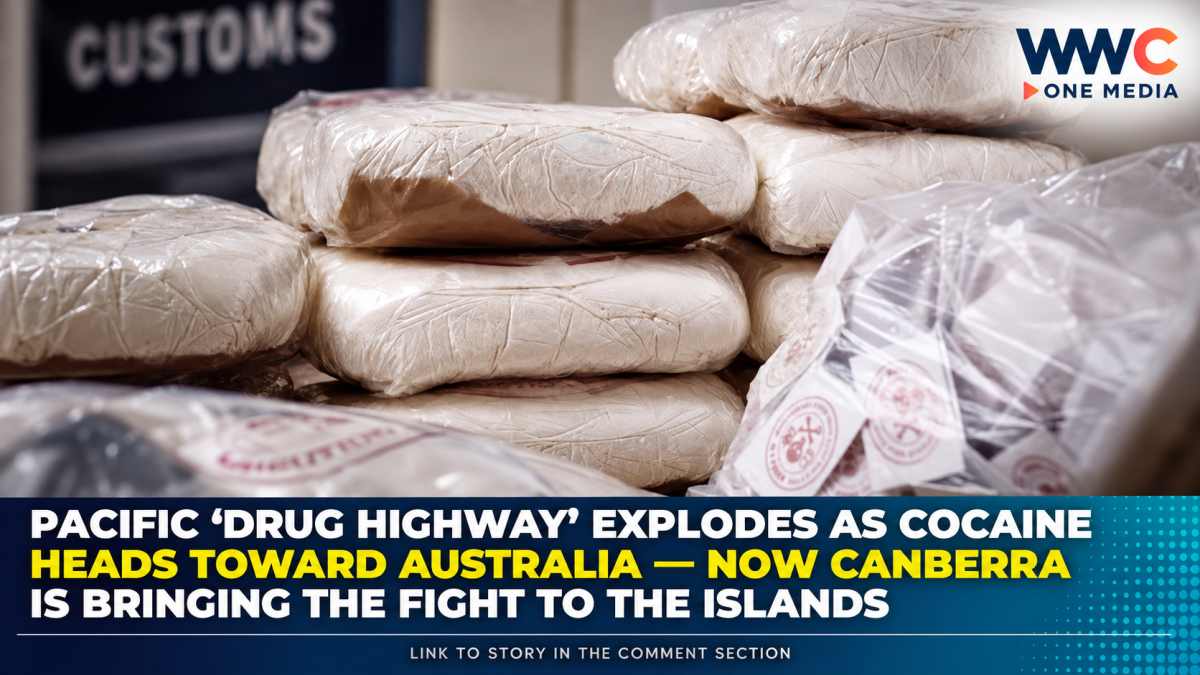
A vast maritime corridor stretching across the Pacific is emerging as a major battleground in the global fight against cocaine and methamphetamine trafficking, prompting Australia and Pacific island nations to launch a far-reaching security response.
Australia has committed A$600 million to strengthen regional efforts against transnational and organised crime, including drug trafficking, as authorities warn that criminal networks are increasingly exploiting the Pacific’s enormous distances, thousands of islands and vast areas of open ocean.
The new initiative, backed by Pacific leaders, is designed to improve intelligence-sharing, maritime surveillance and cooperation between police and security agencies.
But the scale of the challenge is becoming increasingly difficult to ignore.
Billions of dollars of drugs moving through the Pacific
Australian authorities say the Pacific has become an important maritime pathway for cocaine and other illicit drugs travelling toward Australia and New Zealand.
The Australian Border Force reported that around 20 tonnes of cocaine had been detected offshore while being trafficked through what it described as the Pacific maritime highway, with the shipments likely destined for Australia and New Zealand.
Meanwhile, more than 17 tonnes of cocaine and methamphetamine had already been seized in Australia during 2026, according to figures cited by ABC News.
Those figures represent seizures and detections, not the total amount successfully entering the region.
That distinction is critical: authorities can measure what they intercept, but the true volume moving through the Pacific remains unknown.
Australia’s answer: A$600 million regional push
At a Pacific leaders’ meeting in September, Australian Prime Minister Anthony Albanese announced a A$600 million package to strengthen the region’s response to transnational crime.
Pacific leaders unanimously endorsed Waqa Moana, a Pacific-led maritime security initiative intended to put actionable intelligence into the hands of Pacific police and operational responders.
The Australian Federal Police will contribute A$49 million to new counter-transnational and organised-crime programs, in addition to A$140 million the AFP is already contributing over four years to regional security priorities, including Waqa Moana.
The objective is not simply to catch smugglers after drugs reach Australia.
It is to disrupt the networks earlier — before vessels reach their destination.
Narco-submarines are changing the game
One of the most alarming developments is the growing use of semi-submersible vessels, commonly called narco-subs, to move cocaine across enormous stretches of ocean.
ABC News reported that at least seven narco-subs had been discovered in Pacific waters near Australia over an 18-month period, highlighting how traffickers are adapting their methods.
In another case, Australian authorities charged six crew members of the MV Raider after French Polynesian authorities intercepted the vessel. Australian police alleged that the crew had been involved in an attempt to bring approximately one tonne of cocaine into Australia.
The cases illustrate why traditional border controls are becoming increasingly difficult.
A trafficker does not necessarily need to bring a suspicious shipment directly into an Australian port.
A vessel can travel thousands of kilometres, transfer cargo at sea or near remote islands, and use multiple jurisdictions before the drugs reach their intended destination.
Fiji and other Pacific islands caught in the middle
The Pacific is not simply a highway between South America and Australia.
The drug trade is increasingly affecting the island nations themselves.
ABC investigations have described Fiji as a major transit point for cocaine and methamphetamine, with enormous quantities moving through the region and creating additional pressure on local police, communities and institutions.
In January, Fijian authorities also investigated a suspected drug operation involving a narco-sub after local residents reported suspicious vessels and activity along the coastline.
Authorities described the alleged cocaine shipment as being worth hundreds of millions of Australian dollars.
A separate ABC investigation into Fiji’s largest-ever methamphetamine seizure reported an alleged four-tonne import operation and links to organised criminal networks operating between Australia and Fiji.
The cases demonstrate why Pacific governments are increasingly insisting that the problem cannot be treated simply as an Australian border-security issue.
The Pacific is becoming a destination, too
Australian Home Affairs Minister Tony Burke has acknowledged that the region faces a dual problem.
Some drugs pass through Pacific nations on their way to Australia.
Others are increasingly being sold and consumed within Pacific communities.
At a Pacific police ministers’ meeting in May, Burke said the response must therefore include maritime cooperation, intelligence-sharing, harmonisation of laws and financial investigations targeting money laundering and criminal proceeds.
That is an important shift.
Instead of viewing Pacific islands merely as transit points, authorities are increasingly treating them as countries directly affected by the criminal economy.
Why the Pacific is so difficult to police
The geography gives traffickers a huge advantage.
The Pacific contains thousands of islands scattered across an immense ocean. Some communities are extremely remote, while policing and maritime surveillance resources vary dramatically between countries.
That makes it difficult for individual governments to monitor suspicious vessels, identify transfers at sea or track criminal networks operating across several jurisdictions.
Regional security experts have warned that criminal organisations are likely to continue developing more sophisticated methods to evade law enforcement.
The Pacific Islands Forum’s 2026 security outlook also identifies drug demand in Australia and New Zealand as a major driver of cocaine and methamphetamine trafficking through the region.
Australia’s own demand is part of the equation
There is another uncomfortable reality behind the crackdown: the enormous market for illegal drugs in Australia.
As long as demand remains strong and criminal organisations can generate huge profits, traffickers have powerful incentives to develop new routes.
That is why Australian authorities say stopping drugs at the source remains the best option.
Burke has said Australia needs to intervene at multiple points — in source countries, during maritime transit, throughout the Pacific and at Australia’s own borders.
The strategy is therefore becoming less about a single interception and more about building a regional intelligence and enforcement network.
A new security race across the Pacific
The Australian government says Waqa Moana will focus on getting intelligence to the people who can act on it.
That means improving information-sharing between Pacific police forces, strengthening maritime surveillance and making it easier for countries to coordinate when criminal networks cross borders.
The approach also reflects a broader recognition that organised crime is becoming increasingly international.
A shipment can originate in South America, move across the Pacific, stop at an island nation, change vessels and eventually reach Australia or New Zealand.
No single police force can effectively track the entire chain alone.
The bigger question: Can Australia get ahead of the traffickers?
Australia’s A$600 million commitment is one of the most significant attempts yet to build a coordinated regional response to the Pacific’s growing drug problem.
But money alone will not solve the problem.
Authorities must overcome enormous geographic challenges, differences in policing capabilities, corruption risks, limited surveillance resources and the ability of criminal networks to rapidly change routes.
And every successful interception may only reveal one part of a much larger operation.
The Pacific was once viewed primarily as an enormous expanse separating continents.
For organised crime networks, it increasingly looks like something else — a vast maritime corridor with countless places to hide, transfer cargo and evade detection.
Australia is now spending hundreds of millions of dollars to close that corridor. The question is whether Canberra and its Pacific partners can move faster than the traffickers who have already learned how to exploit it.



Leave a Reply