
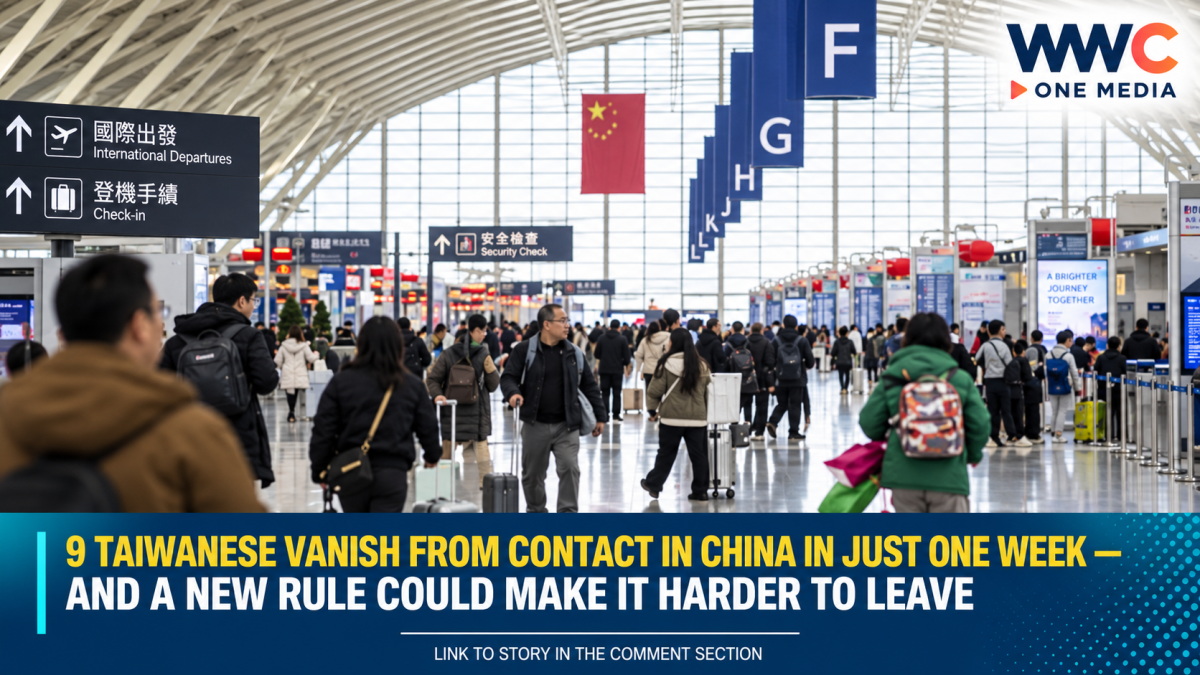
TAIPEI — Taiwan is sounding a fresh warning to citizens traveling to China after authorities reported nine new cases involving Taiwanese whose whereabouts or freedom of movement became a concern in the past week, bringing the cumulative number of cases recorded since January 2024 to 440.
The figures were released by Taiwan’s Mainland Affairs Council (MAC) on Saturday, just days before China’s revised entry-and-exit regulations are scheduled to take effect on September 15.
Taipei says the new rules could give Chinese authorities broader powers to restrict people’s movement in cases involving national security, technology and other vaguely defined grounds.
But the 440 figure needs an important clarification.
Taiwan’s government does not say that all 440 people simply “disappeared.”
Instead, the MAC divides the cases into three categories: people who lost contact with the outside world, people whose freedom was restricted, and people who were detained.
440 cases since January 2024
According to the latest MAC figures, covering cases from January 1, 2024 through Friday, 163 Taiwanese had lost contact, 36 had their movement or personal freedom restricted, and 241 had been detained.
The latest weekly update added seven detention cases and two additional people who lost contact.
Two individuals previously categorized as missing were subsequently confirmed to have been detained, highlighting why the MAC maintains separate categories rather than treating every case as an unexplained disappearance.
The numbers have been steadily drawing attention in Taiwan as officials warn citizens to exercise greater caution when traveling across the Taiwan Strait.
New Chinese rules add to the concern
The timing of the latest warning is particularly significant.
China’s revised entry-and-exit regulations are scheduled to take effect on September 15.
According to Focus Taiwan, the regulations allow authorities to prevent people from leaving China for certain national-security offenses for up to three years, while technology and export-control violations could also trigger restrictions.
Taiwanese officials are concerned about how broadly such provisions could be interpreted.
Taipei’s National Security Council adviser Alex Huang warned that people working in sensitive technology industries, civil servants and members of religious organizations could face particular risks when traveling to China.
He said Taiwanese engineers in advanced technology and defense-related fields have already expressed concerns about business travel.
China says the rules address security concerns
Beijing’s regulations are not officially described as a measure specifically targeting Taiwanese travelers.
China says its revised border rules are intended to address emerging security risks, including unlawful cross-border activity and threats involving national security and technological interests.
Channel NewsAsia reported that most ordinary foreign travelers and tour operators it interviewed expected little practical change from the new rules.
However, analysts told CNA that the regulations give authorities greater discretion to intervene in cross-border movements deemed sensitive.
That distinction is important.
The new rules do not mean that ordinary tourists will automatically be prevented from leaving China.
Instead, the concern in Taipei is that the expanded legal framework could give authorities greater room to impose restrictions in particular cases.
Taiwan is preparing travel guidelines
Taiwan is responding by preparing new guidance for citizens traveling to China.
Taipei has previously warned that China’s expanding national-security framework could create risks for Taiwanese businesspeople, technology workers and other groups whose activities or information could attract official scrutiny.
The government is considering ways to make the warnings more accessible, including information provided before departure and potentially through mobile-phone alerts when travelers arrive in China.
Taiwan has also introduced measures requiring travel agencies handling certain group trips to China to assist travelers with registration through a government reporting system, although the implementation has faced political debate and backlash.
Technology workers face particular concerns
One of the biggest concerns involves Taiwan’s semiconductor and technology industries.
Taiwan is home to some of the world’s most strategically important technology companies, and many Taiwanese engineers and executives travel to China for business.
Taipei officials fear that broad security provisions could create uncertainty for employees carrying sensitive information or working in industries that Beijing considers strategically important.
Taipei Times reported that Taiwanese technology workers could face risks if Chinese authorities interpret their work as involving sensitive technology or companies considered hostile.
The concern is not merely theoretical.
Some multinational companies have reportedly begun advising employees traveling to China to use dedicated phones and laptops rather than ordinary personal or company devices.
The rules could affect more than travelers
The controversy also reflects a much broader change in the relationship between China and Taiwan.
Beijing regards Taiwan as part of China and maintains that Taiwanese citizens fall under China’s nationality framework.
Taipei rejects Beijing’s sovereignty claims over Taiwan.
That political dispute creates an unusual situation in which Taiwanese travelers can enter China while facing a legal and political environment that Taiwan’s government considers increasingly difficult to predict.
The MAC has therefore repeatedly warned that travelers should not assume that normal commercial or tourist activity guarantees protection from Chinese authorities.
Not every case is an unexplained disappearance
The distinction between “missing,” “detained” and “restricted” is crucial for responsible reporting.
Taiwan’s MAC itself has warned against collapsing the three categories into one broad claim that hundreds of people have simply disappeared.
Some people lost contact with family or authorities.
Others were detained.
Others experienced restrictions on their freedom of movement.
In some cases, people initially reported as missing were later found to have been detained.
That does not make the issue less serious.
For families, being unable to contact a relative or learning that a loved one has been detained can be deeply alarming regardless of the legal category.
Taiwan rejects unverified organ-harvesting claims
The latest MAC statement also addressed an especially disturbing claim circulating online.
Taiwan’s council said it had not found evidence linking the reported cases to an alleged scheme involving Taiwanese jobseekers being sent to China for organ harvesting.
That point should not be overlooked.
The growing number of cases has generated legitimate concerns about detention and freedom of movement, but unverified allegations should not be presented as established fact.
Why September 15 matters
The immediate focus is now on what happens after China’s revised rules take effect on Tuesday.
Taiwanese officials are watching closely to see how the new provisions are enforced and whether travelers encounter greater scrutiny at airports, border crossings or during their stay.
The regulations are also attracting international attention.
CNA reported that the rules specifically spell out additional circumstances under which Chinese citizens can be prevented from leaving the country, including certain illegal activities, national-security concerns and technology or export-control violations.
For Taiwan, the concern is that the broad concept of national security could create uncertainty for people whose work or affiliations intersect with sensitive areas.
A warning that is becoming harder to ignore
The latest figures do not establish that every Taiwanese traveler to China faces detention or disappearance.
Millions of people travel between the two sides without such incidents.
But Taiwan’s government argues that the growing number of cases, combined with China’s expanding national-security framework, warrants greater caution.
And the numbers are difficult to ignore.
Nine new cases in one week.
440 cases recorded since January 2024 across the categories of lost contact, detention and restricted freedom.
And now, a new set of Chinese border rules is about to take effect.
For Taiwanese families and businesses, the question is no longer simply whether it is safe to travel to China.
It is whether travelers can be certain that they will be allowed to leave.
As September 15 approaches, Taipei is preparing for a new era of cross-Strait travel in which the biggest risk may not be getting into China — but knowing exactly what could prevent someone from getting back out.




Leave a Reply