
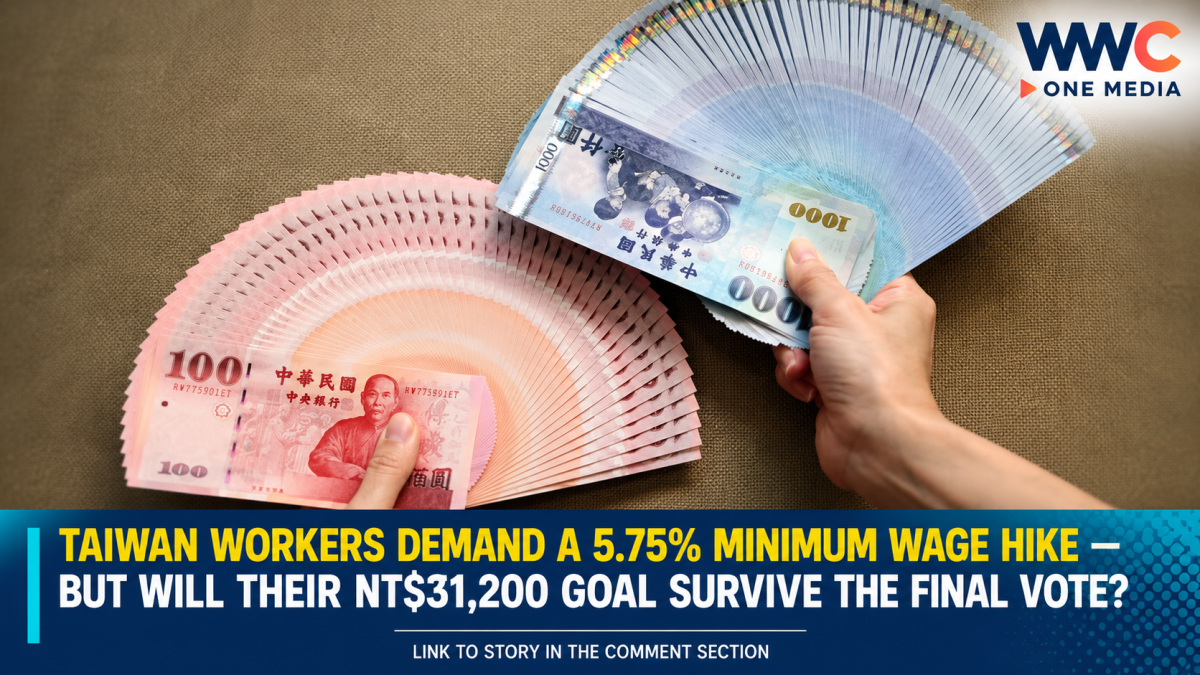
TAIPEI — Taiwan’s labor groups are pushing for a 5.75% increase in the minimum wage next year, a proposal that would lift the monthly minimum wage from NT$29,500 to approximately NT$31,196.
But workers are not guaranteed the increase.
Taiwan’s Minimum Wage Review Committee is scheduled to meet on September 24 to determine the 2027 minimum wage, with the government already signaling that another increase is highly likely. President Lai Ching-te and Premier Cho Jung-tai have repeatedly said next year’s monthly minimum wage should exceed NT$30,000.
The debate now centers on just how far that increase should go — and whether Taiwan’s booming economy is translating into meaningful gains for workers across all industries.
Labor groups want NT$31,200
Taiwan’s current minimum wage is NT$29,500 per month, while the hourly minimum wage is NT$196.
Labor representatives are proposing a 5.75% increase, which would bring the monthly figure to roughly NT$31,196, or about NT$31,200 when rounded.
The proposal is based on a formula that would fully account for the projected 2.07% increase in consumer prices while allocating one-third of economic growth to workers.
The labor side says this approach would better reflect the economic realities facing lower-paid employees.
The proposal is particularly significant because Taiwan’s economy is performing strongly overall, but that growth has not been evenly distributed.
Taiwan’s economy is booming — but not everyone feels it
Taiwan’s Directorate-General of Budget, Accounting and Statistics recently raised its forecast for economic growth this year to 11.05%, according to the Taiwan News report.
That extraordinary headline growth is being driven heavily by the technology sector, particularly industries benefiting from strong global demand for artificial intelligence and advanced semiconductors.
But labor representatives argue that using the headline economic-growth figure alone could give a misleading picture of conditions faced by workers in sectors that are not benefiting from the technology boom.
That has become one of the central arguments in this year’s minimum-wage debate.
Why labor groups are changing their calculation
Taiwan’s labor representatives are not simply demanding that workers receive an equal share of overall economic growth.
Taiwan Confederation of Trade Unions Chairman Tai Kuo-rong said labor representatives would instead propose incorporating one-third of economic growth while fully reflecting inflation.
Using that approach produces the proposed 5.75% increase.
The argument is straightforward: workers should benefit from economic expansion, but the calculation should also recognize that different industries are experiencing very different economic conditions.
High-tech companies may be posting spectacular growth, while traditional manufacturing, retail, hospitality and other labor-intensive sectors may face much thinner margins.
Economists warn against a one-size-fits-all formula
The debate has also attracted economists who question whether Taiwan should continue relying on a traditional formula for determining minimum-wage increases.
National Taiwan University’s Hsin Ping-long argues that there is no statutory formula requiring Taiwan to divide economic growth equally between workers and employers.
He has also warned that the country’s overall GDP growth is being heavily boosted by high-tech industries that employ comparatively fewer workers than many other sectors.
Using the national growth rate without considering those differences could therefore overstate the economic improvement experienced by lower-paid workers.
At the same time, Hsin said it would be unreasonable to completely exclude the technology sector’s contribution to the economy.
Another economist, Tamkang University’s Tsai Ming-fang, has argued that labor productivity should also be considered because higher productivity reflects workers’ contribution to increased output.
A smaller increase is also being discussed
The 5.75% proposal is not the only number circulating ahead of the September 24 meeting.
United Daily News reported that outside estimates were generally expecting an increase of at least 5%, which would put the monthly minimum wage around NT$30,975.
That means the final increase could be below the labor groups’ NT$31,196 proposal while still comfortably exceeding the NT$30,000 threshold repeatedly cited by Taiwan’s top officials.
The final decision will be made through the Minimum Wage Review Committee, which includes representatives from government, labor, management and academia.
The NT$30,000 promise is already shaping expectations
President Lai and Premier Cho have both indicated that the monthly minimum wage will exceed NT$30,000 next year.
That effectively establishes a political floor for expectations, even though the precise amount has not yet been decided.
For workers earning close to the minimum, the difference between a 5% and 5.75% increase may appear relatively small on paper.
But over a full year, the difference adds up.
It can affect rent, food, transportation, household expenses and the ability of lower-income workers to save.
For employers, however, a higher minimum wage means increased labor costs — particularly for businesses with large numbers of minimum-wage employees.
Taiwan has raised its minimum wage for years
The current NT$29,500 monthly minimum wage took effect in January 2026, alongside an hourly minimum of NT$196. Taiwan’s Labor Ministry says the increase was intended to protect workers’ basic living standards and purchasing power.
The latest increase would continue a long-running trend of annual adjustments.
Focus Taiwan reports that the government expects the 2027 rate to exceed NT$30,000, which would make this another consecutive annual increase.
The debate, therefore, is no longer about whether Taiwan will raise the minimum wage.
It is about how much.
The bigger question: Who is benefiting from Taiwan’s economic boom?
The minimum-wage debate comes at a pivotal moment for Taiwan.
The island’s semiconductor and artificial-intelligence industries are enjoying extraordinary demand, helping drive some of the strongest economic growth rates in years.
But that success has also exposed a widening gap between high-growth technology companies and sectors that depend much more heavily on lower-paid workers.
Labor groups argue that the country’s economic gains should reach workers beyond the technology sector.
Business groups, meanwhile, have urged policymakers to examine the contribution and conditions of individual industries before deciding how much wages should rise.
That tension will be at the center of the September 24 meeting.
Millions of workers are waiting for the decision
The final figure could determine how much Taiwan’s lowest-paid workers earn in 2027 — and how much employers across the economy must spend on wages.
A 5.75% increase would push the monthly minimum wage to approximately NT$31,196.
A 5% increase would produce a figure closer to NT$30,975.
Either way, Taiwan appears headed toward a minimum wage above NT$30,000.
The question is whether policymakers will side closer to the labor movement’s NT$31,200 target or settle on a smaller increase.
For workers, the answer could arrive on September 24.
And when the committee finally meets, one number could determine the size of millions of paychecks across Taiwan in 2027.




Leave a Reply