
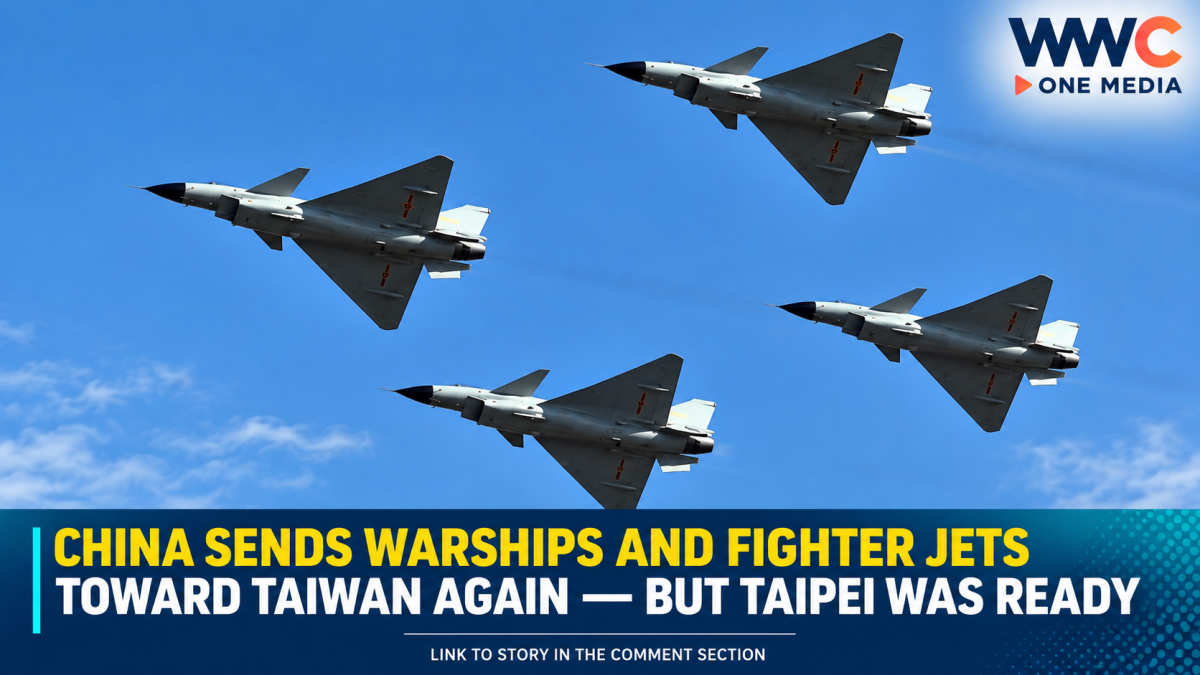
TAIPEI — Tensions around Taiwan remain high after Taipei detected a new wave of Chinese military activity around the island, including fighter aircraft, naval vessels and government ships operating in nearby waters and airspace.
Taiwan’s Ministry of National Defense said it tracked five Chinese military aircraft, five Chinese naval vessels and two official ships during the 24-hour period from 6 a.m. Saturday to 6 a.m. Sunday.
Three of the Chinese military aircraft crossed the Taiwan Strait median line and entered Taiwan’s southwestern and eastern air defense identification zones, according to Taiwan’s Defense Ministry.
Taiwan responded by deploying its own military aircraft, naval vessels and coastal-based missile systems.
The latest activity adds to a pattern that Taipei describes as China’s increasingly persistent use of “gray-zone” tactics — pressure designed to challenge Taiwan without triggering a full-scale military conflict.
Chinese aircraft cross the Taiwan Strait median line
The Taiwan Strait median line has historically served as an unofficial buffer between the two sides.
China increasingly sends military aircraft across or close to the line, however, and Taiwan regards such operations as part of Beijing’s growing military pressure.
Taipei said three of the five aircraft detected during the latest period crossed the median line before entering areas monitored by Taiwan’s air defenses.
The aircraft activity was accompanied by a larger maritime presence.
Five Chinese naval vessels and two official ships were also detected around Taiwan, forcing Taipei to monitor developments across both the air and maritime domains.
Taiwan scrambles forces in response
Taiwan said it used its own aircraft and naval forces to respond to the Chinese activity while also deploying coastal missile systems.
The response reflects Taipei’s increasingly layered approach to deterring a potential Chinese attack.
Rather than relying on a single defense system, Taiwan is building a network involving fighter aircraft, naval forces, missiles, drones, surveillance systems and other asymmetric capabilities.
Taiwan President Lai Ching-te has repeatedly emphasized the need to strengthen the island’s defense capabilities and societal resilience.
Taiwan News reported this week that Lai has also called for stronger unmanned combat capabilities, arguing that drone training needs to translate into actual battlefield effectiveness.
Beijing’s pressure is becoming routine
The latest incident is significant not necessarily because it represents an imminent attack, but because such military activity has become increasingly routine.
Taiwan News reported that, so far in September, Taiwan had tracked Chinese military aircraft 81 times and Chinese ships 126 times by the latest reporting period.
Taipei says Beijing has steadily increased this type of activity since 2020.
The strategy is commonly described as gray-zone coercion — pressure that remains below the threshold of open warfare while attempting to exhaust an opponent, test its defenses and normalize a military presence.
The objective, analysts say, can include forcing Taiwan to spend resources responding repeatedly while gathering intelligence about its military reactions.
Why the ships matter as much as the aircraft
The presence of naval vessels alongside military aircraft is particularly important.
A potential Taiwan conflict would not be fought only in the skies. China’s People’s Liberation Army Navy would play a critical role in any blockade, invasion or effort to isolate Taiwan.
Regular naval deployments around the island allow China to practice operations and potentially gather information about Taiwan’s responses.
For Taipei, monitoring these movements is therefore crucial.
The latest activity does not, by itself, establish that China is preparing to invade Taiwan.
That distinction is important.
Military activity around Taiwan has become frequent enough that individual incidents must be assessed within the broader pattern rather than automatically interpreted as evidence of an imminent attack.
Washington is watching closely
The growing pressure on Taiwan is also being closely watched in Washington.
Raymond Greene, the de facto U.S. ambassador to Taiwan, warned this week that any conflict across the Taiwan Strait could have enormous consequences for the global economy, potentially exceeding the economic impact of World War II. He also stressed the importance of maintaining peace and avoiding miscalculation.
The United States does not maintain formal diplomatic relations with Taiwan but remains Taiwan’s most important international security partner and arms supplier.
Washington has repeatedly called for peace and stability across the Taiwan Strait while supporting Taiwan’s ability to defend itself.
That makes every significant increase in Chinese military activity a matter of international concern.
Taiwan is also strengthening ties abroad
Beijing’s pressure is occurring alongside Taiwan’s efforts to expand its international relationships.
Reuters reported that Taiwan Vice President Hsiao Bi-khim recently made a rare trip to Europe, attending a democracy conference in Italy alongside Foreign Minister Lin Chia-lung.
China strongly objected to the visit and lodged protests with Italy and the European Union.
The episode illustrates the larger diplomatic struggle surrounding Taiwan.
Beijing seeks to restrict Taiwan’s international space and insists that Taiwan is part of China.
Taipei, meanwhile, is seeking stronger international relationships and greater participation in global institutions.
The military pressure is only one part of the equation
Taiwan’s strategic importance also extends far beyond military geography.
The island is a critical player in the global semiconductor industry, with companies such as TSMC at the center of the world’s advanced-chip supply chain.
Reuters reported this month that Taiwan is using its semiconductor strength to deepen relationships with democratic partners while simultaneously facing pressure from the United States to expand manufacturing overseas.
That means a serious Taiwan Strait crisis would potentially affect much more than Taiwan and China.
Shipping, semiconductors, financial markets, technology supply chains and global trade could all be affected.
Is Beijing testing Taiwan’s limits?
The latest deployment may therefore be less about a single dramatic military operation and more about a continuing test of Taiwan’s readiness.
Every time Chinese aircraft cross the median line, every time warships operate near Taiwan and every time Taipei scrambles forces, both sides gain information.
China can observe Taiwan’s response.
Taiwan can study Chinese operating patterns.
And both sides are learning how the other might react during a genuine crisis.
That is what makes the current situation so difficult.
The danger may not necessarily be an intentional decision to start a war.
It could be miscalculation.
A military aircraft gets too close.
A ship makes an unexpected maneuver.
A radar lock is misinterpreted.
A commander responds more aggressively than expected.
And suddenly, an operation intended to send a political message could become something far more dangerous.
For now, Taiwan says it remains prepared.
China continues to increase military pressure.
And across the Taiwan Strait, the question hanging over both sides is becoming harder to ignore:
How long can this cycle of military pressure continue before one encounter goes too far?


Leave a Reply