
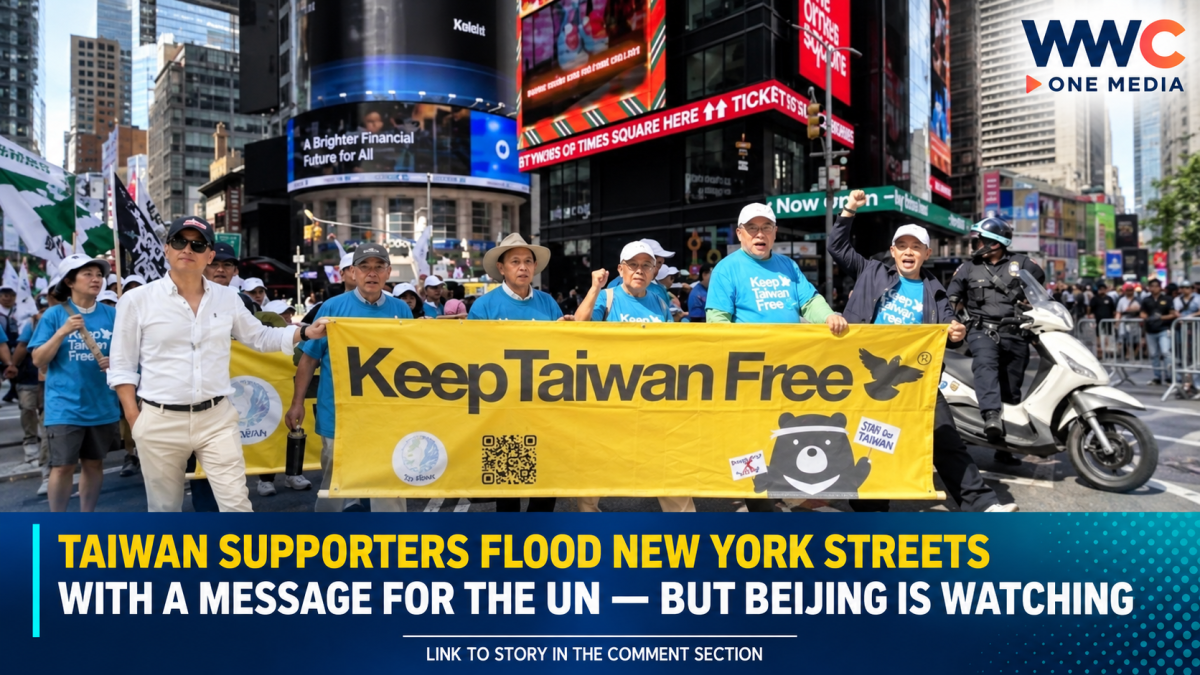
NEW YORK — Taiwan supporters took their campaign for greater international participation directly to the streets of Manhattan on Saturday, marching through New York with a message aimed at the United Nations: “UN for Taiwan.”
The annual demonstration brought together Taiwanese lawmakers, Taiwanese Americans, nongovernmental organizations and overseas Taiwanese during the opening period of the 81st UN General Assembly.
Participants carried signs and chanted “UN for Taiwan” and “Keep Taiwan Free” as they marched through Manhattan, highlighting Taiwan’s long-running campaign for greater participation in international organizations.
But behind the colorful banners and chants is a much bigger geopolitical dispute — one involving Taiwan, China and the future of Taiwan’s place in the international system.
Why Taiwan is pushing the issue again
Taiwan has been excluded from the United Nations since 1971, when the General Assembly adopted Resolution 2758 and recognized the People’s Republic of China as the representative of China at the UN.
Taipei argues that the resolution does not itself determine Taiwan’s sovereignty or prevent Taiwan from participating meaningfully in UN-affiliated organizations.
Beijing rejects that interpretation and maintains that Taiwan is part of China and has no right to separate representation at the United Nations. Chinese officials have repeatedly accused Taipei of attempting to promote “Taiwan independence.”
That disagreement has become increasingly prominent as Taiwan seeks greater international visibility.
Marchers take their message through Manhattan
The latest march traveled along Manhattan’s 42nd Street, passing locations including the Chinese Consulate General, Times Square and Bryant Park before ending near the New York Public Library, according to Taiwan News and Focus Taiwan reports.
Taiwanese lawmaker Wang Yi-chuan and Taiwan United Nations Alliance chairman Shih Shu-hua led the demonstration.
Organizers said the campaign has expanded beyond simply demanding UN membership. They also want Taiwan to be able to participate more broadly in international organizations and engage in exchanges with other countries and international institutions.
The distinction is important.
Taiwan is seeking greater meaningful participation in the international system, while full UN membership would be a far more politically difficult step.
A diplomatic ally joins the march
Among those attending was John Silk, the Marshall Islands’ permanent representative to the United Nations.
The Marshall Islands is one of Taiwan’s remaining diplomatic allies and has previously supported Taiwan’s meaningful participation in the UN system.
His participation gave the demonstration additional diplomatic visibility at a moment when governments around the world are closely watching Taiwan’s international position.
Taiwan launches a broader UN campaign
The street demonstration is only one part of Taipei’s broader campaign surrounding this year’s UN General Assembly.
Taiwan’s Ministry of Foreign Affairs announced ahead of the session that it would promote Taiwan’s participation in the UN system through public diplomacy, side events and other activities in New York.
Taipei says Taiwan contributes significantly to the international community, particularly in areas such as technology, public health and sustainable development, and argues that its 23.5 million people should not be excluded from international institutions.
The 81st General Assembly opened on September 8, while the high-level General Debate is scheduled for September 22–26 and September 28.
China pushes back
Beijing’s position remains sharply different.
Chinese officials continue to insist on the “One China” principle and accuse Taiwan’s government of distorting Resolution 2758.
China reiterated this position after the UN session opened, saying Taiwan is not a separate country and warning against efforts it considers moves toward Taiwan independence.
That means Taiwan’s campaign is taking place against the backdrop of much broader tensions across the Taiwan Strait.
China has increased military activity around Taiwan in recent years, while Taipei has strengthened its defense preparations and sought closer relationships with democratic partners.
The issue of Taiwan’s international participation therefore extends far beyond the question of a UN seat.
Why the timing matters
The timing of this year’s campaign is particularly significant.
The UN General Assembly is meeting while wars, geopolitical rivalries and divisions among major powers are putting renewed pressure on the international system.
Taiwanese officials argue that those global challenges make it even more important for Taiwan to have a voice in international institutions.
Taipei has also emphasized that maintaining peace and stability across the Taiwan Strait should remain a priority.
Taiwan’s Foreign Ministry has called for meaningful participation in the UN system while stressing that Taiwan intends to preserve the status quo, safeguard democracy and resolve disputes peacefully.
This is bigger than one march
The Manhattan demonstration may not immediately change Taiwan’s status at the United Nations.
But it illustrates how Taiwan is increasingly using public diplomacy to make its case directly to international audiences.
The campaign is also becoming more visible outside New York. Earlier this month, Taiwanese communities in Vancouver organized a convoy that formed the letters “TW” to express support for Taiwan’s participation in the UN.
And similar demonstrations have become an annual feature around the UN General Assembly, showing that Taipei’s campaign is not a one-time political event.
For Taiwan supporters, the message is straightforward: 23.5 million people should not be invisible in the international system.
For Beijing, however, the campaign touches directly on one of China’s most sensitive political issues.
That is why the chants in Manhattan may carry consequences far beyond the streets where they were heard.
The immediate question is whether Taiwan can gain greater access to international organizations without triggering another escalation with Beijing.
The bigger question is even harder:
As global tensions rise, how much international space will Taiwan be allowed to claim — and how far will China go to stop it?
Leave a Reply