
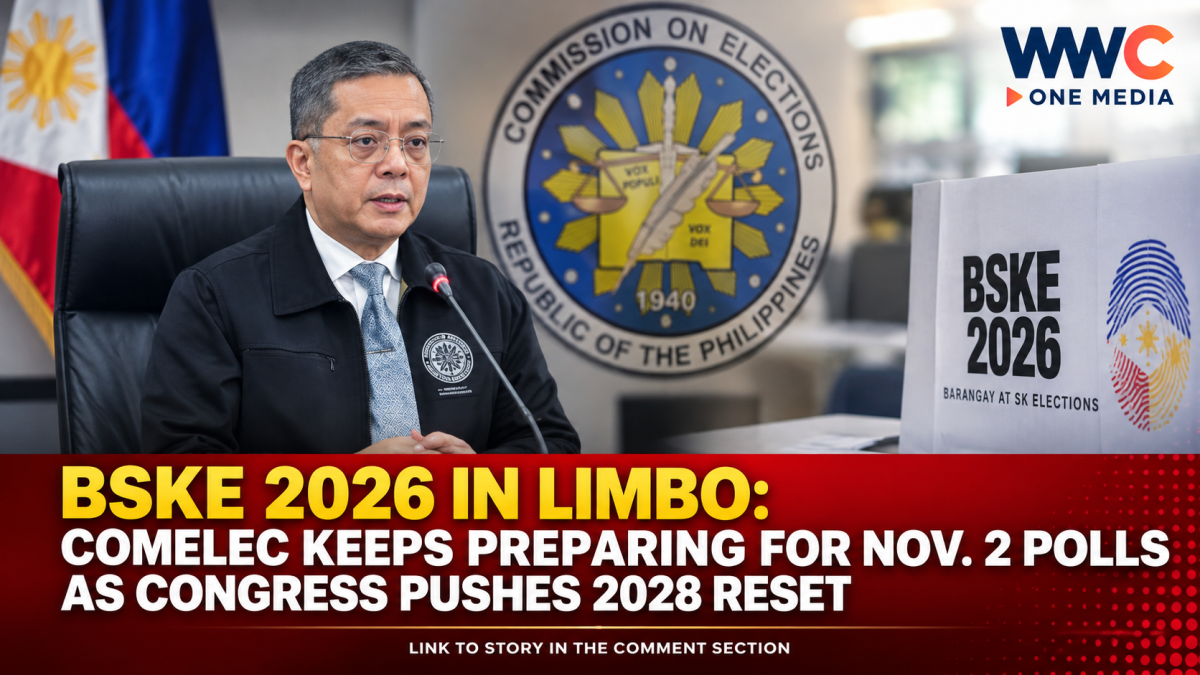
MANILA, Philippines — The country’s barangay and Sangguniang Kabataan elections remain caught between two competing timelines: the law still points to November 2, 2026, while Congress is moving toward a possible two-year postponement.
The Commission on Elections (Comelec) said it will continue preparing for the scheduled Barangay and Sangguniang Kabataan Elections (BSKE) unless Congress actually passes a law changing the election date.
Comelec Chairperson George Garcia said the poll body has no legal basis to simply stop its preparations while the proposed postponement remains under legislative consideration.
“As of today, the law mandates an election on November 2.”
Garcia stressed that the Comelec will implement whatever schedule is ultimately established by law.
Congress moves to push elections to 2028
The uncertainty intensified after the House of Representatives approved House Bill No. 10971 on third and final reading on September 8.
The measure proposes changing the term of barangay and SK officials from four years to five years, effectively moving the next elections to November 2028.
The House approved the measure by a vote of 211-13, with one abstention. It was transmitted to the Senate on September 10.
In the Senate, Senate Bill No. 2387, sponsored by Senate President Francis Escudero, similarly seeks to establish a five-year term for barangay and SK officials.
Escudero has argued that the measure is intended to create a more predictable electoral cycle rather than simply give incumbent officials additional time in office. The proposal would nevertheless have the immediate effect of moving the 2026 elections to 2028.
But the election is still legally scheduled for November 2
This is the crucial part of the developing story.
Congress has not yet enacted a law postponing the 2026 BSKE.
Under Republic Act No. 12232, signed in August 2025, the next barangay and SK elections are scheduled for the first Monday of November 2026, which falls on November 2.
The law also established a four-year term for barangay and SK officials.
Consequently, Comelec cannot simply assume that Congress will approve the postponement.
Garcia said the poll body must continue preparing and receiving election supplies that have already been procured. He added that Comelec would follow whichever schedule Congress ultimately establishes.
Comelec preparations are already underway
The situation has created a difficult logistical problem for the poll body.
Earlier, Comelec temporarily held the delivery of some election supplies because of uncertainty surrounding the proposed postponement. The poll body had already procured materials through public bidding but wanted greater clarity before proceeding with deliveries.
By late August, Comelec offices were nevertheless continuing preparations for the November exercise.
In Negros Oriental, for example, local election officials said they were preparing for the filing of certificates of candidacy scheduled from September 28 to October 5, with the campaign period set for October 22 to 31, unless the election is formally postponed.
That means prospective candidates and election officials are facing a particularly unusual situation: preparations for an election that Congress is simultaneously considering postponing.
The money already spent is another issue
The potential postponement also raises questions about election spending.
During a Senate hearing, Garcia said approximately PHP8 billion of the PHP19.57-billion allocation for the 2026 BSKE had already been spent, obligated or earmarked.
Comelec estimated that roughly PHP3 billion had already been incurred, while other election materials could potentially be preserved and used later if the polls are reset.
This has become part of the broader debate over whether postponing the elections would ultimately save resources or create additional logistical and financial complications.
Why Congress wants the postponement
Supporters of postponement have cited several considerations, including the need for a longer and more predictable term for barangay and SK officials and concerns over the cost and logistics of conducting another nationwide election.
Escudero has argued that a five-year term could give local officials more time to implement community development, disaster-response, peace-and-order and other programs without repeatedly being disrupted by election preparations.
Earlier proposals also cited economic pressures and the energy situation as reasons for moving the elections.
However, the proposal has drawn criticism from lawmakers and election advocates who question whether there is sufficient justification for another postponement so soon after the previous delay.
GMA News reported that critics in the House argued that repeatedly extending local officials’ tenure could undermine the electorate’s right to choose new leaders and potentially encourage political entrenchment.
A decision is becoming increasingly urgent
The timing is becoming critical because Comelec’s electoral calendar is already moving toward the candidate filing period.
Philstar previously reported that Garcia wanted Congress to provide clarity by the second week of September, particularly because prospective candidates and election personnel need certainty about whether they should proceed with preparations.
With September already underway, the pressure for Congress to settle the issue is increasing.
For now, however, the legal situation remains straightforward:
November 2, 2026 remains the scheduled BSKE date unless and until Congress passes, and the President signs, a law changing it.
The Comelec therefore continues to prepare for the November elections while lawmakers debate whether those elections should happen at all.
And that leaves barangay officials, SK aspirants, voters and election workers facing one major unanswered question:
Will Filipinos actually go to the polls on November 2—or will Congress once again move the barangay and youth elections to another year?



Leave a Reply