
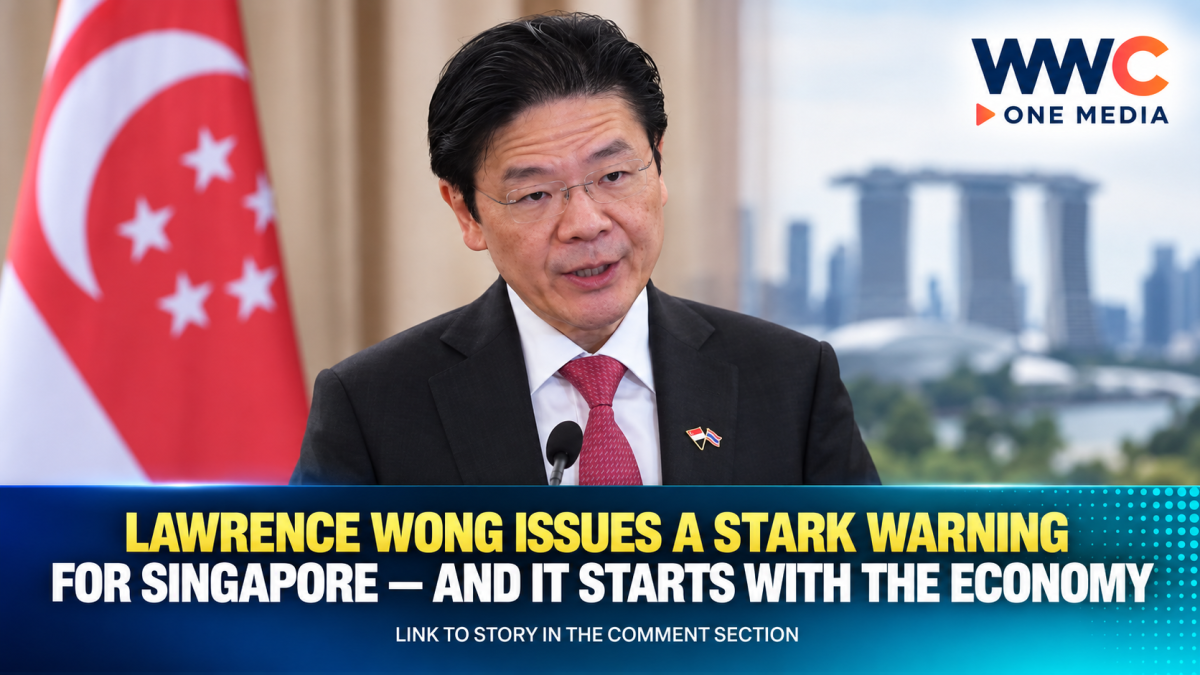
SINGAPORE — Singapore may remain one of Asia’s most stable and harmonious societies, but Prime Minister Lawrence Wong has warned that economic frustration could become a much deeper social problem if it begins to fuel resentment over race, religion, nationality and belonging.
Speaking at the 85th anniversary dinner of the Singapore Kadayanallur Muslim League on Sept. 12, Wong said economic pressures can become particularly dangerous when people begin to interpret unequal outcomes through the lens of identity and perceived unfairness.
The danger, he said, is when frustration evolves into an “us versus them” mentality.
Wong acknowledged that Singapore is not immune to the same pressures contributing to growing polarization in societies around the world. He pointed to racist comments that have recently appeared online, including those linked to debate over Singapore Airlines’ investment in Air India.
From economic anxiety to social division
Wong’s warning goes beyond the cost of living or employment.
He said economic challenges can leave some people feeling disappointed when they believe they are not benefiting equally from economic progress. Those frustrations can become more entrenched when they are connected to questions of identity, belonging and fairness.
That is when economic dissatisfaction can turn into social division.
Wong said people may begin drawing boundaries between Singaporeans and foreigners, local-born and naturalised citizens, as well as along racial and religious lines.
For a country built around a carefully managed multiracial and multireligious social model, the warning is particularly significant.
Racist comments have already resurfaced online
The prime minister’s remarks came amid a recent controversy involving racist and xenophobic comments online.
Singapore authorities have been investigating comments connected to two issues: Singapore Airlines’ investment in Air India and the devastating Nepal-Tibet disaster.
Senior Minister K. Shanmugam previously described some of the online comments as “shameful” and said police were investigating. CNA reported that five people had been identified and interviewed over online comments relating to the two matters.
The Air India controversy has attracted particular attention because Singapore Airlines is investing in the Indian carrier and Temasek, Singapore’s state investment company, is the airline’s major shareholder.
Reuters reported that Air India’s request for additional funding from Tata Sons and Singapore Airlines triggered political scrutiny in Singapore, including questions about the role of Temasek and Singapore Airlines’ investment decisions. The debate was subsequently accompanied by racist abuse targeting people because of their Indian ethnicity.
Wong has previously warned that legitimate public debate must not become a vehicle for hostility toward particular communities or foreigners.
Singapore’s stability is not being taken for granted
Importantly, Wong did not portray Singapore as a society already consumed by racial or religious conflict.
Instead, he emphasized that the country remains generally harmonious and stable — but said that stability requires constant effort.
His message was that social cohesion cannot simply be assumed to continue indefinitely.
The government can address concerns over jobs, costs and economic opportunities through policy, but Wong said relationships and trust between communities must also be strengthened by Singaporeans themselves.
Singapore’s multiracial model faces a changing environment
The warning also builds on Wong’s broader message about Singapore’s identity.
During his 2026 National Day Rally, Wong said Singapore would remain open to newcomers while maintaining its multiracial and multireligious character. He said every community should continue to have a place for its language, culture and traditions.
That balancing act is becoming increasingly important as Singapore manages immigration, economic competition, demographic change and concerns over foreigners while attempting to preserve social cohesion.
The Straits Times reported that Wong stressed the importance of allowing communities to retain confidence in their identities while also building bridges with people from different backgrounds.
The numbers show both progress and warning signs
Singapore’s social cohesion has generally remained strong.
An Institute of Policy Studies-OnePeople.sg survey found that 65.4% of respondents in 2024 rated racial and religious harmony in Singapore as high or very high, up from 57.1% in 2018.
But the same research also found a rise in racial stereotyping: 43.5% of respondents said they formed assumptions about someone’s behaviour based on race, compared with 35.2% in 2018.
That combination — high overall confidence in racial and religious harmony alongside persistent stereotyping — illustrates why Singaporean authorities continue to treat social cohesion as an issue requiring active attention.
Wong’s message: don’t let economic frustration become an identity battle
Wong’s central argument was ultimately about preventing economic dissatisfaction from becoming something more destructive.
Singaporeans can disagree over government policies, foreign investment, immigration, jobs and the cost of living.
But when those disagreements become associated with race, religion or nationality, the consequences can extend far beyond economics.
Singapore’s government therefore intends to continue addressing concerns over cost pressures and jobs while ensuring that Singaporeans have a share in the country’s progress. At the same time, Wong stressed the importance of strengthening the relationships and trust that bind different communities together.
The message from Singapore’s prime minister is clear: economic frustration is manageable; allowing it to harden into racial or religious resentment could be far harder to reverse.
And for a city-state whose stability has long depended on its multiracial social compact, that may be the warning Singapore cannot afford to ignore.




Leave a Reply