
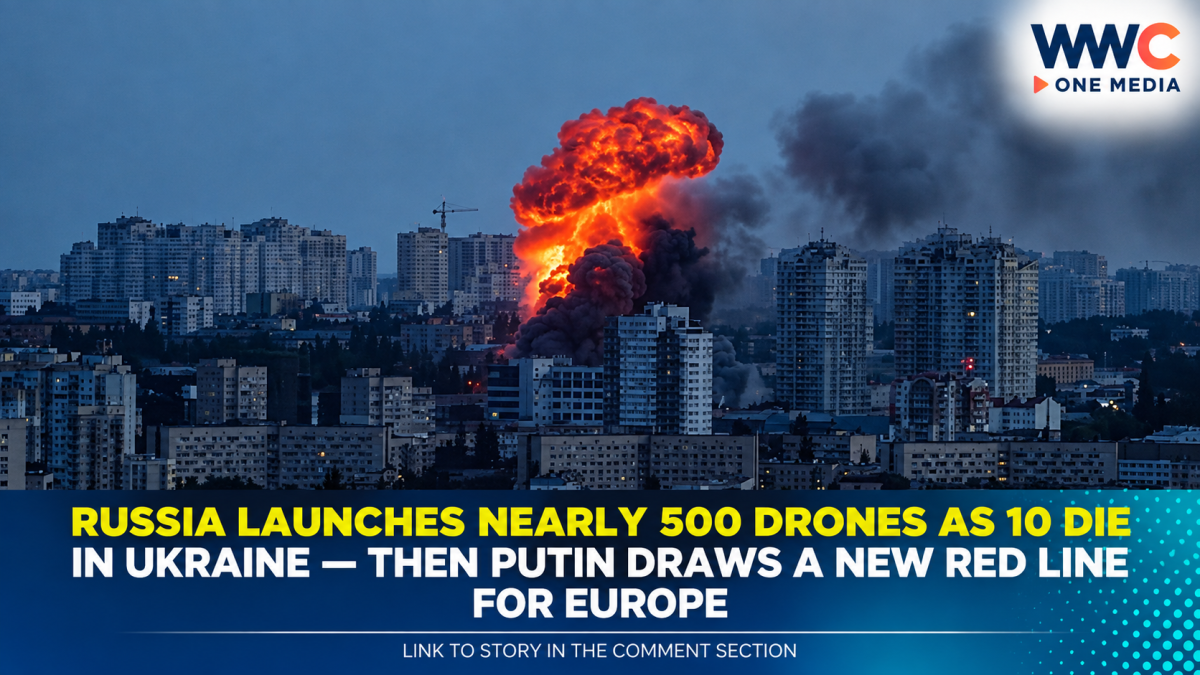
KYIV — Russia unleashed another sweeping wave of attacks across Ukraine, killing civilians from residential neighborhoods to roadside vehicles and damaging homes and infrastructure as Moscow intensifies its long-range campaign ahead of winter.
But the latest bombardment came with an even broader warning.
Russian President Vladimir Putin said that sending European troops into Ukraine would mean “war with Russia,” drawing another red line as European governments debate how they could help guarantee Ukraine’s security if a ceasefire or peace agreement is eventually reached.
The combination of accelerating drone warfare and increasingly explicit threats between Moscow and European capitals underscores the dilemma facing Ukraine more than four and a half years after Russia launched its full-scale invasion: diplomatic efforts are being revived, but military pressure is increasing at the same time.
And one important update changes the headline number in the original AsiaOne report.
The death toll rose after the initial report
The AsiaOne story, based on Associated Press reporting, said eight civilians had been killed.
That was accurate at the time of AP’s report. But casualty figures continued to change as regional authorities reported additional deaths.
Reuters subsequently put the toll from the September 12 attacks at 10 civilians killed, with dozens more wounded across several Ukrainian regions. That later figure is the one used in this updated version.
The changing totals are a reminder that casualty counts during large-scale attacks are often provisional, particularly while emergency workers continue searching damaged buildings and local authorities consolidate reports.
Homes, cars and a grocery store were hit
The attacks stretched across widely separated parts of Ukraine.
In Zaporizhzhia, two people were killed when Russian drones struck a residential area, according to regional authorities. A strike on Kryvyi Rih, President Volodymyr Zelenskyy’s hometown, killed another person and wounded others.
In the Black Sea port city of Odesa and the surrounding region, dozens were injured during what regional governor Oleh Kiper described as a massive attack. A residential high-rise was among the buildings damaged, with its upper floors destroyed.
Three people were initially reported killed after drones hit vehicles in Kramatorsk, in the partially occupied Donetsk region, while civilians were also killed in an attack on a grocery store in the Zhytomyr region.
Reuters’ later nationwide update brought the total to 10 dead.
Zelenskyy says Russia launched nearly 500 drones
The scale of the assault was striking.
Zelenskyy said Russia had launched nearly 500 drones since early September 12 as Moscow increasingly focuses attacks on Ukraine’s economy, logistics and critical infrastructure.
Russia said its strikes hit industrial facilities, while Ukrainian authorities reported damage to residential and other civilian locations. Reuters noted that both Russia and Ukraine have intensified attacks on infrastructure and shipping as the largely static ground war increasingly expands into long-range economic warfare.
Ukraine also continued its campaign inside Russia.
Zelenskyy said Ukrainian forces struck chemical-industry facilities in Russia, while Reuters reported an attack on a major synthetic-rubber producer in Togliatti that has links to production used in Russia’s defense sector.
As throughout the war, battlefield claims by either side can be difficult to independently verify immediately.
Putin: European troops would mean ‘war with Russia’
While missiles and drones were flying, Putin was delivering a political warning from New Delhi.
Speaking around the BRICS summit, the Russian president said European governments would cross a threshold if they eventually stationed forces inside Ukraine.
“That means a war with Russia.”
Putin simultaneously insisted Moscow did not intend to threaten European countries.
The context is important.
European governments are not currently sending conventional combat forces into Ukraine to join the war against Russia. Discussions have instead centred on a potential multinational force or other security arrangements that could operate after fighting stops and help deter another invasion.
That distinction is sometimes lost in more dramatic headlines.
Previous European planning has included possible land, air and maritime security commitments designed to reinforce Ukraine after a ceasefire, rather than entering the present war as a combatant. Moscow has repeatedly rejected the concept.
Why Putin’s warning matters
Sending European military personnel into postwar Ukraine would create one of the most sensitive security questions of any eventual settlement.
Ukraine argues that a ceasefire without strong guarantees could simply allow Russia time to rearm and attack again.
Moscow, meanwhile, views a Western military presence in Ukraine as unacceptable and has repeatedly linked the war to NATO’s expansion and Western military support for Kyiv.
European governments therefore face a difficult calculation: How can Ukraine be protected after a peace deal without creating the conditions for a direct Russia-Europe confrontation?
Putin’s latest remarks make Moscow’s answer particularly explicit.
Europe is already worried about spillover
Those fears are not confined to theoretical peacekeeping plans.
Days before the latest barrage, two civilians were killed when Russian drones struck the Starokozache border crossing between Ukraine and Moldova. Poland has also warned that incidents near Ukrainian border crossings could foreshadow further provocations near European territory.
NATO, however, said in late August that it saw no imminent threat of a direct Russian attack on the alliance, while warning that Moscow’s hybrid activity in Europe was increasing.
That distinction is important: tensions are high, but Putin’s statement does not mean a Russia-NATO war has begun or is inevitable.
Ukraine is entering another dangerous winter
The attacks are particularly concerning because cold weather is approaching.
Russia has repeatedly targeted Ukraine’s electricity, heating and other energy infrastructure.
The UN Human Rights Office documented systematic Russian attacks during the 2025-26 winter that caused emergency electricity cuts affecting millions and disrupted heating and hot water for hundreds of thousands of civilians, sometimes during temperatures below minus 20 degrees Celsius.
Reuters reported that infrastructure damage from air attacks has already approached $10 billion in 2026, while disruption to ports and exports is weighing heavily on Ukraine’s economy.
The implication is clear: destroying generating capacity in September can have consequences months later when electricity and heating demand peaks.
Civilian casualties have already surged in 2026
The September strikes are also part of a broader escalation rather than an isolated spike.
The UN Human Rights Monitoring Mission recorded 437 civilians killed and 2,610 injured in July alone, up 70% from July 2025. July produced the highest civilian death toll since May 2022, while missiles and long-range drones were the leading cause of civilian casualties.
During the first six months of 2026, civilian casualties were already 37% higher than during the same period of 2025.
That trend helps explain why Ukraine continues to press Western governments for additional air-defense systems and interceptors.
Yet peace talks may be returning
The escalation is occurring alongside another diplomatic track.
Reuters reported that Kyiv is preparing for possible U.S.-Russia-Ukraine talks in October, after American envoys Steve Witkoff and Jared Kushner recently travelled to Moscow and Kyiv. No breakthrough has been announced, and disputes over territory — particularly the Donbas — remain central obstacles.
Zelenskyy has separately said he would be willing to meet Putin if both leaders attend the G20 summit in Miami in December.
The Kremlin has not confirmed that Putin will attend and has continued to insist that Zelenskyy could travel to Moscow if he wants a bilateral meeting — an option Kyiv rejects.
Russian Foreign Minister Sergey Lavrov has also said Moscow is ready for negotiations while making clear that Russian military operations would not stop simply because talks were underway.
The real cliffhanger is what happens if diplomacy fails
That is what makes the latest strikes more significant than a single night’s casualty count.
Ukraine is trying to protect an increasingly vulnerable power grid before winter. Europe is considering how to guarantee Ukraine’s security after any future settlement. Russia is warning that one version of those guarantees could cross its threshold for direct conflict.
And U.S.-backed diplomacy is attempting to restart while both sides continue attacking one another’s infrastructure.
For Ukrainians, however, the geopolitical calculations remain brutally immediate.
Each failed interception can mean an apartment building, supermarket, vehicle or power station becoming the next target.
And with Russia now fielding enormous waves of drones while Europe debates what comes after the war, one uncomfortable question remains unanswered:
Can negotiators reach a settlement strong enough to stop the attacks without creating the direct Russia-Europe confrontation everyone says they want to avoid?


Leave a Reply