
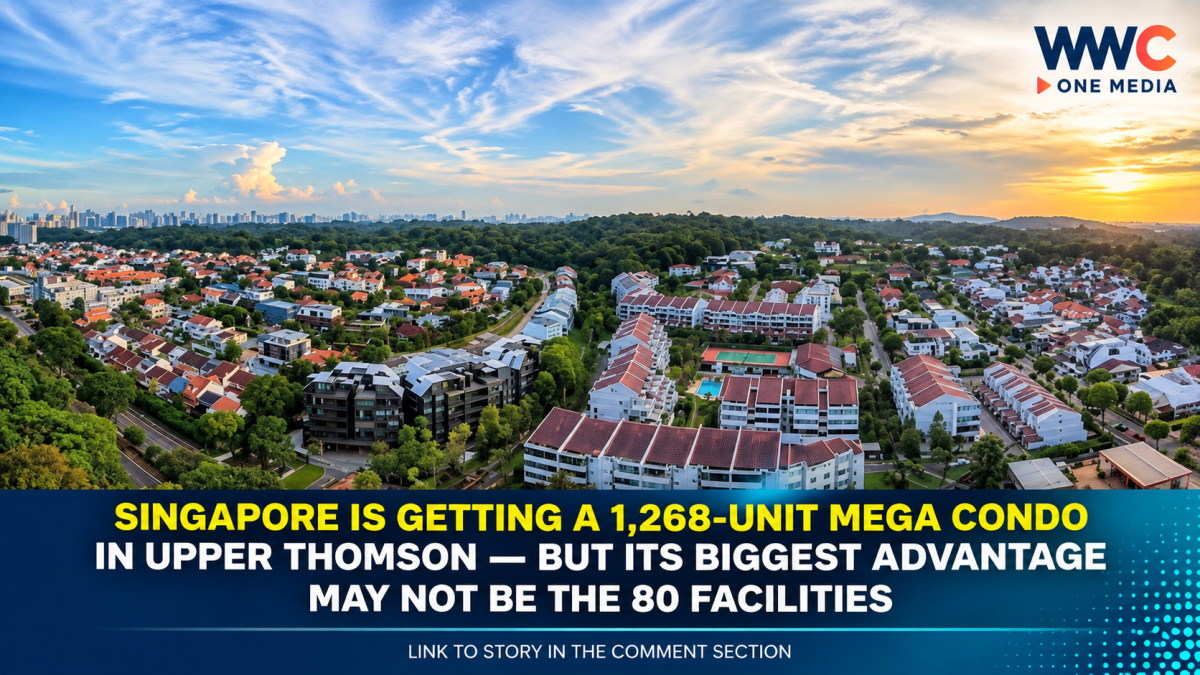
SINGAPORE — A sprawling new condominium is preparing to enter one of Singapore’s most tightly supplied private-housing districts, bringing 1,268 homes to Upper Thomson after years with few major new-launch options in the area.
But while Thomson Reserve is being promoted for its sheer size, extensive facilities and resort-style landscaping, the more important long-term story may lie outside its gates.
Its proximity to an existing MRT station, a future Cross Island Line interchange nearby, established schools, a large land parcel and the relative scarcity of major new projects in District 20 could ultimately matter more to buyers than the headline number of swimming pools and clubhouses.
And unlike lifestyle facilities, those location advantages are difficult for future developments to reproduce.
Thomson Reserve is being jointly developed by UOL Group, Singapore Land Group and CapitaLand Development on the former Thomson View Condominium site along Bright Hill Drive. CapitaLand confirms the project will contain 1,268 units across four 21-storey towers and two 30-storey towers, with homes ranging from two to five bedrooms.
The project is expected to launch in mid-October 2026, according to recent reporting by The Business Times.
The land deal behind Thomson Reserve was already enormous
Before Thomson Reserve became a 1,268-unit project, the site was home to Thomson View, an ageing 99-year leasehold condominium comprising 200 apartments, 54 townhouses and one shop unit.
UOL, SingLand and CapitaLand Development acquired the property through a S$810 million collective sale.
The transaction ultimately worked out to about S$1,178 per square foot per plot ratio, after accounting for the relevant land costs and lease-related charges.
It was no ordinary en-bloc transaction.
The deal became Singapore’s biggest completed collective sale since the S$890 million Chuan Park transaction and followed a lengthy process that included a reduction in Thomson View’s reserve price, objections from some owners and eventually a High Court sale order.
The purchase was finally completed in October 2025.
That large site—roughly five hectares—is what gives the developers room to build Thomson Reserve on a scale that has become increasingly uncommon in central and city-fringe locations.
Why 1,268 units makes Thomson Reserve unusual
There is no official government definition of a “mega development,” but the term is commonly used in Singapore property circles for condominium projects containing 1,000 homes or more.
By that standard, Thomson Reserve clearly qualifies.
The source article notes that only a relatively small number of Singapore condominiums have crossed the 1,000-unit threshold, with developments such as Grand Dunman, Parktown Residence and JadeScape among the more prominent examples.
Thomson Reserve will also be larger than JadeScape’s 1,206 units, making it an unusually large addition to District 20.
Its developers are marketing more than 80 facilities, organised around areas including a Grand Clubhouse, Island Club and Wellness Club. Plans also include multiple pools and amenities such as a tennis court.
Yet size comes with both advantages and trade-offs.
A bigger estate can support more recreational facilities because costs are shared by more households. But it does not automatically mean maintenance fees will be lower: operating multiple pools, landscaped areas, clubhouses and other facilities also costs money.
Likewise, some buyers appreciate having a large resident community and extensive shared spaces; others may prefer the privacy and lower density of boutique developments.
That distinction is often lost when “mega project” is presented as an advantage by itself.
The bigger story may be the MRT
One of Thomson Reserve’s strongest objectively verifiable advantages is transport.
The development is located next to Upper Thomson MRT station on the Thomson-East Coast Line, giving residents direct rail access towards Orchard, the CBD and Marina Bay.
The Land Transport Authority confirms that Upper Thomson forms part of Stage 2 of the Thomson-East Coast Line, which has been operating since 2021.
But another transport project could be equally important over the longer term.
Nearby Bright Hill MRT station is being developed as an interchange with the Cross Island Line.
LTA says Phase 1 of the Cross Island Line will run between Aviation Park and Bright Hill and connect with several existing MRT lines, including the Thomson-East Coast Line at Bright Hill. The wider line will eventually stretch more than 50km across Singapore.
For homeowners, that potentially means access not only to the north-south corridor served by the Thomson-East Coast Line but also to a new east-west connection across the island.
That is a more structural advantage than a condominium facility because a future competitor can build another swimming pool—but it cannot easily recreate the same rail geography.
District 20 has not seen many major launches
Scarcity is another part of Thomson Reserve’s pitch.
The AsiaOne/99.co analysis notes that District 20’s last major new private residential launch was JadeScape in 2018, also a mega development with more than 1,200 units.
That long gap is significant.
New condominium launches are common in some parts of Singapore where government land parcels are regularly released. In established neighbourhoods such as Upper Thomson and Bishan, however, suitable large sites can be harder to assemble.
Thomson Reserve itself exists because developers acquired and redeveloped an older estate through an en-bloc sale rather than purchasing a conventional Government Land Sales parcel.
That limits how often something of comparable scale can emerge nearby.
But scarcity alone does not guarantee capital appreciation.
Future prices will still depend on the launch price, interest rates, economic conditions, government cooling measures, competing supply and how much buyers are willing to pay relative to nearby resale condominiums.
JadeScape shows why investors are paying attention
The strongest comparison being used to support the investment case is JadeScape.
When JadeScape launched in 2018, average selling prices were around S$1,670 psf, according to 99.co.
Its average transacted price over the past year has since risen to about S$2,325 psf, according to the portal’s current transaction data—an increase of roughly 39 per cent from that initial benchmark.
Separate transaction data also shows resale units changing hands above S$2,400 psf in some recent deals, although prices vary substantially according to unit size, floor and layout.
That history helps explain why investors watch large developments closely.
Projects containing more units generally generate more transactions. More transactions create more comparable prices, which can make it easier for banks, valuers, buyers and sellers to establish a market benchmark.
A frequently traded condominium can also stay visible on property portals because listings and transactions appear more regularly.
But there is another side to that argument.
More units also mean more competing sellers.
If several owners want to sell similar layouts at the same time, buyers may have greater bargaining power.
So “1,268 units” is neither inherently bullish nor bearish. The outcome depends on demand.
Parktown Residence showed what strong demand can look like
The developers behind Thomson Reserve already have experience with another major residential project.
UOL and CapitaLand were among the developers of Parktown Residence in Tampines, a 1,193-unit integrated development that sold close to 90 per cent of its apartments during its launch weekend in February 2025.
The Business Times recently cited that project while noting the developers’ track record and reported that the consortium was seeing strong early interest ahead of Thomson Reserve’s planned mid-October launch.
That does not mean Thomson Reserve will repeat Parktown’s sales performance.
Parktown Residence is an integrated development linked to extensive retail and transport infrastructure in Tampines, while Thomson Reserve has a different location, buyer pool and pricing equation.
Its eventual take-up rate will depend heavily on one crucial piece of information that has not yet been established in the source story:
the actual launch price.
That may be the number that decides everything
Property marketing often focuses first on architecture, facilities and location.
Buyers ultimately calculate value differently.
A condominium may have an excellent MRT location and impressive grounds, but whether it becomes a strong long-term purchase depends on the price paid relative to surrounding homes and future competition.
The developers bought the Thomson View land for the equivalent of about S$1,178 psf ppr.
That land cost gives analysts one clue about pricing, but it is not enough to reliably predict final unit prices because construction, financing, marketing, regulatory and profit-margin considerations also matter.
Until an official price list is released, claims that Thomson Reserve represents an unusually strong investment opportunity should therefore be treated as projections rather than established fact.
What buyers are really getting
Strip away the marketing language and Thomson Reserve still has a distinctive proposition.
It is a 1,268-unit project on a large Upper Thomson site, built by three established developers, beside an operating MRT line and near another station that will become part of Singapore’s Cross Island Line network.
Its scale allows for the extensive facilities that smaller developments may struggle to provide.
Its location also places it in an established residential area where new private housing supply has been relatively limited.
Those are tangible characteristics.
What remains uncertain is whether they translate into superior investment returns.
JadeScape’s price growth may encourage buyers. Parktown Residence’s strong launch may encourage developers. And the long absence of new District 20 supply could create pent-up demand.
But property markets are ultimately unforgiving about one thing:
even a rare development can become an expensive purchase if buyers enter at the wrong price.
That is why the most important Thomson Reserve figure may not be 1,268 homes or 80-plus facilities.
It could be the number buyers have not seen yet.
The launch price.




Leave a Reply