
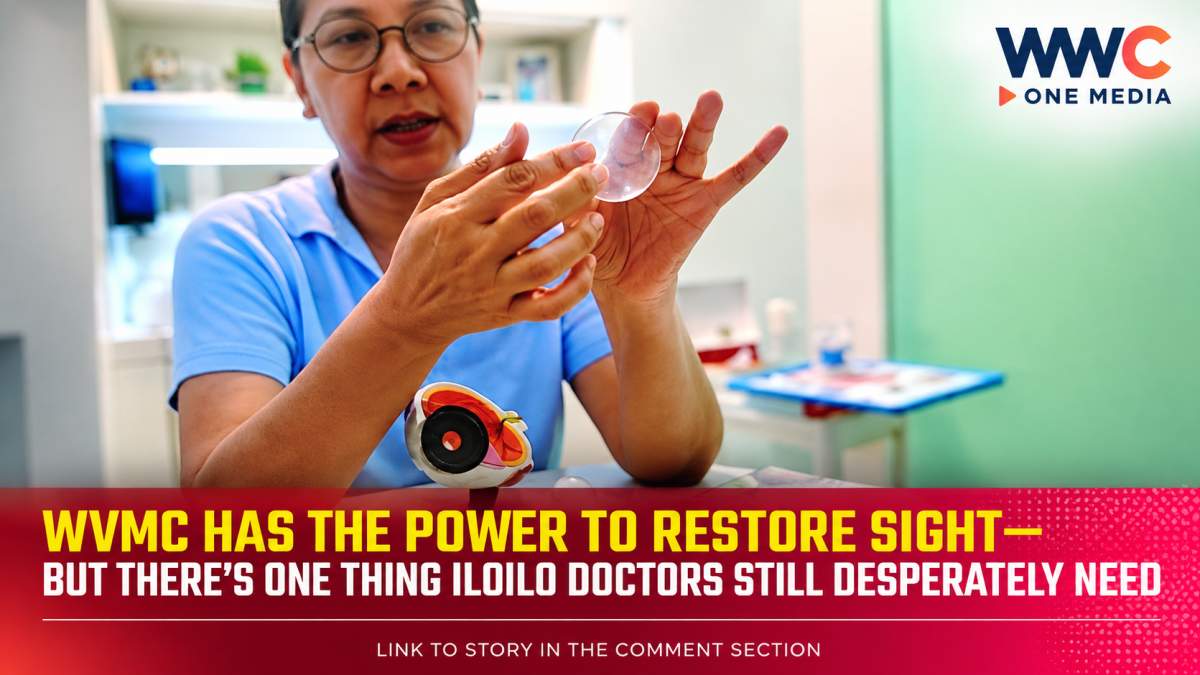
ILOILO CITY — Eight patients in Western Visayas have regained a chance to see after successful corneal transplant surgeries at the Western Visayas Medical Center (WVMC), but doctors say the program’s biggest challenge is not the surgery itself—it is the severe shortage of donated corneal tissue.
WVMC performed five successful corneal transplants in 2025 and three more from January to June 2026, following its partnership with the Eye Bank Foundation of the Philippines and the establishment of a Tissue Retrieval Center at the government hospital in Mandurriao, Iloilo City.
The development is significant for patients in Western Visayas because it allows more sight-restoring procedures to be supported closer to home, rather than relying entirely on donor tissue coming from Manila.
But Dr. Mary Katherine Francia, head of WVMC’s Department of Ophthalmology, said the hospital can only perform transplants when suitable donor tissue is available.
In other words, the medical expertise is there—but the supply of donated corneas remains the bottleneck.
The missing link: donors
Corneal transplant surgery involves replacing damaged or scarred corneal tissue with healthy tissue from a donor.
The cornea is the clear, dome-shaped front surface of the eye and plays a major role in focusing light. When it becomes severely scarred, cloudy, swollen or damaged by disease, infection or trauma, vision can deteriorate dramatically.
WVMC has performed corneal transplantation in Iloilo for around 15 years, but the absence of a local tissue-retrieval facility previously meant the hospital depended heavily on donor tissues sourced through the eye bank in Manila.
That changed after WVMC entered into an agreement with the Eye Bank Foundation of the Philippines in 2024 and established its Tissue Retrieval Center.
The center allows trained personnel to retrieve donated eye tissue locally. Under the arrangement, when a participating institution successfully retrieves a pair of donated eyes, one cornea can be reserved for a patient on its local waiting list while the other enters the national donor pool.
That system is designed to encourage hospitals and communities outside Metro Manila to participate in eye donation.
Why every donor matters
The Eye Bank Foundation of the Philippines says transplantable corneas and eye tissues remain severely scarce and are distributed on a first-come, first-served basis after medical evaluation. Donated tissue undergoes processing, preservation, cell-count testing and screening for infections including HIV, hepatitis B, hepatitis C and syphilis before it can be distributed.
The foundation also says that nearly everyone can potentially become a cornea donor, subject to medical assessment. Being elderly or wearing glasses does not automatically disqualify someone from donation.
And importantly, cornea donation takes place after death.
Philippine law also provides a specific window for corneal retrieval. Under the amended Organ Donation Act, corneas may be removed within 12 hours after death under the conditions set by law and by appropriately qualified medical personnel.
WVMC likewise stressed that retrieval is time-sensitive. The hospital said donor tissue can be harvested up to 12 hours after death before being transported to Manila for processing and evaluation.
The shortage is not unique to Iloilo
The situation at WVMC reflects a wider national problem.
In Northern Mindanao, the Philippine Information Agency recently reported that the Northern Mindanao Medical Center was also intensifying advocacy for cornea donation because donor numbers remain low.
An ophthalmologist cited by PIA said corneal diseases affect more than 100,000 Filipinos, while the region was meeting only about half of an estimated 1,000 annual transplant needs. One donor’s corneas can potentially restore sight to two recipients.
The Eye Bank Foundation itself identifies increasing eye and corneal donations as one of its major goals, saying it wants donation levels to eventually meet the present and future needs for corneal transplantation in the Philippines.
That makes the development at WVMC particularly important for Western Visayas.
A local system could mean fewer patients waiting
WVMC’s Tissue Retrieval Center serves as a link between potential donors, the national eye bank and patients waiting for sight-restoring surgery.
The hospital currently provides a pathway for patients from Iloilo, Capiz, Aklan, Antique and Guimaras, according to Panay News.
WVMC has also recently expanded its specialized-care infrastructure. Its newly opened Building H includes an Eye Care Center, alongside rehabilitation, research and professional-training facilities.
WVMC’s Department of Ophthalmology says its mission is to preserve and restore sight in Region VI while providing comprehensive eye care and expanding access to specialized diagnostic and interventional services.
One decision can change another person’s life
The message from WVMC is ultimately about something much simpler than medical technology: donation.
A corneal transplant cannot proceed without suitable donor tissue.
For families facing the loss of a loved one, agreeing to eye donation can therefore have an impact that continues long after death—potentially giving another person the ability to see.
The Eye Bank Foundation encourages prospective donors to discuss their decision with their families because next-of-kin consent is important to the donation process.
WVMC is now appealing to families across Western Visayas to consider corneal donation.
The hospital has the specialists. It has the retrieval facility. It has access to the national eye-banking system.
What it needs now is more people willing to give the gift of sight.
Why this story matters
This is not simply a story about eight successful surgeries. It highlights a larger healthcare gap: the Philippines has the medical capability to restore sight to many patients, but the availability of donated corneal tissue remains a major limiting factor.
Recent developments at WVMC show that strengthening tissue-retrieval capacity outside Metro Manila can bring transplant services closer to patients—but public awareness and donor participation remain critical.




Leave a Reply