
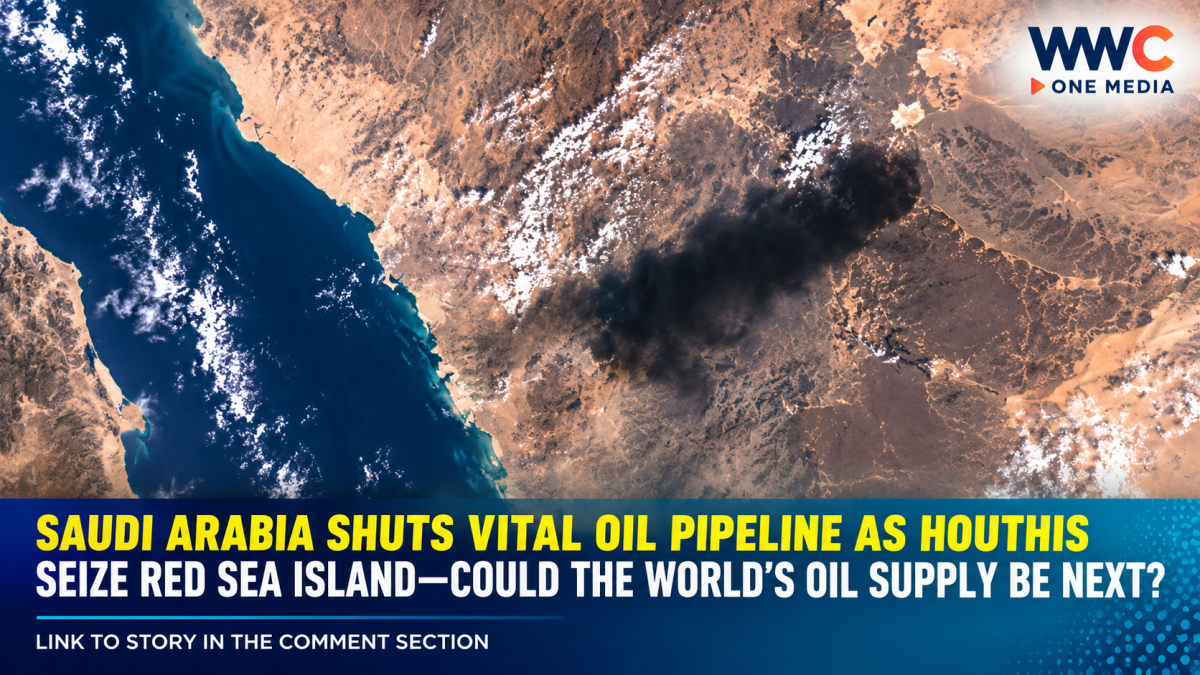
Saudi Arabia has temporarily shut down its crucial East-West oil pipeline after a series of drone attacks, adding a new shock to global energy markets as Iran-linked Houthi forces tighten their hold around one of the world’s most important maritime chokepoints.
The shutdown comes at an especially sensitive moment for the global oil trade. The 1,200-kilometer East-West pipeline has become a critical alternative for Saudi Arabia after the Strait of Hormuz was effectively disrupted during the widening U.S.-Iran conflict.
The pipeline can transport millions of barrels of crude each day from Saudi Arabia’s oil-producing east to export facilities on the Red Sea. Reuters reported that the system had been carrying roughly 4 million to 5 million barrels per day in recent months—equivalent to around 4% to 5% of global oil supply.
Pipeline attacked as regional pressure intensifies
Saudi authorities said the pipeline was hit by multiple attacks in the Riyadh and Medina regions. The Saudi Energy Ministry said the pipeline was temporarily closed as a precaution while emergency and technical teams assessed the damage and secured the infrastructure.
Saudi Arabia and Iraq said the drones originated from Iraq, where Iranian-backed militias operate. Baghdad condemned the attack and dismissed a military commander in response. Saudi authorities said several people were injured in the attacks.
That distinction is important: the pipeline attack has not been publicly attributed to the Houthis. Instead, the pipeline shutdown is unfolding simultaneously with a major Houthi offensive along Yemen’s Red Sea coast.
Houthis move toward the Bab el-Mandeb
The security picture became even more alarming after Iran-aligned Houthi forces reached Perim Island, a strategically located island in the Bab el-Mandeb Strait at the southern entrance to the Red Sea.
The Houthis have also made gains around Yemen’s Red Sea coast, including the capture of the strategic port city of Mocha, according to recent reporting. Their advances have raised fears that the group could gain greater leverage over vessels entering or leaving the Red Sea.
The Bab el-Mandeb is a critical gateway connecting the Red Sea with the Gulf of Aden and the wider Indian Ocean. Ships using the route can eventually connect to the Suez Canal, making the waterway particularly important for trade between Asia, Europe and the Middle East.
The Washington Post and The Guardian have likewise highlighted the growing significance of the Houthi territorial advances, warning that greater control around the strait could put another major global shipping corridor at risk.
Saudi Arabia was already relying on the pipeline
The timing of the pipeline shutdown is particularly damaging because Saudi Arabia had increasingly relied on the East-West route as an escape valve from the crisis around the Strait of Hormuz.
The pipeline allows Saudi crude to bypass the Persian Gulf and reach the Red Sea port of Yanbu. Saudi Gazette reported that approximately 5 million barrels per day had been rerouted through the pipeline since the Strait of Hormuz became severely disrupted.
But that alternative is now under pressure too.
The New York Times reported that Saudi oil exports had already fallen to about 3.2 million barrels per day in August, according to Kpler data, with only a small number of Saudi cargoes passing through the Bab el-Mandeb in the preceding week.
That leaves Saudi Arabia facing a dangerous logistical problem: one major export route is constrained by the Hormuz crisis, while another critical route toward the Red Sea is increasingly exposed to attacks and Houthi military advances.
Oil prices face another potential shock
The developments are also threatening to intensify pressure on global oil prices.
Crude prices had already moved above $100 a barrel amid the broader U.S.-Iran conflict and disruptions around the Strait of Hormuz. Further restrictions on Saudi exports could tighten global supply at a time when traders are already worried about the reliability of Middle Eastern energy shipments.
The East-West pipeline itself does not eliminate the Red Sea risk. Once crude reaches Yanbu, oil still needs a secure maritime route to reach international customers.
That is why the Houthi advance around Bab el-Mandeb matters so much.
If shipping through the strait becomes too dangerous or effectively inaccessible, Saudi Arabia could find itself with oil infrastructure capable of moving crude westward—but fewer safe maritime routes available to transport that crude onward.
Riyadh asks Washington for help
The escalating threat has also pushed Saudi Arabia to seek greater American assistance.
According to sources cited by Reuters, Crown Prince Mohammed bin Salman spoke with U.S. President Donald Trump at least twice on Thursday and sought American military assistance against the Houthis.
Washington, however, was reportedly unwilling to launch direct military action at this stage, while offering intelligence-sharing and targeting assistance instead.
The situation therefore presents Washington with another difficult strategic calculation: increasing military involvement could help protect Saudi infrastructure and shipping, but could also widen an already expanding regional war.
A threat far beyond the Middle East
The immediate danger is not simply another attack on a pipeline or another Houthi territorial gain.
The larger concern is the potential disruption of multiple energy and shipping chokepoints at the same time.
The Strait of Hormuz sits on one side of the Arabian Peninsula, while the Bab el-Mandeb lies on the other. Both are strategically important to global energy and maritime trade.
The New York Times noted that the Bab el-Mandeb is only about 12.5 miles wide at some points, with shipping lanes passing close to Perim Island—placing commercial vessels within potential range of missiles and drones.
If disruptions spread across both waterways, the consequences could extend well beyond Saudi Arabia and Yemen, affecting tanker rates, insurance costs, delivery times, refinery supplies and fuel prices worldwide.
For now, Saudi Arabia says its East-West pipeline shutdown is a precautionary measure while authorities assess the damage.
But with Houthi forces advancing toward one of the world’s most strategically important sea lanes, the bigger question is becoming harder to ignore:
If Saudi Arabia’s backup oil route can also be threatened, how many reliable pathways are left for the world’s energy supply?



Leave a Reply