
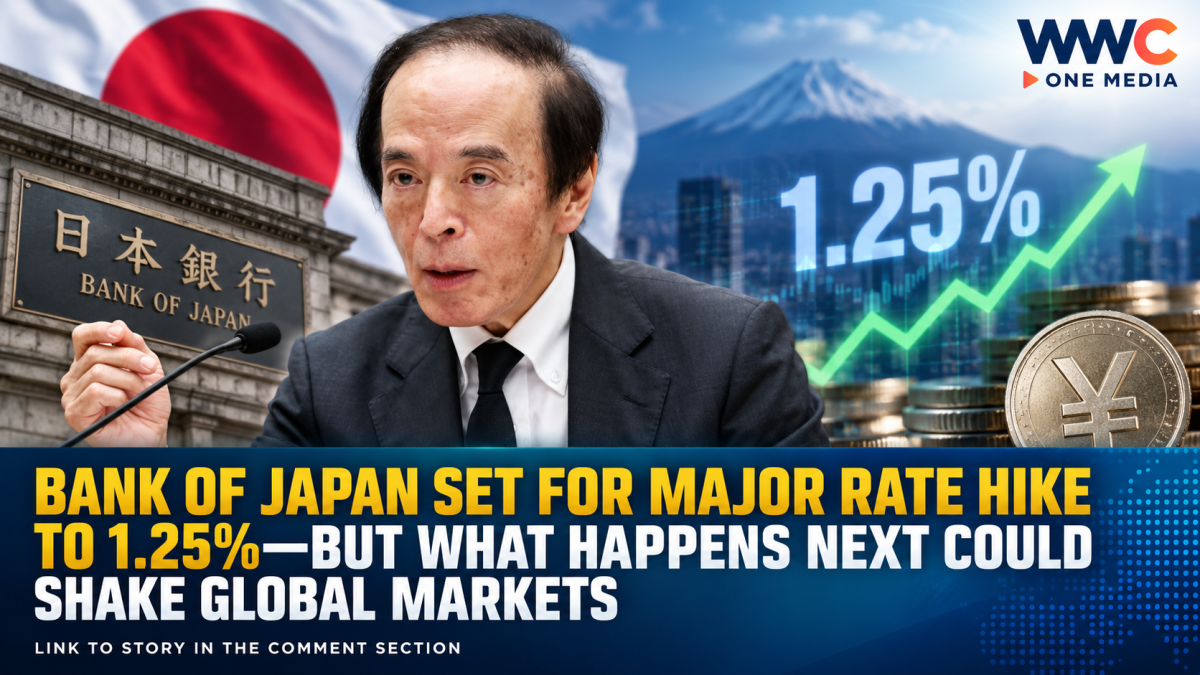
TOKYO — The Bank of Japan is widely expected to raise its benchmark interest rate to 1.25% at its next monetary policy meeting, a move that could mark another major step in Japan’s historic shift away from decades of ultra-loose monetary policy.
The Bank of Japan will hold its next policy meeting on September 17 and 18, with markets increasingly expecting a 25-basis-point increase from the current 1.0% policy rate. Reuters reported that the central bank is expected to raise rates while potentially offering limited clarity on how high borrowing costs could eventually go.
If confirmed, the move would push Japan’s policy rate to its highest level in years and intensify global attention on one crucial question:
How far is the Bank of Japan prepared to go?
BOJ Rate Hike Expectations Are Growing
The Bank of Japan currently guides the uncollateralized overnight call rate at around 1.0%. Its official website confirms that policymakers will meet on September 17 and 18, when investors will closely watch not only the rate decision but also signals about future tightening.
Reuters reported on September 11 that the BOJ was set to lift rates by 25 basis points, although policymakers may avoid giving markets a precise estimate of the so-called terminal rate — the level at which the central bank could eventually stop tightening.
A Reuters poll published ahead of the meeting also indicated that economists expected the BOJ to raise rates to 1.25%, with expectations for further increases extending into the months ahead.
That uncertainty is becoming increasingly important for investors.
A rate hike itself may already be largely priced into markets. The bigger potential shock could come from what the BOJ says about the next move.
Japan’s Economy Is Giving the BOJ More Room to Tighten
Expectations for another rate increase have been supported by signs of continued economic resilience.
Recent reports showed that Japan’s economy expanded at a stronger-than-initially-estimated pace during the second quarter, adding to the argument that the economy may be able to withstand higher interest rates.
At the same time, Bank of Japan officials have increasingly focused on underlying inflation pressures.
The central bank warned in July that underlying inflation could exceed its target, strengthening expectations that policymakers could continue normalizing monetary policy after years of extraordinarily low rates.
The BOJ’s June policy decision had already raised the overnight call rate guideline to around 1.0%, with the decision approved by a 7-1 vote.
Now, markets are watching to see whether 1.25% will be another isolated adjustment — or the beginning of a faster tightening cycle.
The Yen Is Already Reacting
One of the clearest signs of changing expectations can be seen in Japan’s currency.
The Japanese yen has strengthened sharply as traders position for higher Japanese interest rates. Reuters reported that the yen’s recent rally has disrupted investors who had relied on the long-running carry trade strategy, in which traders borrow cheaply in yen and invest in higher-yielding assets elsewhere.
For years, Japan’s ultra-low interest rates helped make the yen one of the world’s most important funding currencies.
But that could be changing.
As Japanese rates rise, borrowing in yen becomes more expensive. A stronger yen can also reduce the profitability of investments funded through cheap Japanese borrowing.
That means a BOJ rate hike could have consequences far beyond Tokyo.
Why the World Is Watching Japan
Global investors are increasingly concerned that higher Japanese interest rates could encourage Japanese institutions to keep more money at home rather than investing overseas.
Fitch Ratings recently warned that rising Japanese bond yields could encourage domestic investors to retain more capital in Japan.
That could potentially affect international bond markets, including countries that have historically benefited from large investments by Japanese institutions.
Japan remains one of the world’s largest creditor nations, making shifts in Japanese investment behavior particularly important for global markets.
If Japanese government bond yields become more attractive, pension funds, insurers and other major investors could reconsider where they deploy capital.
The Real Question: How High Will BOJ Rates Go?
While markets increasingly expect a September hike, there appears to be far less certainty about the BOJ’s long-term destination.
Reuters reported that the central bank may avoid offering clear guidance on its terminal rate, leaving investors to interpret future policy decisions based on inflation, wages, economic growth and financial market conditions.
Some economists surveyed by Reuters expect rates to continue rising beyond 1.25%, with forecasts pointing toward higher levels in the future.
Other analysts believe the pace of future tightening could become the most important issue.
A faster-than-expected series of rate hikes could push the yen higher, raise Japanese borrowing costs and create fresh pressure across global markets.
A slower approach, meanwhile, could give investors more time to adjust.
Could the BOJ Deliver Next Week’s Biggest Market Surprise?
Global markets are already preparing for an important week of central bank decisions.
But some market analysts believe the Bank of Japan could create a bigger surprise than many investors expect, particularly if policymakers signal that future rate hikes could come faster than anticipated.
The risk is not simply the move from 1.0% to 1.25%.
The bigger market question is whether the BOJ will indicate that Japan’s era of extremely cheap money is ending more quickly than investors expected.
That possibility has major implications for:
- The Japanese yen
- Japanese government bond yields
- Global bond markets
- Stock markets
- Carry trades
- International capital flows
- Borrowing costs around the world
All Eyes on September 18
The Bank of Japan’s policy decision is expected at the conclusion of its September 17-18 meeting. The BOJ officially lists those dates as its next Monetary Policy Meeting.
A 25-basis-point hike to 1.25% is increasingly expected.
But investors may be paying even closer attention to the language surrounding the decision.
Will the BOJ signal another hike soon?
Will policymakers indicate that inflation pressures remain strong?
And most importantly, will the central bank reveal how far Japan’s interest rates could ultimately rise?
For a country that spent decades battling deflation and maintaining near-zero interest rates, the answers could reshape not only Japan’s economy — but global financial markets as well.
The rate hike may be expected. What the Bank of Japan says next is what could truly move the world.




Leave a Reply