
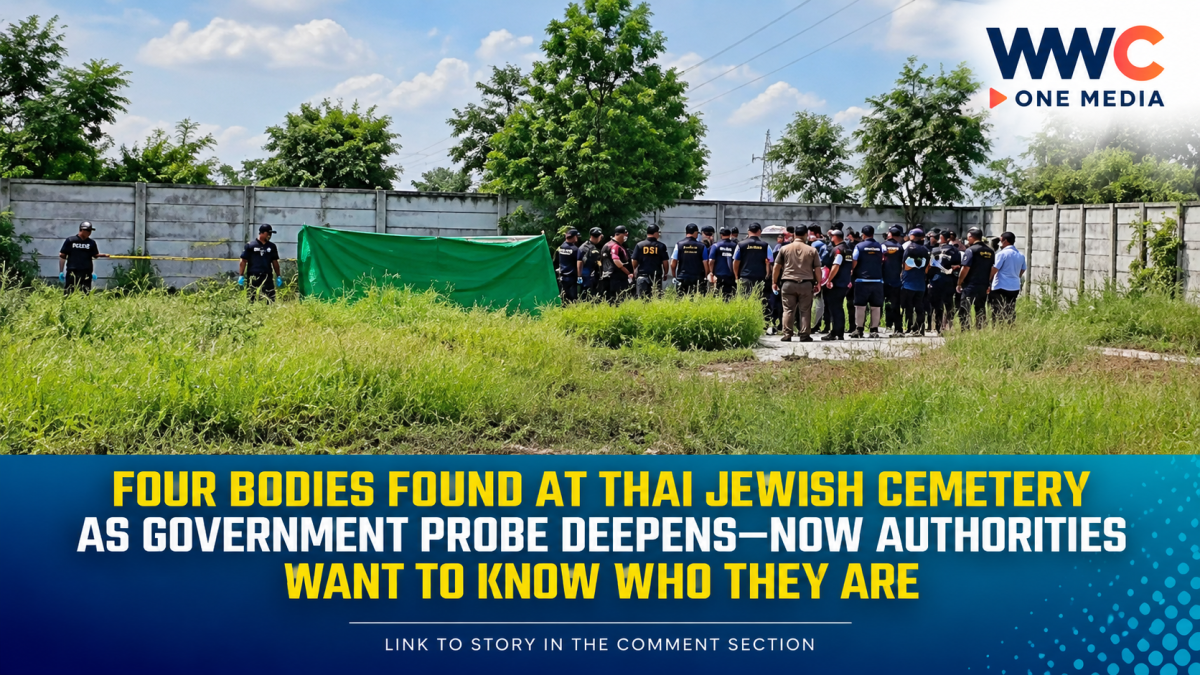
A Jewish cemetery in Chachoengsao province, east of Bangkok, has become the focus of a widening Thai government investigation after officials found four bodies at the site and determined that the cemetery was operating without a valid licence, authorities said.
The inspection, conducted on September 11 by Deputy Interior Minister Polapee Suwunchwee together with provincial officials and investigators, found three graves that had already been sealed with concrete and marked with marble headstones. A fourth body was reportedly still under a temporary covering.
The discovery has prompted authorities to verify who the deceased were, when and how they died, and whether the burials complied with Thai law before any remains can be moved.
Four bodies become the center of the investigation
According to officials, the three completed graves carried death years of 2023, 2025 and 2026. The fourth body was believed to have been brought to the site this year.
Authorities said local administrative offices had not received notifications of the deaths, raising questions that officials say must be resolved before the remains can be transferred elsewhere.
Officials have ordered the Department of Provincial Administration and health authorities to establish the identities of the deceased and determine whether their deaths were from natural causes, accidents or possible violence.
The government has stressed that the immediate priority is verification—not speculation.
The company associated with the cemetery must provide official documentation confirming the identities and causes of death before authorities will authorize the transfer of the bodies.
Cemetery licence reportedly expired
The controversy centers on the cemetery’s legal status.
Thai authorities say the facility currently has no valid licence to operate as a cemetery or crematorium. The site reportedly received a licence in 2021, but that authorization was not renewed in 2023.
Officials have also raised concerns about the site’s location, including its proximity to waterways and roads.
The dispute has already moved into the legal arena, with provincial authorities expected to provide information to the Administrative Court as part of the ongoing case.
The case is bigger than one cemetery
The investigation is now expanding beyond the Chachoengsao property.
Thai authorities have linked the company involved, Gan Chabad Co., Ltd., to a broader investigation into suspected nominee arrangements and foreign-linked business networks.
The land transaction reportedly involved about 15 rai, or roughly 2.4 hectares, with a value of around 20 million baht. Officials said three shareholders were Israeli nationals who had subsequently obtained Thai citizenship, meaning they were legally eligible to own land—but authorities are examining their connections to other businesses.
Authorities have said the investigation is not based simply on nationality. Instead, they are examining whether corporate structures were used to circumvent Thai laws governing land ownership and business operations.
Importantly, officials have acknowledged that no predicate offence for money laundering has yet been identified at the cemetery itself. Allegations involving nominee structures remain under investigation.
Thailand orders checks on about 1,200 cemeteries
The Chachoengsao case has triggered a much broader government response.
Deputy Interior Minister Polapee has ordered inspections of approximately 1,200 cemeteries and cremation sites nationwide, with officials checking licences, ownership information and other regulatory requirements.
Authorities have emphasized that the inspections are not intended to target a particular nationality or religion.
Instead, officials say the objective is to determine whether burial and cremation facilities throughout Thailand are complying with the law.
The government is coordinating the wider effort with agencies including the Department of Special Investigation (DSI), Anti-Money Laundering Office (AMLO), Royal Thai Police, Public Sector Anti-Corruption Commission and Commerce Ministry.
Another Jewish cemetery in Bangkok also under review
The scrutiny has also reached Bangkok.
Authorities are examining a cemetery on Charoen Krung Road that contains about 49 graves of Israeli nationals.
Officials are investigating whether a wall dividing part of the property effectively created a separate burial area and whether every portion of the site is properly licensed.
This has added another layer to an already sensitive investigation involving religious burial practices, land ownership and local regulations.
Residents had already raised concerns
The Chachoengsao controversy became public earlier this month after residents of Samed Tai in Bang Khla district expressed concern over reports that a Jewish cemetery could eventually contain as many as 1,200 burial plots.
Local residents cited concerns about the site’s proximity to waterways, fish and shrimp ponds and residential areas.
Local officials subsequently clarified that no burials were taking place at the proposed larger site and that its original three-year operating licence had expired.
The dispute over the property’s authorization is now being examined through administrative channels.
Authorities warn the investigation could widen
Polapee has said officials are considering additional legal action if violations are established.
Under Thailand’s Cemeteries and Crematoriums Act, authorities have identified potential violations involving the operation of an unauthorized cemetery. Polapee has argued that relying only on the existing fine—reported at 2,000 baht in this case—may not provide a sufficient deterrent and has instructed officials to examine whether other laws could apply.
Authorities have also warned that if serious wrongdoing involving land or corporate structures is eventually proven, stronger measures could follow.
But at this stage, the broader allegations remain under investigation, and the discovery of the four bodies does not by itself establish criminal wrongdoing by the cemetery’s operators or shareholders.
Why the case is attracting national attention
What began as a dispute over one cemetery has now developed into a nationwide regulatory review.
The government is simultaneously examining:
- The identities and causes of death of four people found at the Chachoengsao site
- Whether the burials were legally authorized
- The cemetery’s expired operating licence
- The property’s proximity to regulated areas
- The ownership and corporate structure behind the land
- Possible nominee arrangements involving foreign-linked businesses
- Compliance at other cemeteries nationwide
For now, authorities say the most urgent question is straightforward: Who are the four deceased people, and were their deaths and burials properly documented?
Until those questions are answered, officials say the remains will not simply be moved to another cemetery.



Leave a Reply