
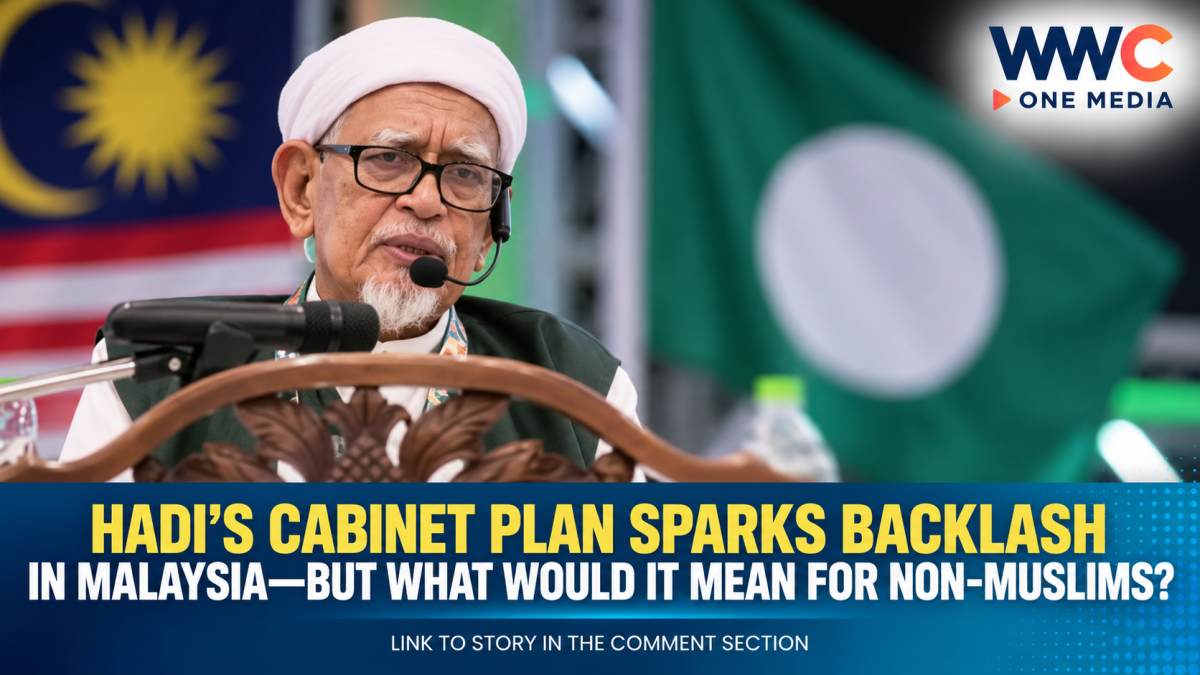
KUALA LUMPUR — A proposal by Malaysian Islamist opposition party Parti Islam Se-Malaysia (PAS) to limit the roles non-Muslim ministers could play in a future PAS-led federal government has triggered a political and constitutional backlash.
PAS president Abdul Hadi Awang said non-Muslims could still serve in a Cabinet under a PAS administration, but suggested their responsibilities would be confined largely to implementing government policies, while Muslim ministers would handle policy formulation. He cited portfolios such as public works and forestry as examples of positions that could be held by non-Muslims.
The remarks, delivered at the conclusion of PAS’ 72nd annual muktamar in Kelantan, have reignited a much broader debate over religion, political representation, minority rights and the future direction of Malaysia’s government.
Hadi’s proposal draws immediate criticism
The proposal was quickly challenged by opposition lawmakers and interfaith representatives.
DAP legal bureau chairman Ramkarpal Singh, a former deputy law minister, said there is no legal basis for dividing Cabinet responsibilities according to race or religion. He argued that Malaysia’s Federal Constitution provides for a single Cabinet and does not establish separate categories of ministerial positions based on religion.
Ramkarpal also pointed to Article 8, which establishes equality before the law, and said ministerial appointments should not be restricted according to a person’s religion.
The Malaysian Consultative Council of Buddhism, Christianity, Hinduism, Sikhism and Taoism (MCCBCHST) went further, describing Hadi’s position as unconstitutional and warning that it could undermine the constitutional framework protecting minority rights.
It is important to distinguish those statements from a judicial ruling: there has been no court ruling establishing that Hadi’s specific 2026 proposal is unconstitutional. The characterization comes from his critics and constitutional arguments surrounding the proposal.
PAS says non-Muslims would not be excluded
The controversy centers partly on how Hadi’s comments are interpreted.
A political aide subsequently argued that Hadi’s speech should not be understood as completely excluding non-Muslims from the Cabinet. According to Malaysiakini, Hadi sought to present a PAS administration as inclusive while proposing different responsibilities for Muslim and non-Muslim ministers.
That distinction, however, has done little to quiet the criticism.
The central concern raised by opponents is that allowing non-Muslims to occupy ministerial positions while restricting their ability to formulate policy could effectively create different levels of political authority based on religion.
Why the controversy is bigger than Cabinet posts
The dispute comes at a politically sensitive moment for Malaysia.
PAS has emerged as a powerful opposition force following the 15th General Election, and the party is preparing for the next federal contest. Hadi has said PAS is ready for an earlier general election, while PAS and UMNO have also been moving closer on calls for Malay-Muslim political unity and potentially earlier polls.
PAS has separately indicated that it has already identified a potential prime ministerial candidate for the next election, although Hadi said the name would not yet be disclosed because the eventual choice would depend on the number of seats won by the parties involved.
That makes the Cabinet proposal more consequential than a theoretical policy debate.
It offers voters a glimpse into how PAS says it would govern if it eventually takes federal power.
Hadi’s latest remarks follow a wider push for Islamic governance
The Cabinet controversy also follows other recent statements by Hadi concerning Malaysia’s legal and constitutional order.
On Sept. 9, Hadi called for the abolition of laws he described as colonial-era restrictions on the implementation of Syariah, arguing that such laws prevent Islam from occupying what he considers its proper position in Malaysian governance. He specifically discussed the Syariah Courts (Criminal Jurisdiction) Act 1965 and limitations created by the constitutional division of federal and state powers.
His position has intensified scrutiny of PAS’ long-term vision for Malaysia.
The interfaith council has linked Hadi’s latest Cabinet comments to earlier statements in which he discussed a model involving different bodies responsible for policy-making and policy implementation. The council argues that such an approach could conflict with constitutional principles protecting equality and minority rights.
Those are the council’s political and constitutional arguments, rather than a determination by Malaysia’s courts.
A constitutional question at the center
Malaysia’s Constitution recognizes Islam as the religion of the Federation while also providing constitutional protections for citizens of different faiths.
Critics of Hadi’s proposal therefore argue that a Cabinet structured around different levels of authority according to religion could fundamentally alter the country’s long-standing model of multiracial and multireligious power-sharing.
Ramkarpal said Article 43 provides for a Cabinet but does not divide it along racial or religious lines. He also argued that Malaysia’s Cabinet has historically included ministers from different communities.
The MCCBCHST similarly invoked the constitutional principle of equality and cited Malaysian Federal Court jurisprudence concerning the protection of fundamental rights and the Constitution’s basic structure.
The political stakes are rising
The debate comes as Malaysia’s next general election increasingly becomes part of the political conversation.
PAS has strengthened its position among Malay-Muslim voters and is seeking to translate that support into greater federal influence. At the same time, UMNO and PAS have shown signs of closer cooperation on Malay-Muslim political unity and election strategy, creating another layer of uncertainty for Prime Minister Anwar Ibrahim’s governing coalition.
PAS’ June decision to end its political cooperation with Bersatu while remaining open to electoral cooperation also illustrates how quickly opposition alliances can shift ahead of GE16.
Against that backdrop, Hadi’s Cabinet comments could become an important issue during the next election campaign.
What happens next?
For now, PAS is not running the federal government, and Hadi’s proposed Cabinet structure remains a political position rather than an implemented government policy.
But the controversy exposes a fundamental question that Malaysian voters could increasingly face as GE16 approaches:
If PAS wins federal power, should religion determine not only who can become a minister—but also who gets to make national policy?
That question is likely to remain at the center of Malaysia’s political debate as parties position themselves for the next election.




Leave a Reply