
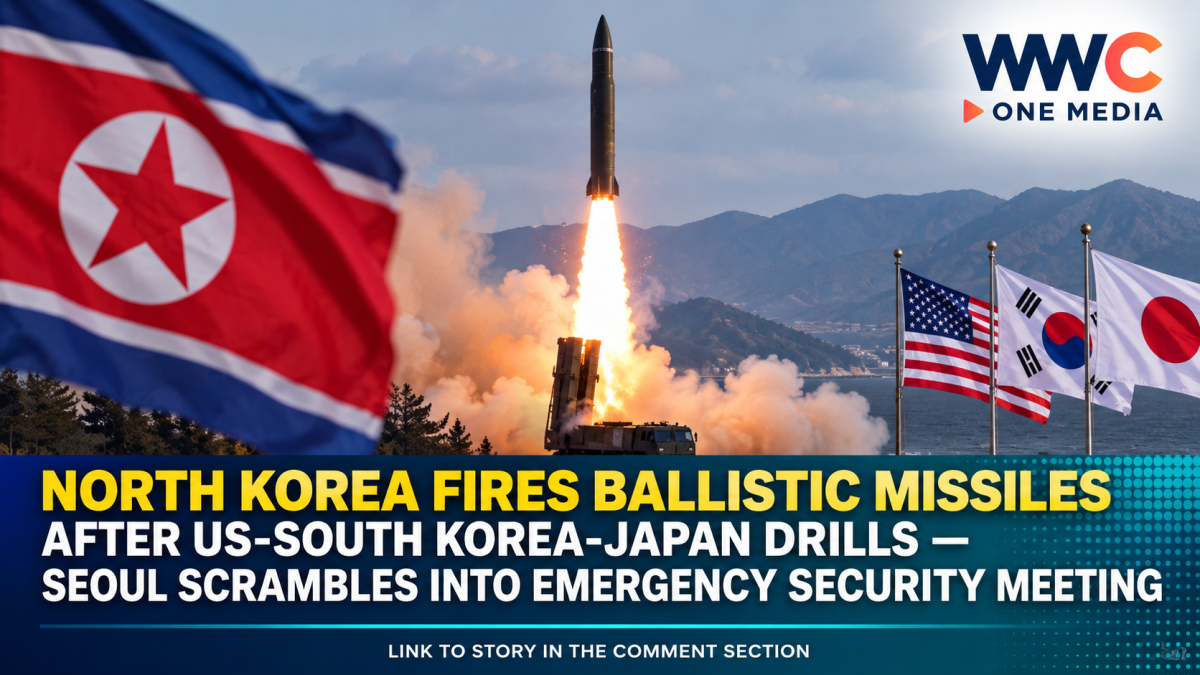
SEOUL — North Korea fired multiple short-range ballistic missiles toward the East Sea on Saturday, September 12, just one day after South Korea, the United States and Japan concluded a five-day trilateral military exercise in waters near the Korean Peninsula.
South Korea’s Joint Chiefs of Staff (JCS) said the missiles were launched from the Wonsan area on North Korea’s eastern coast at around 5:20 a.m. and traveled roughly 250 kilometers before falling into the sea.
The launches immediately triggered heightened surveillance by South Korean and US intelligence authorities, while Seoul maintained a heightened military readiness posture and coordinated information with Washington and Tokyo.
The Korea Herald reported that South Korea’s presidential National Security Office subsequently convened an emergency security meeting with relevant government agencies, including the Ministry of National Defense and the Joint Chiefs of Staff, to assess the security implications and determine what additional measures may be necessary.
Missile launch comes immediately after Freedom Edge
The timing of the launches is significant.
South Korea, the US and Japan had just completed Freedom Edge 2026, a five-day trilateral military exercise that ran from September 7 to 11 in international waters east and south of South Korea’s Jeju Island.
According to US Pacific Command, the fourth iteration of Freedom Edge focused on strengthening cooperation in air, maritime and cyber operations, as well as integrated air and missile defense capabilities. The exercise was designed to improve the three countries’ ability to respond collectively to regional security threats.
North Korea has repeatedly condemned joint military exercises involving South Korea, the United States and Japan, describing them as provocative and threatening to its security.
Before the latest missile launch, North Korean Defense Minister Kim Song-gi warned that Pyongyang would take what he described as “reflective countermeasures” if the US and its allies attempted to provoke a confrontation.
North Korea appears to send a message
The latest launches were the North’s first ballistic-missile test in about three weeks, according to the Associated Press.
The previous barrage occurred on August 20, when North Korea fired multiple short-range ballistic missiles toward the East Sea while South Korea and the US were conducting their annual Ulchi Freedom Shield exercise.
The latest launches therefore come against an already tense backdrop involving North Korea’s expanding weapons capabilities and increasingly close military cooperation among Seoul, Washington and Tokyo.
South Korean and US authorities are analyzing the exact missile specifications. Yonhap reported that South Korean sources believe the North may have used weapons from the Hwasong-11 series, along with rounds from 600-millimeter multiple rocket launchers, although analysis was still underway.
Seoul moves quickly after the launches
Following the missile launches, South Korea’s presidential office called an emergency security meeting to review their potential impact on national security.
The government also ordered officials to maintain full readiness and closely monitor North Korean military activity for any additional launches or movements.
The JCS said South Korean and US intelligence authorities had been monitoring North Korean activity and were sharing information with Japan.
South Korea’s military emphasized that it remained prepared to respond to further provocations while maintaining a firm South Korea-US defense posture.
The bigger regional picture
The missile launch also comes as the US, South Korea and Japan seek to strengthen security cooperation in response to North Korea’s nuclear and missile programs.
Freedom Edge is part of that broader effort. The three countries say the exercises are defensive and intended to improve coordination against missile and nuclear threats.
North Korea, however, views the drills as evidence of hostile military planning against Pyongyang.
The latest launch demonstrates how quickly tensions can rise even after Washington attempted to reduce some military pressure.
US President Donald Trump recently ordered a reduction in the scale of the annual Ulchi Freedom Shield exercise, describing large-scale exercises as costly and arguing that reducing them could help create space for diplomacy. North Korea nevertheless proceeded with the latest weapons test after Freedom Edge concluded.
What happens next?
For now, there is no indication that the missiles posed an immediate threat to South Korean, Japanese or US territory. The missiles landed in the sea after traveling approximately 250 kilometers.
But the timing has raised concerns because the launch followed immediately after a major trilateral military exercise.
With Seoul now conducting an emergency security assessment and South Korean, US and Japanese authorities sharing intelligence, attention will turn to whether Pyongyang follows the latest launch with additional weapons tests or other military actions.
One thing is clear: the Korean Peninsula remains on a heightened security footing, and Saturday’s missile launch could be another signal that tensions between Pyongyang and the US-led security partners are far from easing.




Leave a Reply