
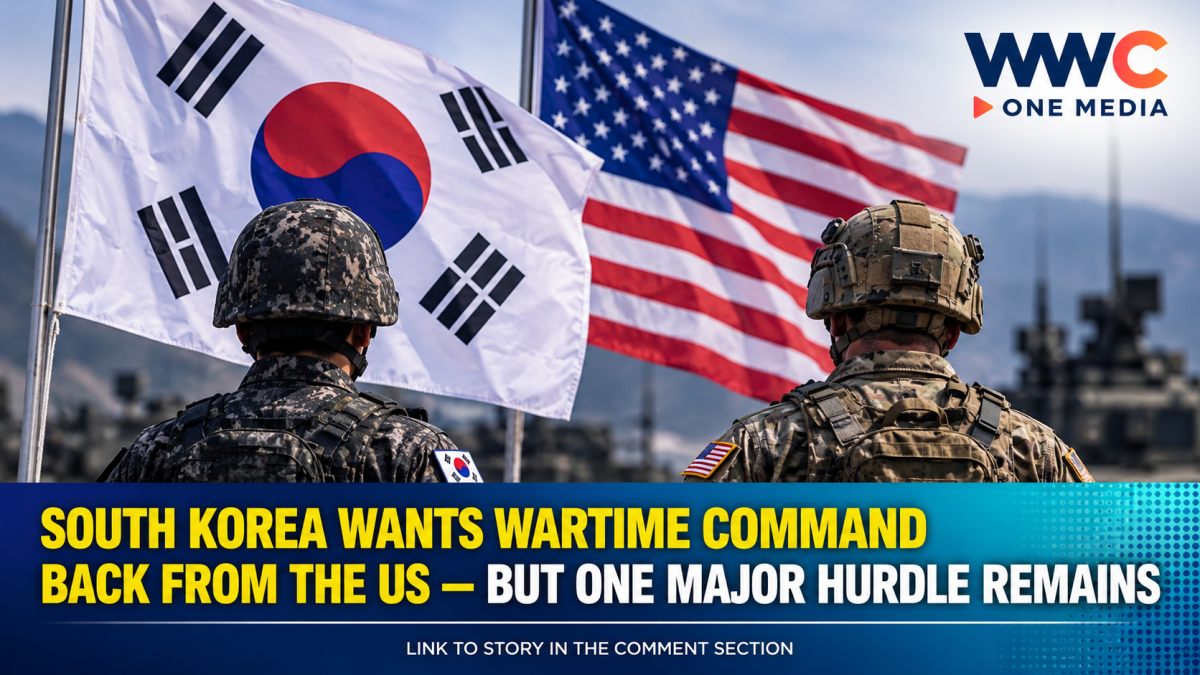
SEOUL — South Korea is stepping up its push to regain wartime operational control, or OPCON, from the United States, with Defense Minister nominee Kang Shin-chul saying Seoul is pursuing the transfer under a principle of “no additional conditions.”
Kang made the statement in written responses submitted ahead of his parliamentary confirmation hearing scheduled for Wednesday. His remarks come as President Lee Jae Myung’s administration seeks to complete the transfer before the end of his five-year term in 2030 — potentially even earlier.
The issue, however, is becoming one of the most sensitive questions facing the South Korea-US alliance, with Seoul emphasizing its growing military capabilities while US military officials continue to stress that the transfer must be based on operational readiness rather than political deadlines.
Seoul wants greater control over its wartime forces
South Korea already regained peacetime operational control of its forces in 1994. Wartime OPCON, however, remains under the US-led Combined Forces Command arrangement.
Under the existing plan, wartime command would eventually move to a future Combined Forces Command led by a South Korean four-star general, with a US general serving as deputy. The transition has been under discussion for years and was originally targeted for 2012 before being repeatedly delayed.
The allies eventually adopted a conditions-based approach, meaning the transfer is supposed to occur only after South Korea demonstrates the required military capabilities and the security environment is deemed suitable.
Those conditions include South Korea’s ability to lead combined forces and maintain key strike and air-defense capabilities.
Kang, a retired four-star Army general and former deputy commander of the South Korea-US Combined Forces Command, said Seoul and Washington have been consulting closely and that he does not see the difference between the two sides as significant.
He also pledged that, if appointed, he would work toward completing the Full Operational Capability (FOC) certification of the future Combined Forces Command.
The timeline is where tensions could emerge
President Lee’s administration has been pushing for an earlier OPCON transfer, with Seoul seeking to establish a target year during the allies’ annual Security Consultative Meeting later this year.
But US officials have repeatedly emphasized that military readiness must come first.
US Forces Korea commander Gen. Xavier Brunson has said the allies have a roadmap aimed at meeting the conditions for OPCON transfer by no later than the first quarter of fiscal year 2029. He has also warned against allowing political considerations to overtake military readiness.
That creates an important distinction: Seoul is pushing for a faster political timeline, while Washington has emphasized a conditions-based military process.
The two positions are not necessarily irreconcilable, but the timing of the transition could become a major point of negotiation.
Washington is not rejecting the transfer
Despite the differences over timing, the United States has not rejected South Korea’s goal of eventually taking wartime OPCON.
US Defense Secretary Pete Hegseth said in May that Washington welcomed Seoul’s desire to assume greater responsibility, while stressing the need to find the right balance as the transition takes place.
The two countries also reaffirmed in their 2025 Security Consultative Meeting that the conditions in their jointly approved OPCON transition plan must be met before the transfer occurs in a systematic and stable manner. They also backed efforts to certify the future Combined Forces Command’s Full Operational Capability in 2026.
Why the issue matters now
The timing is particularly significant because North Korea continues to maintain nuclear and missile capabilities, while the broader security environment in Northeast Asia is becoming more complicated.
Kang identified the North Korean regime and its military as South Korea’s primary adversary, citing Pyongyang’s continuing military threats, including its nuclear weapons program.
At the same time, Washington’s broader strategic focus increasingly includes China and the wider Indo-Pacific, adding another layer to discussions over the future role of US forces on the Korean Peninsula.
The US Congress has also been paying close attention to the OPCON process. A 2026 Congressional Research Service report noted that the United States and South Korea have been preparing since 2006 for a transition to a South Korea-led combined command, while US lawmakers have continued to place conditions around changes to the US military posture in South Korea.
Kang faces a crucial test
Kang’s confirmation hearing next week could therefore provide a clearer indication of how Seoul intends to balance its push for military sovereignty with the need to preserve close coordination with Washington.
His previous experience alongside US commanders could be significant. The Korea Times reported that Kang worked closely with Gen. Brunson during his time as deputy commander of the Combined Forces Command, giving him firsthand experience with the US military’s perspective on readiness and alliance coordination.
Kang has now said his goal is to ensure that the OPCON transition strengthens rather than weakens the South Korea-US alliance.
The central question is no longer simply whether South Korea wants wartime command back.
It is whether Seoul and Washington can agree on when South Korea is ready — and what conditions must be satisfied before that historic transfer takes place.




Leave a Reply