
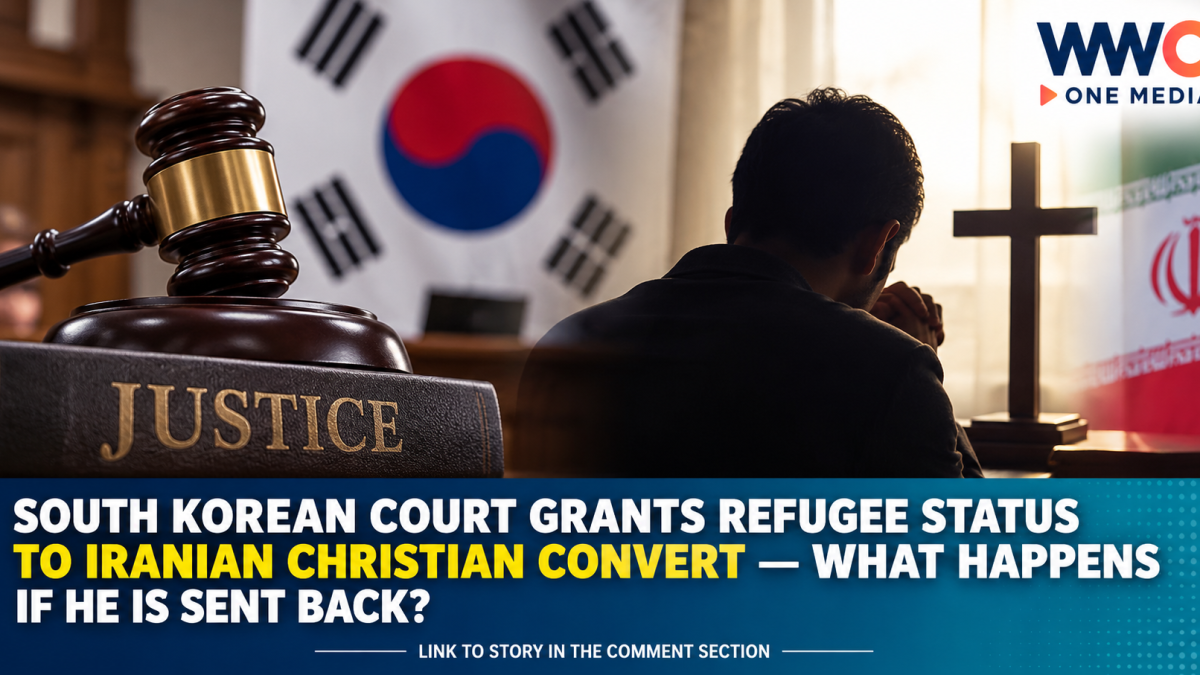
A South Korean court has overturned the government’s rejection of an Iranian national’s refugee application, ruling that his conversion from Islam to Christianity could expose him to serious persecution if he were forced to return to Iran.
The Seoul Administrative Court recently ruled in favor of the Iranian applicant, identified only as A, in a case challenging the Seoul Immigration Office’s decision to deny him refugee status. The case was reported by The Korea Herald on September 12.
The ruling marks the latest development in a six-year legal battle that began after the Iranian national sought protection in South Korea.
From Iran to South Korea
According to court findings reported by The Korea Herald and South Korean broadcaster SBS, A was raised in a devout Muslim family and attended an Islamic religious school before eventually becoming interested in Christianity.
He encountered Christianity at a church in Isfahan, Iran, and later converted. He subsequently traveled to countries including Turkey, Armenia and the Philippines to receive Christian education.
After returning to Iran, he became involved in an underground house-church network and participated in missionary activities.
His situation became more dangerous after another Christian convert in his circle was arrested. A was subsequently warned that he could also face arrest, prompting him to leave Iran and eventually enter South Korea.
He applied for refugee recognition in South Korea in 2020, but immigration authorities rejected his application after questioning the credibility of his account.
Why the court reversed the decision
The court took a different view of his testimony.
Judge Cho Dae-hyeon of the Seoul Administrative Court found that the applicant’s account of his Christian activities was sufficiently specific, consistent and credible.
The court also noted that A provided details about Christian practices in Iran that would have been difficult for someone without genuine knowledge of Christianity to fabricate.
The court therefore concluded that his religious activities, both before and after arriving in South Korea, could place him at significant risk if he were returned to Iran.
South Korea’s judiciary itself published a summary of the case on September 8, saying the court considered the applicant’s religious activities, conditions surrounding religion in Iran and the risk of persecution upon return in determining that he qualified as a refugee under South Korea’s Refugee Act.
Court points to potential danger for converts
A key issue in the ruling was the treatment of people who convert from Islam to Christianity in Iran.
The court cited Iran’s legal and religious environment, including interpretations of Sharia, and found that apostasy could carry extremely severe consequences. It concluded that the applicant’s Christian activities could potentially expose him to punishment under Iran’s constitutional, criminal and religious framework.
The ruling comes amid broader international concerns over the treatment of Christian converts in Iran.
A June 2026 country assessment published by the UK government says Iranian Christians known or believed by authorities to have converted from Islam and who openly practice Christianity are likely to face treatment that can amount to persecution. It also says authorities may take particular interest in Christian converts who actively proselytize or organize religious activities.
The Philippines connection
One notable detail in the case is the applicant’s connection to the Philippines.
Before settling in South Korea, he reportedly traveled to the Philippines as part of his Christian education. South Korean media reports say he entered South Korea via the Philippines in 2018.
That detail adds an unexpected Southeast Asian dimension to a case that ultimately became a major question of refugee protection and religious freedom in South Korea.
Not the first case involving Iranian Christian converts
South Korea has previously dealt with refugee cases involving Iranian nationals who converted to Christianity.
In an earlier case reported by Yonhap, South Korea’s Supreme Court ultimately recognized an Iranian national as a refugee after finding that his conversion to Christianity could expose him to religious persecution if he returned to Iran. The case also involved South Korea’s obligations under the 1951 Refugee Convention.
A separate 2019 Seoul Administrative Court case likewise recognized the potential persecution faced by an Iranian Christian convert, including restrictions on the person’s ability to freely practice his faith.
Why the latest ruling matters
The latest decision reinforces an important principle in refugee law: a person does not necessarily have to prove that severe persecution has already happened to them personally if credible evidence demonstrates a well-founded fear of persecution upon return.
In this case, the court looked not only at the applicant’s past experiences but also at his religious activities, the circumstances surrounding Christianity in Iran and the potential consequences of returning him to the country.
For the Iranian applicant, the ruling represents a dramatic reversal after years of uncertainty.
For South Korea, meanwhile, the case highlights the difficult balance between immigration enforcement and its obligations to protect people who face credible threats because of their religion.
The bigger question now is whether this ruling will further shape how South Korean authorities evaluate refugee claims from Iranian Christian converts — particularly as religious persecution and human-rights concerns in Iran remain under international scrutiny.


Leave a Reply