
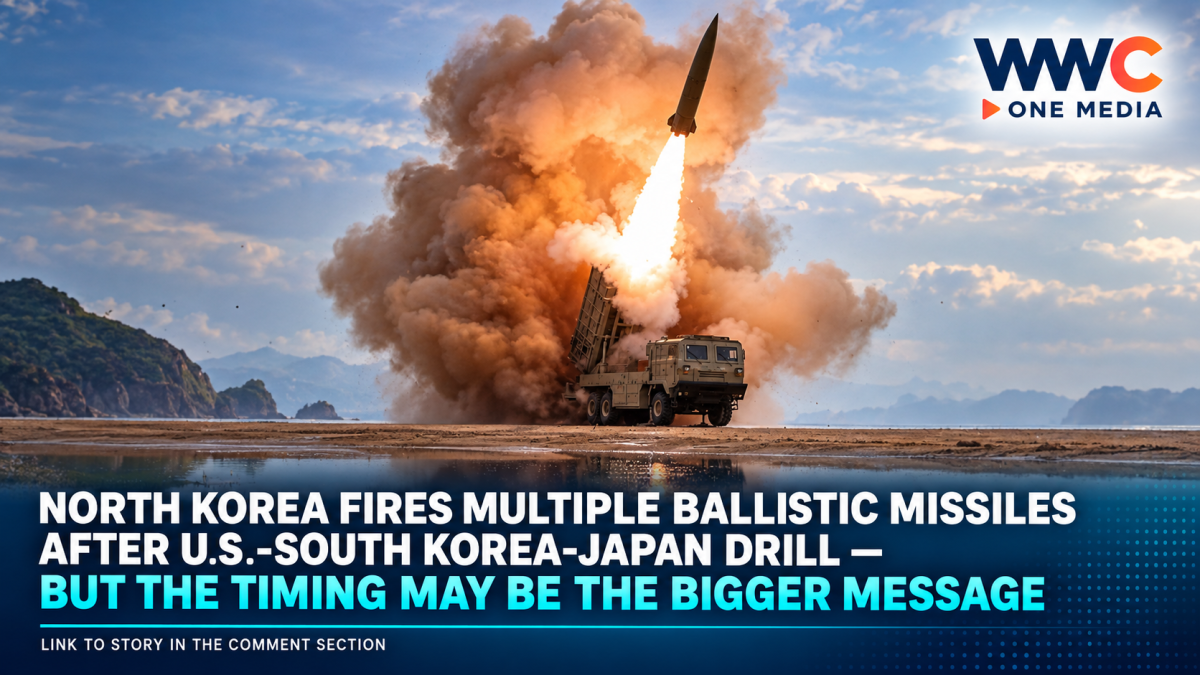
SEOUL — North Korea fired multiple ballistic missiles toward waters off its east coast early Saturday, September 12, putting South Korea’s military on heightened alert just after the United States, South Korea and Japan completed a major trilateral military exercise.
But the missiles themselves may be only part of the story.
Their timing — immediately following another demonstration of military cooperation among Pyongyang’s three principal regional rivals and ahead of high-level diplomacy involving Washington and Beijing — could make this latest launch as much a political signal as another weapons test.
South Korea’s Joint Chiefs of Staff said it detected multiple ballistic missiles launched from the Wonsan area at around 5:20 a.m., upgrading an initial announcement that had described only an unidentified projectile.
The South Korean military said it had strengthened surveillance for possible additional launches, remained on full alert and was sharing information with the United States and Japan as analysts worked to determine the missiles’ precise type, flight distance and trajectory.
Launch Came Just After Freedom Edge Exercise
The timing was difficult to ignore.
The launch came just one day after South Korea, the United States and Japan completed their latest Freedom Edge trilateral military exercise in international waters around the Korean Peninsula.
The exercise is intended to improve the three countries’ ability to respond jointly to threats including North Korea’s expanding nuclear and missile programs.
Pyongyang, however, has repeatedly portrayed U.S.-led military exercises in the region as preparations for an attack.
North Korean Defense Minister Kim Song Gi had already criticized the latest Freedom Edge drills and warned that Pyongyang would respond with what he called strong “countermeasures” if the United States and its allies moved toward military confrontation.
That warning now looks more consequential following Saturday morning’s launches.
Washington Says No Immediate Threat
The Associated Press reported that the U.S. military was monitoring the launch and said the missiles did not appear to pose an immediate threat to U.S. territory or American allies.
Washington nevertheless reaffirmed its security commitments in the region as South Korea, Japan and the United States continued exchanging information on the launches.
No immediate reports of casualties or damage had emerged in the first hours following the launch.
Crucially, authorities had also not yet released complete information on the missiles’ altitude, range, flight path or exact model at the time of the initial assessments.
That means early speculation over whether Pyongyang tested a particular new weapon should be treated cautiously until military authorities release more detailed tracking data.
North Korea Has Been Accelerating Its Weapons Activity
Saturday’s launch was not an isolated event.
On August 20, North Korea fired a barrage of short-range ballistic missiles while U.S. and South Korean forces were conducting their annual Ulchi Freedom Shield drills.
South Korea said roughly a dozen missiles were launched in that earlier test.
North Korea had also launched a ballistic missile from the Wonsan area on August 12. That missile flew roughly 700 kilometers, according to South Korean and Japanese assessments. Japan’s Defense Ministry said it reached an altitude of about 90 kilometers and landed outside Japan’s exclusive economic zone.
The pattern points to something larger than individual launch events.
Pyongyang has spent years trying to diversify its missile arsenal, including short-range weapons designed for regional targets, solid-fuel systems that can potentially be launched faster, maneuverable missiles intended to complicate interception and weapons North Korea says can carry tactical nuclear warheads.
Japan’s Defense Ministry has warned that North Korea has been working on missiles capable of flying at lower altitudes and on irregular trajectories specifically to make missile-defense operations more difficult.
North Korea Is Also Expanding Its Naval Nuclear Strategy
The latest launches come amid another significant shift in North Korea’s military strategy.
Just days earlier, Kim Jong Un attended the commissioning of a new 5,000-ton-class destroyer named Kang Kon, with North Korean state media saying the vessel would form part of the country’s nuclear response system.
Reuters reported that Kim described the destroyer as part of a broader effort to strengthen North Korea’s ability to deliver retaliatory strikes and expand its naval forces.
That matters because Pyongyang is no longer developing its missile forces in isolation.
Its broader strategy increasingly combines land-based missiles, naval platforms, nuclear weapons and more sophisticated delivery systems — giving neighboring countries more types of threats to monitor simultaneously.
Then There Is the Political Timing
Saturday’s launch also arrives at a particularly sensitive diplomatic moment.
Yonhap reported that U.S. President Donald Trump and Chinese President Xi Jinping are expected to hold a high-stakes meeting later this month, with North Korea likely to be among the security issues discussed.
Trump has simultaneously signaled interest in reducing tensions with Pyongyang.
Reuters reported in late August that the Freedom Edge exercise was proceeding even as Trump had scaled back some U.S.-South Korean military activity while exploring the possibility of renewed engagement with North Korean leader Kim Jong Un.
That creates a complicated strategic picture.
North Korea can condemn trilateral military exercises while demonstrating that its own missile program continues regardless of diplomatic overtures.
And by conducting launches around major exercises or diplomatic events, Pyongyang can force itself back onto the regional agenda without necessarily crossing the much more dangerous threshold represented by a nuclear test or an intercontinental ballistic missile launch.
What Happens Next Could Matter More
The immediate question is what kind of ballistic missiles North Korea fired from Wonsan and how far they traveled.
But the more important question could be whether Saturday’s launch is the end of Pyongyang’s response to Freedom Edge — or the beginning of another sequence of weapons demonstrations.
South Korea has already increased surveillance for additional launches.
That caution is understandable.
North Korea has repeatedly used military exercises, diplomatic negotiations and geopolitical turning points as opportunities to demonstrate new weapons or send political messages.
This time, it has done both with a single early-morning launch.
And if Saturday’s missiles were meant as a message rather than simply another test, the next move may reveal who Pyongyang actually intended to hear it.




Leave a Reply