
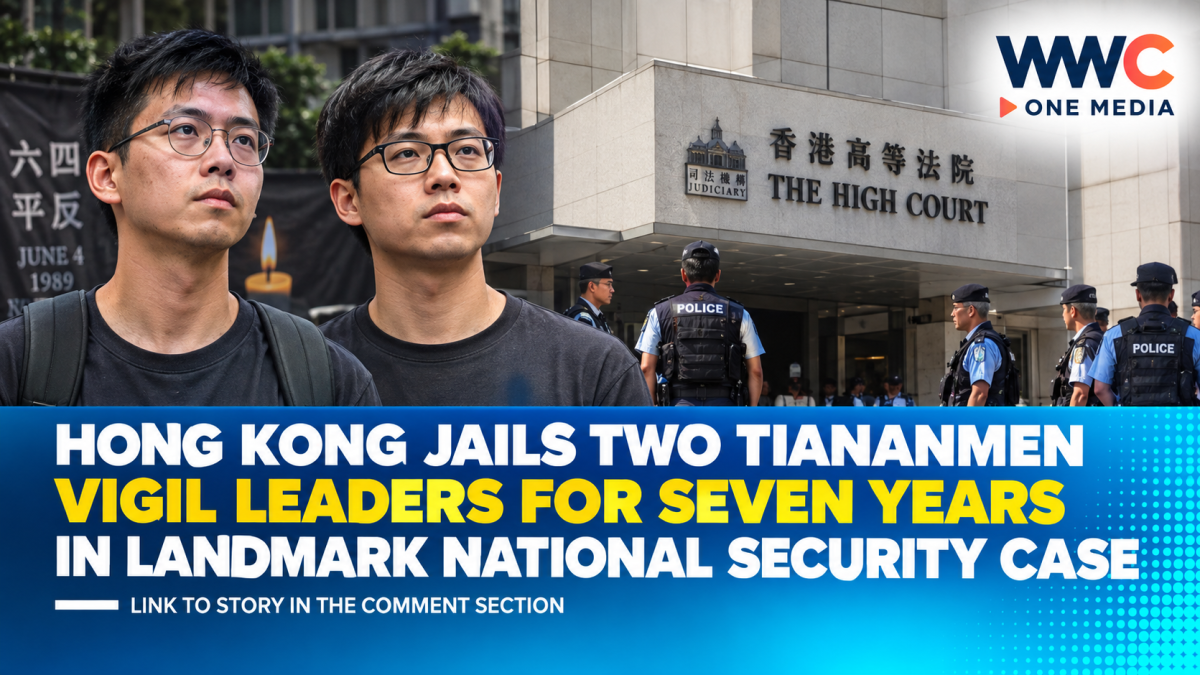
HONG KONG — Two prominent Hong Kong pro-democracy activists have been sentenced to more than seven years in prison for inciting subversion, in a landmark national security case linked to a now-disbanded group that organised the city’s annual Tiananmen Square vigils.
Former labour leader Lee Cheuk-yan, 69, was sentenced to seven years, while barrister and activist Chow Hang-tung, 41, received seven years and three months.
Their sentencing marks another major chapter in Hong Kong’s political transformation under the national security framework.
And for supporters, the case raises a question that stretches far beyond the courtroom: Can the act of organising public remembrance itself become a matter of national security?
Leaders of Hong Kong’s Tiananmen Vigil Movement
Lee and Chow were leading figures in the now-disbanded Hong Kong Alliance in Support of Patriotic Democratic Movements of China.
For decades, the group was best known for organising Hong Kong’s annual candlelight vigils commemorating the 1989 Tiananmen Square crackdown.
The gatherings, traditionally held at Victoria Park, once drew huge crowds and became one of the most visible public commemorations of the events of June 4 anywhere in the world.
However, the alliance was later disbanded amid increasing legal and political pressure.
The case against its former leaders centred on allegations that their activities and advocacy amounted to inciting subversion under Hong Kong’s National Security Law.
Court Cites Call to ‘End One-Party Dictatorship’
A central issue in the case involved the alliance’s long-standing call to “end one-party dictatorship.”
The court found that the phrase and related advocacy could amount to incitement to subvert state power.
Judges viewed the campaign as going beyond simple commemoration and as an effort that could challenge the political system led by China’s Communist Party.
Lee and Chow had pleaded not guilty to the charges.
The prosecution argued that the defendants had continued to pursue activities considered subversive despite the introduction of the National Security Law.
The ruling means words and political advocacy that had once formed part of Hong Kong’s public protest culture are now being judged under a dramatically different legal framework.
Albert Ho Also Sentenced
A third former alliance leader, veteran barrister and pro-democracy figure Albert Ho, 74, had pleaded guilty in the same case.
He received a sentence of five years and two months.
The different sentences reflected differences in the defendants’ legal positions and circumstances in the case.
All three men and women were prominent figures in Hong Kong’s long-running democracy movement.
Their prosecution has drawn international attention because of the alliance’s decades-long role in organising the Tiananmen vigils.
What Was the Hong Kong Alliance?
The Hong Kong Alliance was established in 1989 and became one of the city’s most recognisable civil society organisations.
Its annual candlelight vigil brought together activists, families, students and ordinary residents to remember those affected by the Tiananmen Square crackdown.
The alliance also operated the June 4th Museum, which documented the events and preserved materials connected to the pro-democracy movement in China.
For many years, Hong Kong’s annual vigil was viewed as a symbol of the city’s political freedoms under the “one country, two systems” framework.
But the political environment changed sharply after the massive anti-government protests of 2019 and the introduction of the National Security Law in 2020.
A Law That Changed Hong Kong’s Political Landscape
The National Security Law was introduced in Hong Kong in June 2020.
It created offences involving:
- Secession
- Subversion
- Terrorism
- Collusion with foreign forces
Authorities have repeatedly said the legislation is necessary to restore stability and protect national security following the political unrest that shook Hong Kong.
Critics, however, argue that the law has dramatically narrowed the space for political opposition, civil society activism and public dissent.
The prosecution of the former Tiananmen vigil leaders has become one of the latest cases at the centre of that debate.
Supporters see the defendants as activists being punished for peaceful political advocacy, while authorities maintain that national security offences must be dealt with according to the law.
Chow Represented Herself in Court
Chow Hang-tung, a barrister and long-time activist, represented herself during the proceedings.
She has previously been imprisoned in connection with other cases linked to Tiananmen commemorations and the activities of the Hong Kong Alliance.
Despite the years of legal challenges, Chow has remained one of the most prominent voices associated with the movement to preserve public memory of the 1989 crackdown.
Lee, meanwhile, has been involved in Hong Kong’s labour and democracy movements for decades and is one of the city’s best-known veteran activists.
Both have now received lengthy prison terms in addition to previous legal proceedings they have faced.
Alliance Faces Major Financial Penalty
The Hong Kong Alliance itself was also fined HK$1.5 million in connection with the case.
The organisation no longer operates after its leadership came under increasing scrutiny and several of its members faced prosecution.
Its disappearance has left Hong Kong without the organisation that once coordinated one of the world’s largest annual public Tiananmen commemorations.
The annual vigils were once attended by tens of thousands of people.
Today, public remembrance of the Tiananmen crackdown in Hong Kong has become far more restricted.
Appeals Expected
Lee and Chow are expected to challenge their convictions and sentences through the legal process.
Their appeals could once again place the case under intense scrutiny.
The outcome may also have wider implications for how Hong Kong courts interpret political speech and activism under the National Security Law.
For now, both activists remain among a growing number of prominent democracy figures serving lengthy prison sentences.
A Defining Moment for Hong Kong
The sentencing reflects how dramatically Hong Kong’s political and civil society landscape has changed in recent years.
Organisations that once operated openly have disbanded.
Public demonstrations have become far less common.
Several major opposition figures, activists and media personalities have faced prosecution under national security legislation and other laws.
The case involving the Tiananmen vigil leaders carries particular symbolic weight because the annual June 4 gatherings were once a defining feature of Hong Kong’s public life.
Now, the people who helped keep that memory alive have been handed some of the longest sentences connected to the movement.
The Bottom Line
Two former leaders of Hong Kong’s once-powerful Tiananmen vigil movement have been sentenced to more than seven years in prison for inciting subversion.
Lee Cheuk-yan received a seven-year sentence, while Chow Hang-tung was jailed for seven years and three months. Former alliance leader Albert Ho, who pleaded guilty, received five years and two months.
The case centres on the now-disbanded Hong Kong Alliance and its decades-long advocacy, including its call to end one-party rule.
But as Lee and Chow prepare to challenge the ruling, one question now hangs over Hong Kong’s future: In a city where the Tiananmen vigil once drew enormous crowds, what space remains for public memory, political activism and dissent?



Leave a Reply