
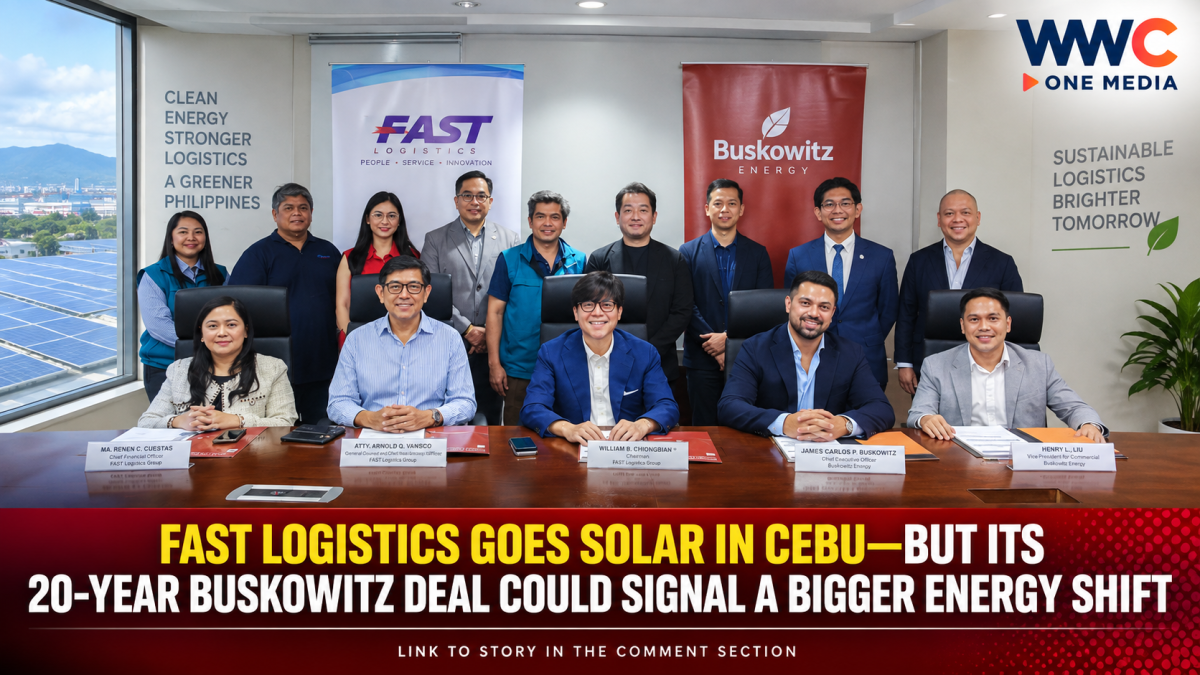
CEBU, Philippines — FAST Logistics Group is taking another major step toward cleaner and more energy-efficient operations, expanding its solar strategy in Cebu through a long-term partnership with Buskowitz Energy.
The move comes as the Philippine logistics giant accelerates its transition toward renewable energy, with solar power increasingly becoming a key part of its strategy to reduce operating costs, strengthen energy resilience and achieve its long-term net-zero emissions target by 2050.
The latest development, reported by Bilyonaryo, involves a 20-year agreement with Buskowitz for solar power at FAST’s Cebu operations—another indication that the company is moving beyond individual renewable-energy projects toward a longer-term transformation of its logistics infrastructure.
Cebu becomes an important piece of FAST’s solar strategy
FAST has already identified Cebu as an important location in its renewable-energy roadmap.
The company’s sustainability report said its Tayud, Cebu facility was among the warehouses targeted for solar deployment, alongside facilities in Batino, Laguna and Casinglot, Misamis Oriental. FAST previously disclosed plans involving a combined 1.30 MWp of additional solar capacity across those sites.
FAST’s broader strategy is not limited to putting solar panels on warehouse roofs.
The company envisions an integrated, closed-loop system in which solar-powered warehouses supply electricity to battery storage and electric-vehicle charging infrastructure, eventually supporting fully electric trucks. FAST has described this as part of its effort to create a more resilient and lower-carbon logistics network.
Why the 20-year deal matters
A 20-year solar arrangement is significant because it gives a logistics operator a much longer planning horizon for its electricity requirements.
For FAST, the strategy is particularly relevant because warehouses, cold-chain facilities and transportation operations are energy-intensive businesses. Reducing dependence on conventional grid electricity can potentially help the company manage long-term energy costs while lowering the carbon footprint associated with its operations.
Buskowitz Energy has specialized in solar installations and solar-financing models in the Philippines since 2012. The company says its business has focused on rooftop photovoltaic systems, solar leases and renewable-energy solutions for commercial customers.
The company’s solar-lease model also includes operations and maintenance throughout the lease period, according to its published FAQs.
FAST’s solar push is much bigger than Cebu
The Cebu deal is part of a much wider renewable-energy strategy.
FAST said its existing solar installations in Cavite and Laguna generated nearly 1 million kilowatt-hours of renewable electricity in 2025, while avoiding roughly 675 metric tons of carbon emissions, according to PortCalls Asia. The company has also been expanding electric-vehicle operations as part of its decarbonization program.
FAST has publicly committed to achieving net-zero emissions by 2050, making it one of the Philippine logistics industry’s most aggressive adopters of renewable energy and fleet electrification.
The company has said it wants to maximize the usable roof space across its warehouse network for solar installations and pair those systems with battery storage.
The bigger business reason: controlling costs
FAST’s green-energy strategy isn’t simply about environmental branding.
Company executives have repeatedly pointed to rising fuel and electricity costs as major reasons for investing in renewable energy.
At an industry event in 2026, FAST CEO for Logistics Manuel L. Onrejas Jr. said renewable energy and fleet electrification could help logistics companies reduce their exposure to fuel-price volatility and protect margins over the long term.
That matters in an industry where transportation, warehousing, refrigeration and distribution all carry substantial energy costs.
FAST is also pursuing electric vehicles and solar-powered charging infrastructure, potentially allowing renewable energy generated at its facilities to eventually power parts of its transport network.
FAST is also tapping renewable electricity from the grid
The company’s renewable-energy strategy extends beyond rooftop solar.
In August, FAST Logistics and the Chiongbian Group selected Jin Navitas Electric Corp. (JNEC) as electricity supplier for key facilities under the government’s Retail Aggregation Program.
PortCalls Asia reported that JNEC would supply renewable electricity to six FAST facilities, including cold-chain, cross-docking, container-freight, office and warehouse operations.
JNEC likewise announced that FAST and the Chiongbian Group had chosen the company to provide renewable power to key operations.
This suggests FAST’s energy transition is being pursued on multiple fronts: onsite solar generation, renewable electricity procurement, battery storage and fleet electrification.
From trucks and warehouses to a low-carbon supply chain
FAST is one of the country’s largest end-to-end logistics providers, with operations spanning warehousing, transportation, distribution, cold chain and supply-chain management. The Department of Trade and Industry’s logistics portal describes the company as having a presence across the country’s major islands and cities.
The company’s scale makes its energy transition particularly significant.
FAST’s current network includes more than 160 dry warehouses, approximately 1.9 million square meters of warehouse space, and more than 2,500 vehicles, according to CVC Capital Partners’ announcement on the company’s ownership transition.
That means even incremental improvements in energy efficiency and renewable-energy use can potentially have a sizeable impact across its operations.
And FAST isn’t stopping at solar.
The company has already introduced fully electric trucks and solar-powered EV charging infrastructure, while continuing to develop technology-enabled logistics systems designed to improve route optimization and fleet utilization.
The next question: how far can FAST take the model?
The Cebu solar agreement could ultimately be viewed as more than a single facility-level energy project.
FAST has increasingly framed its sustainability program as an interconnected system: solar warehouses → battery storage → EV charging → electric trucks → lower-emission logistics.
If that model can be replicated across more of the company’s nationwide warehouse network, FAST could significantly reshape the energy profile of one of the Philippines’ largest logistics operations.
For now, Cebu is another important step in that transition—and the 20-year Buskowitz partnership could prove to be a long-term building block in FAST’s race toward a more energy-independent and low-carbon logistics network.

Leave a Reply