
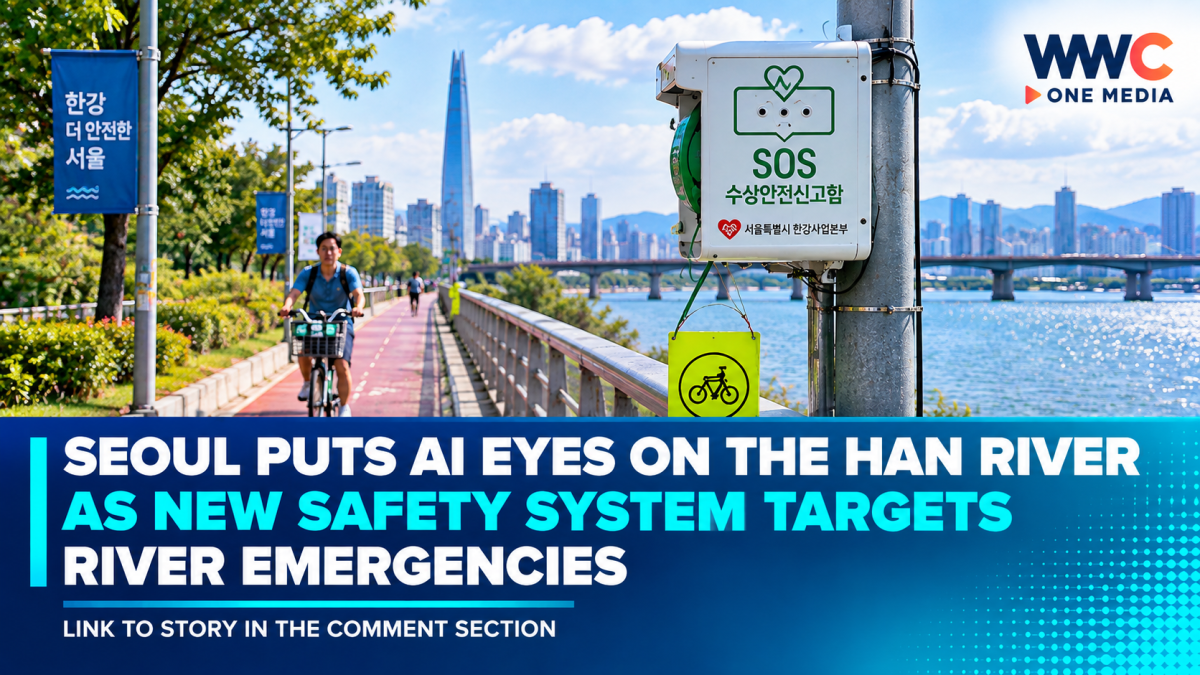
SEOUL — Seoul is turning to artificial intelligence to strengthen safety along its waterways, deploying AI-powered intelligent CCTV designed to detect dangerous situations and help authorities respond before a river emergency becomes a tragedy.
The initiative forms part of the Seoul Metropolitan Government’s broader push to transform conventional surveillance cameras into systems capable of recognizing situations rather than simply recording them.
For residents and visitors along the city’s rivers, that could mean a new kind of safety net: AI watching the water even when human operators may not immediately notice a developing emergency.
AI Cameras Designed to Detect Trouble
Seoul’s 2026 summer safety program includes the pilot introduction of AI-based intelligent CCTV for rivers.
The city says 20 intelligent CCTV cameras were scheduled for installation across five rivers—Jungnangcheon, Dorimcheon, Jeongneungcheon, Tancheon and Hongjecheon—with the system designed to automatically recognize people entering controlled areas and support real-time intervention.
The cameras are intended to help prevent incidents such as people becoming isolated in waterways or entering areas that have been restricted for safety reasons.
The program is part of Seoul’s wider strategy to identify warning signs earlier rather than relying exclusively on people watching multiple CCTV feeds and reacting after an incident has already occurred.
What ‘Physical AI’ Really Means Here
The phrase “physical AI” can sound as if Seoul is deploying autonomous robots into the river.
That is not what the city’s current announcement describes.
Instead, the system represents AI being connected to the physical urban environment through cameras, sensors and emergency-response infrastructure.
Seoul has been moving toward what it calls context-aware generative AI monitoring, in which AI analyzes CCTV footage to distinguish potentially dangerous situations from ordinary activity.
The city announced in February that it plans to invest 27.1 billion won in 2026 to upgrade intelligent CCTV infrastructure and pilot generative-AI monitoring.
The objective is to move beyond simple video recording toward systems capable of helping operators understand what is happening in real time.
From Recording Events to Detecting Risk
Traditional CCTV is largely passive: cameras capture footage and human operators watch screens or review recordings.
AI-enabled CCTV changes that model.
Seoul says its intelligent systems can analyze movement and identify situations such as people wandering, falling or being involved in dangerous incidents, with alerts sent to control centers and emergency authorities when appropriate.
The city’s broader AI-monitoring strategy also aims to learn from false alarms and over-detection so that the systems can gradually become more accurate.
That distinction matters.
The technology is not intended to replace emergency personnel. Instead, it is designed to help them spot potentially dangerous situations faster and prioritize their response.
Han River Safety Is Part of a Much Bigger AI Push
The river-safety project is only one piece of Seoul’s rapidly expanding smart-city infrastructure.
In April, the city announced plans to complete an AI-based high-speed CCTV search system across all 25 districts.
The system is designed to search large quantities of CCTV footage simultaneously, with Seoul saying AI can analyze up to 100 hours of footage in about 10 minutes for relevant information.
That capability could become particularly valuable during emergencies, when authorities need to trace a person’s movements across multiple camera networks quickly.
Seoul’s broader goal is to make its massive CCTV network more useful for prevention and emergency response rather than simply using cameras as passive evidence after an incident.
AI Is Also Watching Seoul’s Roads and Flood Risks
The city’s AI safety strategy extends well beyond waterways.
Seoul’s 2026 summer disaster plan includes AI-based flood prediction, using weather-radar data to estimate flooding risks on vulnerable roads.
The city identified 15 flood-prone road locations, including areas around Gangnam Station and Dorimcheon, for enhanced monitoring and response.
Seoul Facilities Corporation is also introducing AI systems for other safety problems, including road incidents, crowd management and wildfire monitoring.
At Seoul World Cup Stadium, for example, an AI crowd-management system uses LiDAR sensors and intelligent CCTV to estimate crowd density in real time and classify risk levels.
The emerging picture is clear: Seoul is increasingly attempting to build an urban safety network in which machines detect warning signs first and human responders act on the information.
Privacy and Accuracy Still Matter
The expansion of AI surveillance also raises important questions.
More intelligent cameras mean more automated analysis of people’s movements in public spaces. That makes accuracy, data governance and privacy important considerations alongside the potential safety benefits.
AI systems can also produce false alarms or fail to recognize unusual situations.
Seoul itself acknowledges the problem of false and excessive detection, which is why its new monitoring strategy includes learning from those errors to improve performance.
The technology should therefore be viewed as an additional layer of emergency protection—not a guarantee that every dangerous situation will automatically be detected or prevented.
A Correction Worth Noting
The recent discussion surrounding AI surveillance on Seoul’s bridges has also produced misinformation online.
AFP recently fact-checked viral claims suggesting that South Korea had installed suicide-prevention cameras on Han River bridges in response to the country’s recent stock-market losses.
That claim was false.
AFP reported that the AI surveillance program on the bridges predated the market losses and had been operating since 2021.
The clarification is important because Seoul’s AI safety expansion is a long-running policy effort, not a sudden reaction to a single recent event.
Seoul’s Bigger Bet: Prevention Before Emergency
The most significant change may not be the cameras themselves.
It is the shift in philosophy.
Instead of waiting for someone to report an emergency, Seoul wants technology to identify warning signs automatically and give responders more time to act.
Along rivers, on roads, at crowded venues and in other vulnerable locations, AI is increasingly being integrated into the city’s safety infrastructure.
The Han River initiative represents one particularly visible example of that transformation.
The question now is whether Seoul’s AI-powered eyes can turn earlier detection into faster intervention—and ultimately prevent emergencies from becoming tragedies.


Leave a Reply