
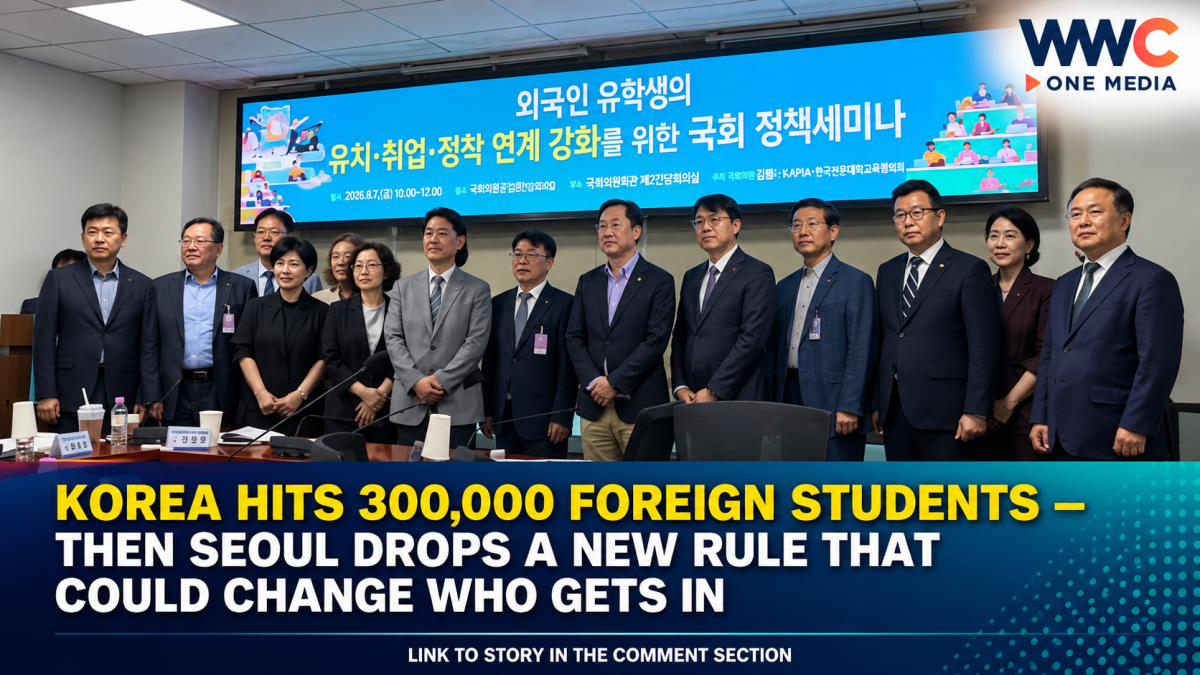
SEOUL — South Korea has reached a major milestone in its push to attract international students — but instead of chasing even bigger enrollment numbers, the government is now changing the rules of the game.
The country’s Ministry of Education has unveiled a new strategy that shifts the focus from simply attracting more foreign students to improving educational quality, strengthening student protections and retaining talented graduates who can contribute to South Korea’s economy and regional communities.
The policy shift comes after South Korea recorded 307,464 international students in 2026, nearly 70% higher than the roughly 182,000 recorded in 2023.
That means Seoul has already surpassed its 300,000-student target under the Study Korea 300K Project — one year ahead of the original 2027 deadline.
And now comes the harder part:
making sure those students receive quality education, are protected from abuse and misleading recruitment — and have a realistic pathway to jobs after graduation.
FROM QUANTITY TO QUALITY
For years, South Korea aggressively expanded its international student recruitment efforts as it sought to counter a rapidly aging and shrinking domestic population while strengthening its future workforce.
But the government says the rapid increase has also exposed problems.
The Education Ministry cited cases involving misleading or exaggerated advertisements by recruitment agencies, weak academic management and questionable educational practices. There have also been cases involving students allegedly using forged academic credentials.
The new strategy therefore places much greater responsibility on universities and the agencies they use to recruit students overseas.
One planned measure is a standard agreement between universities and overseas recruitment agencies, expected to be distributed later this year.
The agreement is intended to require more accurate information about degree programs, tuition and working conditions while studying — while prohibiting misleading advertising.
Universities would also have greater responsibility for monitoring recruitment agencies working on their behalf.
VISA DENIED? TUITION REFUNDS COULD GET TOUGHER FOR UNIVERSITIES TO AVOID
One particularly important protection concerns tuition payments.
The government plans to require clearer information about refund procedures before students enroll.
Under the proposed framework, if admission is canceled because a student is unable to obtain a visa, universities would be required to return tuition directly to an account in the student’s name.
The Education Ministry is also preparing legal changes that could make important parts of the university-recruitment agency agreement mandatory and establish corrective measures for violations.
This could become especially significant for students who rely on overseas recruitment agencies to navigate the Korean university system.
A ministry survey of 8,300 international students found that 17.8% said recommendations from recruitment agencies were a major factor in choosing their university.
UNDERPERFORMING UNIVERSITIES COULD FACE A BIG PROBLEM
Perhaps the biggest change is coming to South Korea’s International Education Quality Assurance System (IEQAS).
The system evaluates universities on their ability to recruit and manage international students, provide academic and living support, and maintain acceptable education standards.
Under the revamped system, universities that fail basic institutional accreditation or are classified as financially distressed for two consecutive years could be placed in the lowest category.
That could have a major consequence:
restrictions on visas for newly admitted international students.
In practical terms, universities that fail to meet basic standards could find it significantly harder to recruit foreign students.
The new system is expected to apply to the 2029–2032 certification cycle, while the current IEQAS framework remains in effect through 2028.
KOREA ALSO WANTS STUDENTS WHO CAN STAY AND WORK
The policy isn’t simply about controlling universities.
South Korea also wants international students to become part of its future workforce.
According to Education Ministry data cited by The Korea Herald, 14,966 international graduates eligible for employment in Korea in 2024 produced 4,993 successful job placements, an employment rate of 33.4%.
That was an improvement from 21.7% the previous year — but the government sees considerable room for improvement.
The challenge is even more pronounced among Global Korea Scholarship recipients.
Although 83.8% reportedly indicated that they wanted to work in South Korea, only 28.3% had actually secured employment, according to ministry figures cited in the report.
So Seoul is preparing additional career support.
Beginning in 2027, the government plans to publish information explaining Korea’s recruitment system, occupations and workplace culture.
The government’s Study in Korea platform will also provide more personalized employment information for international students based on their preferred industries and regions.
SEOUL ISN’T THE ONLY PLACE KOREA WANTS FOREIGN TALENT
There is another problem: too many international students want to work in Seoul.
More than 60% of international students who intended to work in South Korea preferred jobs in the capital, according to 2025 data cited by the Education Ministry.
That creates a mismatch because many regional areas are facing labor shortages.
The government therefore plans to encourage universities and education-internationalization zones to build stronger connections between international students and regional industries.
Beginning in 2027, Korea also plans to establish a certification system for academic departments that are particularly successful at educating international students and connecting them with regional employment opportunities.
High-performing programs could receive government funding and additional scholarship allocations.
AI COULD ALSO BECOME PART OF THE INTERNATIONAL STUDENT EXPERIENCE
The new strategy goes beyond admissions and employment.
South Korea plans to expand support services for international students, including a 24-hour AI chatbot capable of providing counseling in students’ native languages, with the ability to connect users with professional counselors when necessary.
The government also wants universities to create more opportunities for international students to interact with local communities rather than remaining isolated on campus.
STEM TALENT GETS SPECIAL ATTENTION
South Korea is also targeting international students in science and technology fields as it competes for talent needed by advanced industries.
The share of graduate-level Global Korea Scholarship recipients in science and engineering is targeted to rise from 43% in 2026 to 45% in 2027.
Outstanding master’s students could receive additional support to continue into doctoral programs, while stronger research performers may receive additional incentives.
The government is also considering preferential visa treatment for high-performing science and engineering scholarship recipients.
WHAT THIS MEANS FOR FUTURE INTERNATIONAL STUDENTS
The message from Seoul is becoming increasingly clear:
Getting into Korea may not simply be about finding a university willing to accept you.
The government is moving toward a system in which the quality of the university, legitimacy of recruitment, language proficiency, academic support and eventual employment outcomes matter much more.
South Korea has already achieved the numerical target it once considered ambitious.
Now it is asking a more difficult question:
Can those 300,000-plus international students become the highly skilled global talent the country actually needs?
That may determine whether South Korea’s international education boom becomes a short-term enrollment success — or a long-term economic strategy.




Leave a Reply