
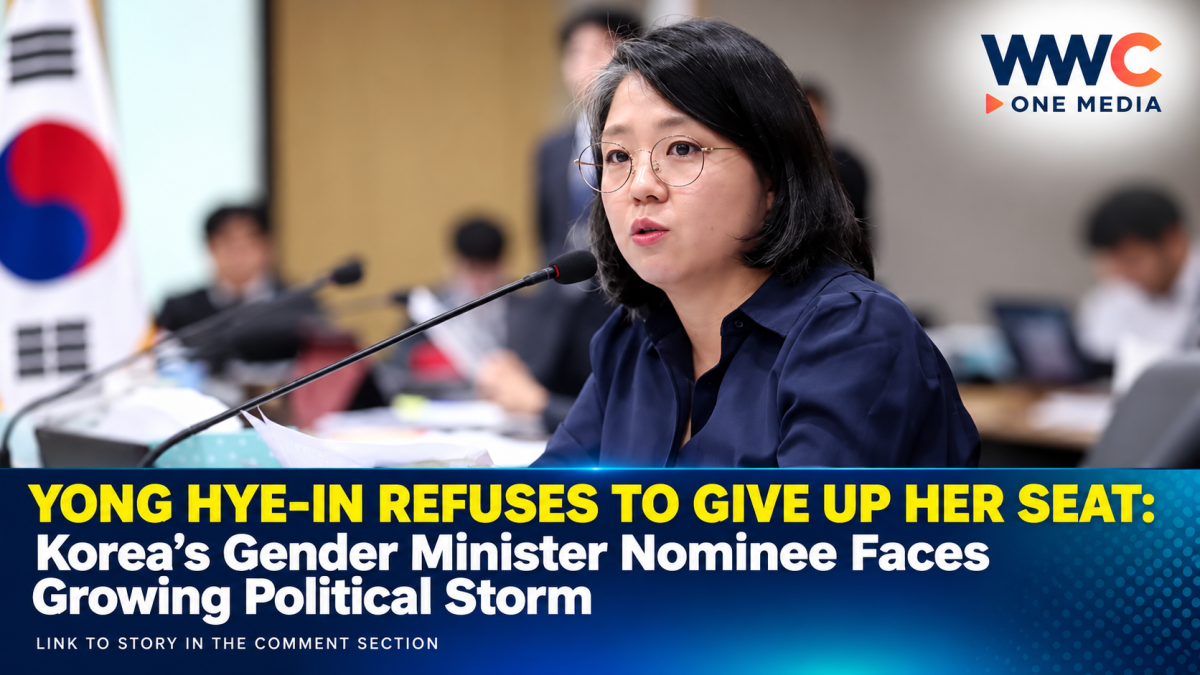
SEOUL — South Korea’s nominee for gender equality and family minister, Yong Hye-in, is refusing to surrender her seat in the National Assembly if she is appointed to the Cabinet, setting up a politically sensitive confirmation battle over parliamentary convention, party survival and the role of proportional representatives.
Yong, 36, a two-term proportional-representation lawmaker from the minor Basic Income Party, said Thursday that she intends to retain her parliamentary seat even if President Lee Jae Myung’s nomination is approved.
Her decision has drawn criticism from both ruling- and opposition-party figures, while the nominee insists that simultaneously serving as a lawmaker and Cabinet minister is permitted under Korean law.
The controversy is now becoming one of the most closely watched issues surrounding President Lee’s latest Cabinet reshuffle.
WHY YONG IS REFUSING TO STEP DOWN
Yong’s position is unusual because South Korean proportional-representation lawmakers who move into Cabinet positions have generally surrendered their Assembly seats as a matter of political convention.
But Yong argues that the practice should not automatically apply to her simply because she was elected through proportional representation.
“The concurrent holding of posts as a National Assembly member and a Cabinet member is a principle permitted by law.”
She also rejected the argument that she should leave the Assembly simply because previous politicians followed that practice.
Her case is particularly consequential because she is currently the Basic Income Party’s sole lawmaker in the National Assembly.
If she resigns, the party would lose its parliamentary representation, while the next person on the proportional-representation list would take the seat. Korea JoongAng Daily reported that the successor would be Ko Jae-soon, a former secretary-general of the Roh Moo-hyun Foundation who is affiliated with the ruling Democratic Party.
That possibility has turned what could have been a routine personnel issue into a much broader debate over Korea’s proportional-representation system.
PARTY SURVIVAL AND STATE SUBSIDIES ENTER THE DEBATE
The Basic Income Party has strongly defended Yong’s decision.
Critics argue that keeping the seat could help preserve the party’s parliamentary status and access to state subsidies.
The Korea Times reported that the party could lose roughly 1.1 billion won ($800,000-plus) annually in state subsidies if it loses its parliamentary status. The party, however, disputes the characterization that Yong is retaining her seat simply to protect funding.
The Basic Income Party says its eligibility for state subsidies is tied to its electoral performance, including receiving support from roughly 290,000 voters — about 1 percent — in the 2026 local elections, above the statutory threshold cited by the party.
Yong herself also rejected the claim that subsidies were driving her decision.
She said the party had received about 9 million won ($6,730) per quarter in subsidies over the past six years and challenged both major parties to reconsider how state subsidies are structured.
HER HUSBAND’S ROLE ADDS ANOTHER LAYER
The controversy does not stop with the Assembly seat.
Yong has also faced scrutiny over her husband, Park Ki-hong, who previously worked for the Basic Income Party and has since taken a senior position within the party.
The issue has fueled accusations that the minor party has become too closely tied to Yong and people around her.
The Basic Income Party has rejected those allegations, arguing that Park’s appointment followed internal procedures and that Yong was not responsible for all of the decisions being questioned.
Korea Herald reported that Yong also pushed back against criticism surrounding Park’s compensation.
She said he received approximately 160 million won over more than six years, equivalent to roughly 2.5 million won a month on average, excluding about a year of parental leave. She also denied that he improperly received parental-leave benefits.
YONG SAYS HER RECORD QUALIFIES HER FOR THE JOB
Yong has also faced questions over whether she has sufficient expertise to lead the Ministry of Gender Equality and Family.
She rejected those concerns, pointing to legislation and policy work involving intimate-partner violence, nonmarital partnerships, childcare and youth protection.
She argued that the ministry’s responsibilities extend well beyond gender policy, encompassing youth, families, women’s employment and other social issues.
Yong entered politics after becoming active in social movements following the 2014 Sewol ferry disaster and later helped establish the Basic Income Party in 2020. She is now serving her second term in the National Assembly.
POLITICAL PRESSURE IS MOUNTING
The pressure on Yong is coming from multiple directions.
The main opposition People Power Party has demanded that she choose between her parliamentary position and the Cabinet post, while some members of the ruling Democratic Party have also questioned whether she should retain both positions.
The controversy has become so politically sensitive that the presidential office has now said it will wait for the confirmation hearings before making a final decision on whether to proceed with the appointments of Yong and Justice Minister nominee Kim Seung-won.
A presidential official said Thursday that the nominees would be assessed after their confirmation hearings and based on the explanations they provide.
PUBLIC OPINION IS ALSO TURNING AGAINST THE NOMINATION
A newly released poll adds another complication.
According to an SBS report on Thursday, a Media Tomato survey commissioned by News Tomato and conducted September 7–8 found that 73.4% of respondents opposed Yong’s appointment as gender equality and family minister, while 18.4% supported it and 8.3% were undecided.
That polling result does not itself determine whether Yong will be appointed, but it demonstrates the political headwinds facing the nominee ahead of the confirmation process.
THE CONTROVERSY IS NOW BIGGER THAN ONE POLITICIAN
What began with a Cabinet nomination has evolved into a debate over several fundamental questions in South Korean politics:
Can a proportional-representation lawmaker simultaneously serve as a Cabinet minister?
Should political convention outweigh what the law permits?
What happens to a small party when its only lawmaker leaves the Assembly?
And perhaps most importantly:
Should a politician’s responsibility to a party take precedence over the convention that a Cabinet minister should not simultaneously hold an elected legislative seat?
Yong says her decision is not about personal advancement. She argues that maintaining her seat protects the political voice of a minor party and challenges what she sees as an unfair double standard for proportional representatives.
Critics see it differently, arguing that a minister should choose one responsibility and that preserving the seat could create a troubling precedent.
THE NEXT TEST: HER CONFIRMATION HEARING
The political drama is far from over.
On Thursday, Yong did not report to the office preparing for her confirmation hearing and instead planned to review documents at home. Her preparation team said there was no particular reason for her absence.
Meanwhile, the presidential office has indicated that the final decision on her appointment will come after the confirmation process.
That means the confirmation hearing could become the decisive stage of the controversy.
Yong will have to defend not only her qualifications but also her decision to challenge a long-standing political convention — while answering questions surrounding her party, its finances, her husband and her political record.
For South Korea, this is no longer simply a question of whether Yong Hye-in becomes the country’s next gender equality and family minister.
It could become a precedent-setting test of how far a Cabinet nominee can go in challenging political convention — and whether one politician can legally hold two of the country’s most important political roles at the same time.



Leave a Reply