
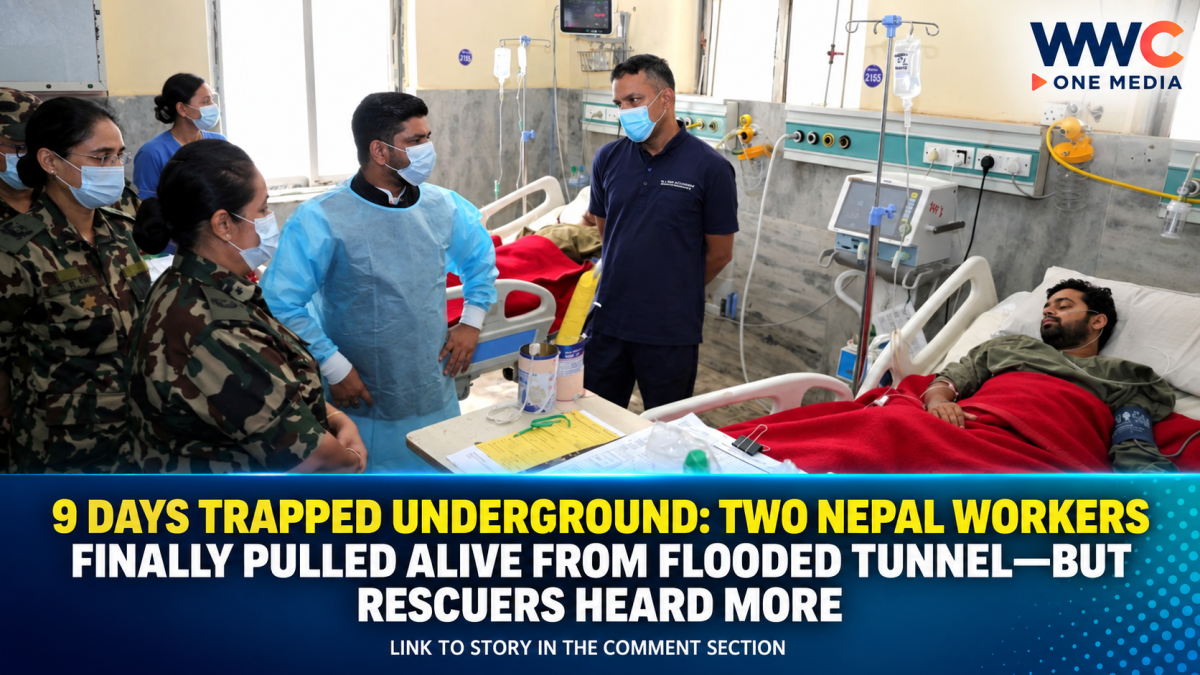
KATHMANDU, Nepal — A dramatic rescue operation in Nepal has delivered a rare breakthrough after two hydropower workers were pulled alive from a mud-filled tunnel nine days after devastating floods and landslides swept through the region.
The two men, identified as Sanjay Sah, a mechanical foreman, and Kabir Maharjan, a mechanical supervisor, were rescued Friday from the underground facilities of the Upper Trishuli 3A Hydropower Project in Nepal’s Rasuwa district.
Their rescue immediately raised hopes that other workers could still be alive inside the network of tunnels buried beneath the disaster zone.
Voices From the Darkness Led Rescuers to the Two Men
Rescue teams had been working through thick mud, debris and damaged infrastructure when they reportedly heard voices coming from inside the tunnel.
That breakthrough helped rescuers locate the trapped workers, who were eventually brought out from roughly 170 meters underground, according to Nepalese officials cited by The Guardian and other international outlets.
Images released by the Nepal Army showed rescuers carrying one survivor from the tunnel while another was taken out on a rescuer’s back, his face covered in mud.
The scenes prompted cheers among people gathered at the site as the long-shot rescue became a reality.
Both survivors were taken for medical treatment in Kathmandu. Reports said their vital signs were stable, although Maharjan was suffering serious physical problems and was reportedly unable to move his hands and legs. Sah’s injuries were described as non-critical by an aide to Nepal’s energy minister.
One Survivor Says Others May Still Be Alive
The rescue became even more significant after Sah indicated that other people could potentially still be trapped inside the underground complex.
According to reports, Sah had been working in a control room when the disaster struck. He said he warned colleagues about the danger and helped others escape but was unable to get out himself.
While trapped underground, he reportedly spent time reciting a mantra as he waited for rescuers to reach him.
That account has fueled renewed efforts to search the tunnels for additional survivors.
The Guardian reported that authorities had believed around 30 to 40 people could still have been alive inside the Trishuli 3A tunnel, although the exact number remains uncertain.
Nepal’s Hydropower Tunnels Became Death Traps
The rescue operation is taking place against the backdrop of one of Nepal’s most devastating recent natural disasters.
On August 26, a massive surge of water, ice, rocks and mud tore through valleys along the Trishuli and Bhote Koshi river systems after what authorities and international reports described as a likely glacial collapse.
The disaster destroyed homes, roads, bridges and critical infrastructure while severely damaging hydropower facilities.
Nepal’s Ministry of Foreign Affairs said search-and-rescue operations were continuing across affected hydropower projects, including Langtang, Chilime, Upper Trishuli 1, Upper Trishuli 3A and Upper Trishuli 3B. Rescue teams from Nepal, India, China and South Korea have been involved in the operation.
Authorities believe hundreds of hydropower workers may have been trapped underground.
Reuters reported that about 900 workers from 12 hydropower projects remained missing, with roughly 500 believed to be trapped in tunnels.
Disaster Toll Continues to Rise
Nepal’s Ministry of Foreign Affairs reported on September 4 that 1,287 bodies had been recovered and about 5,083 people remained missing.
The government also said more than 13,000 people had been rescued, including more than 300 foreign nationals. The figures remain subject to verification and updates as search operations continue.
The disaster has also affected China’s Tibet region.
International reports citing Chinese authorities said dozens were killed and hundreds remained missing on the Tibetan side of the border, bringing the overall regional impact even higher.
Billions of Dollars in Damage
Beyond the human toll, the floods have inflicted enormous damage on Nepal’s infrastructure.
Nepal’s National Disaster Risk Reduction and Management Authority estimated losses to property, housing and infrastructure at approximately 387.5 billion Nepalese rupees, or about $2.6 billion.
The government said thousands of homes were destroyed or damaged and that extensive work would be needed to restore roads, bridges, electricity and communications.
The hydropower industry has been particularly affected because several projects sit along river valleys vulnerable to sudden flooding, landslides and glacial hazards.
Search Operation Enters a Critical Phase
The successful rescue of Sah and Maharjan has given emergency crews a crucial boost, but the operation remains a race against time.
Rescuers are using heavy machinery, drones, specialized equipment and assistance from international experts to locate possible survivors and clear access routes.
Nepal’s government said teams from India, China and South Korea were assisting with tunnel searches, while other international partners were contributing equipment and technical support.
The United Nations and humanitarian partners have also launched a $49.6 million emergency appeal to assist people affected by the disaster, according to Reuters.
For families still waiting for missing relatives, however, the most important development came from deep beneath the earth.
After nine days of darkness, two men walked—or were carried—back into the light alive.
And now, rescuers are listening carefully for what may come next.
Because somewhere beneath the mud and shattered concrete, there may still be voices waiting to be heard.
WWC ONE MEDIA J.M.S




Leave a Reply