
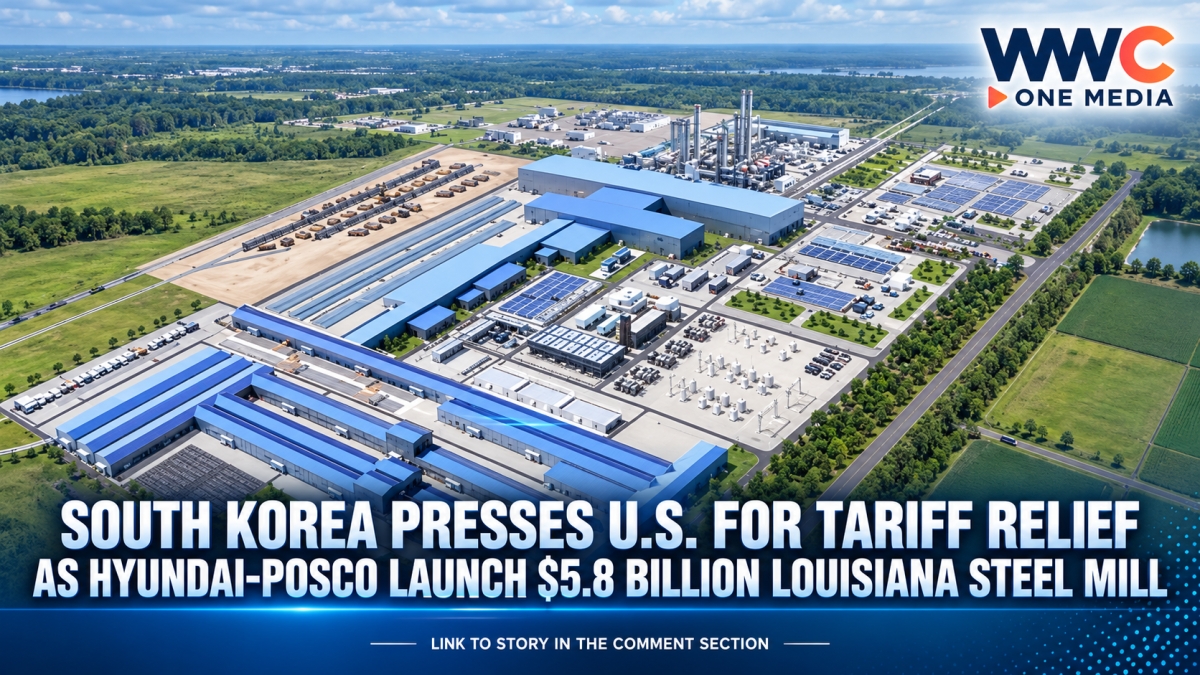
South Korea is pushing Washington for additional tariff relief just as Hyundai Steel and POSCO move ahead with one of the biggest Korean industrial investments ever undertaken in the United States — a $5.8 billion next-generation steel mill in Louisiana.
Industry Minister Kim Jung-kwan raised the issue with Louisiana Gov. Jeff Landry ahead of the ceremonial launch of the Hyundai-POSCO Louisiana Steel project in Ascension Parish, asking U.S. authorities to ease tariff burdens on specialized equipment and materials that Korean companies say are difficult to source locally.
The request exposes an unusual tension at the heart of America’s manufacturing push: Korean companies are spending billions to produce more goods inside the United States, but they may first have to import some of the machinery needed to build the factories — potentially subjecting those imports to the very trade barriers designed to encourage domestic production.
A $5.8 Billion Bet on American Steel
The Louisiana facility will be operated by Hyundai-POSCO Louisiana Steel LLC, a joint venture involving Hyundai Steel, Hyundai Motor, Kia and POSCO.
Hyundai Steel holds a 50% interest, Hyundai Motor and Kia each own 15%, while POSCO owns the remaining 20%, according to Korean reporting on the project.
Commercial production is targeted for 2029, with annual capacity expected to reach approximately 2.7 million metric tons of hot- and cold-rolled steel, much of it destined for automotive applications. Hyundai says the facility will supply steel not only to Hyundai Motor and Kia operations but potentially to other automakers across North America.
The project is also expected to create about 1,300 direct jobs and roughly 4,100 indirect jobs, giving it a potential regional employment impact of around 5,400 positions. Louisiana Economic Development says the mill will occupy roughly 1,700 acres in the RiverPlex MegaPark near Donaldsonville.
For Hyundai Motor Group, the steel mill represents something larger than another overseas factory.
It is designed to bring a critical part of the automotive supply chain closer to the group’s U.S. assembly operations, reducing dependence on imported steel while giving Hyundai greater control over costs, logistics and supply disruptions.
The plant forms part of Hyundai Motor Group’s expanded $26 billion U.S. investment commitment, covering manufacturing and other strategic technologies.
But Tariffs Create a Catch
The problem is that building an advanced steel mill requires highly specialized industrial machinery — and not every piece of equipment can be readily purchased from a U.S. supplier.
That is why Seoul is asking Washington to distinguish between imports that compete with American manufacturers and specialized machinery that is necessary to create new American manufacturing capacity.
U.S. Section 232 tariffs covering steel, aluminum and derivative products have been repeatedly expanded and revised. Washington modified the system again in 2026, introducing different rates for categories including industrial machinery and certain products from trading partners such as South Korea. The result is a complex system in which some qualifying industrial imports receive reduced treatment, while others may still face substantial additional duties.
For Korean manufacturers, even a seemingly modest tariff can become expensive when applied to hundreds of millions of dollars worth of industrial equipment.
That could make the Louisiana project an important test case: Will Washington provide tariff flexibility to foreign companies that are importing machinery specifically to build factories and create jobs inside the United States?
The Mill Is Also Part of America’s Low-Carbon Steel Experiment
Hyundai is positioning the Louisiana operation as an advanced alternative to conventional blast-furnace steelmaking.
The project will rely on an electric-arc-furnace-based production system combined with direct-reduction technology. Louisiana officials and Hyundai say the process could produce steel with roughly 70% lower carbon emissions than traditional blast-furnace production.
But the environmental picture is more complicated.
Independent reporting by Canary Media notes that the facility is initially expected to rely on natural gas for its direct-reduced-iron process rather than fully replacing fossil fuels with green hydrogen. Environmental groups have therefore argued that while the project may emit significantly less carbon than traditional coal-based steelmaking, it should not be portrayed as emissions-free or completely “green.”
The project’s environmental permitting process has also attracted local scrutiny. Louisiana regulators recently extended the public-comment process surrounding proposed air permits, while residents and environmental advocates have raised questions about potential emissions and their impact on surrounding communities.
That means the groundbreaking ceremony represents a major milestone — but not the end of the regulatory process.
Why This Matters Beyond Hyundai
The Louisiana project illustrates how dramatically global trade policy is changing corporate investment decisions.
For years, automakers built international supply chains around cost efficiency: steel could be produced in one country, processed in another and assembled into vehicles somewhere else.
Tariffs, geopolitical tensions and supply-chain disruptions are pushing companies toward a different model — producing more critical components inside the markets where finished products are sold.
Hyundai’s answer is essentially to bring the steel mill closer to the car factory.
If successful, the Louisiana operation could give Hyundai Motor Group a more vertically integrated American manufacturing network — stretching from steel production to automobile assembly.
But Seoul’s tariff request highlights the contradiction policymakers now have to solve.
The United States wants foreign companies to invest, manufacture and hire American workers. Yet those companies may still depend on specialized equipment from their home countries before those American factories can operate.
For Hyundai, POSCO and South Korea, the argument is simple: tariff relief on machinery isn’t about avoiding American manufacturing.
It’s about getting the American manufacturing started.
WWC ONE MEDIA M.J.E




Leave a Reply