
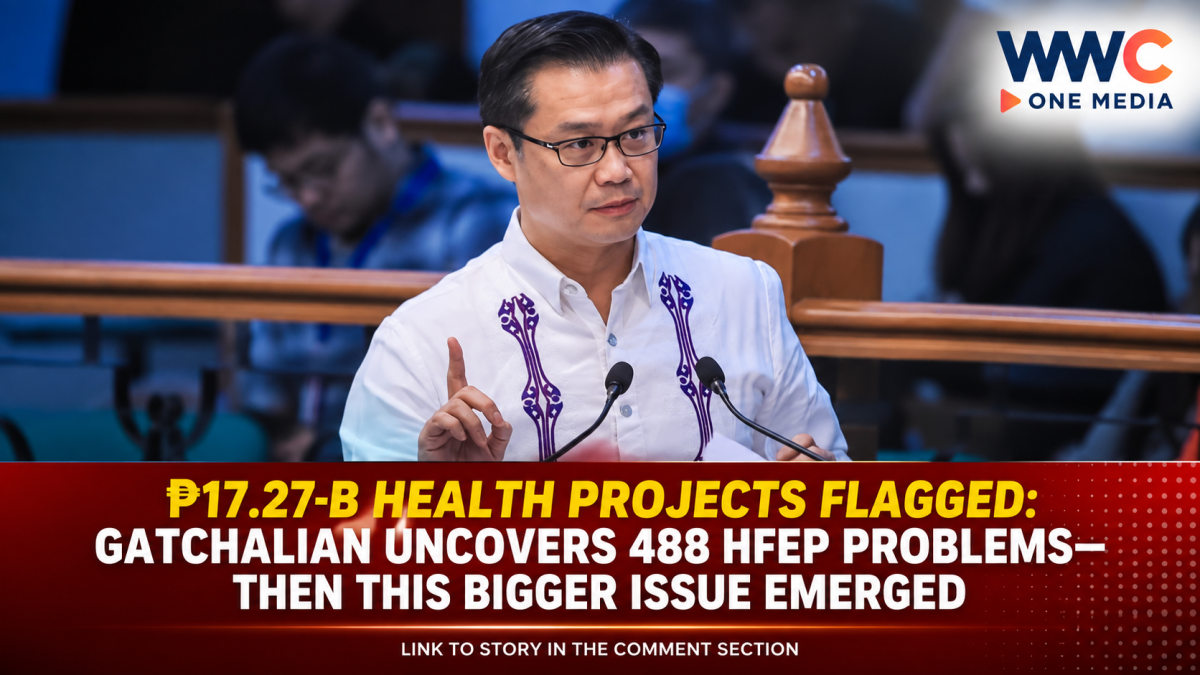
MANILA, Philippines — Hundreds of government-funded health infrastructure projects have been flagged for implementation problems, raising fresh questions over how billions of pesos intended to improve public healthcare facilities are being used.
Senate President Sherwin Gatchalian raised the alarm over 488 infrastructure implementation deficiencies under the Department of Health’s (DOH) Health Facilities Enhancement Program (HFEP) during the agency’s 2027 budget briefing at the Senate on Friday.
According to figures presented by Gatchalian, the problems include delayed projects, facilities that remain idle or non-operational, underutilized funds, and projects that have yet to begin.
Gatchalian said 38 projects worth ₱11 billion were delayed in implementation, while 136 projects worth ₱1.1 billion were classified as idle, unutilized or non-operational.
He also cited ₱1.1 billion in underutilized funds and 227 projects worth ₱3.1 billion that had not been implemented or had yet to start.
The figures were documented before newly appointed Health Secretary Edwin Mercado assumed office, Gatchalian noted.
Billions more set for health infrastructure
The Senate President questioned how the DOH intends to address the implementation deficiencies, particularly as government has already allocated ₱17.27 billion for the affected projects and is preparing another ₱14.5 billion allocation under the proposed 2027 national budget.
The issue comes as the government continues to pour substantial resources into HFEP, a program designed to improve public healthcare infrastructure, including primary care facilities, hospitals, equipment and other health-related investments.
The Department of Budget and Management’s 2026 General Appropriations Act, for instance, includes a dedicated HFEP allocation covering infrastructure, medical equipment and other investments in public health facilities.
DOH promises a different approach
Mercado said the DOH is looking to improve what he called allocative efficiency—essentially making sure that health facilities and equipment are built where they are actually needed and can be properly operated.
He said the agency plans to establish clearer standards for different levels of healthcare facilities, from rural health units to Super Health Centers and district hospitals.
Mercado also questioned whether it makes sense for facilities located near one another to each seek expensive equipment such as MRI and CT scan machines when such an arrangement may not be economically efficient.
For existing infrastructure, Mercado said the immediate priority should be facilities that have already been constructed but remain non-operational, including those that may only need equipment, additional construction or personnel before they can begin serving patients.
The DOH also intends to check whether proposed project sites meet the requirements of the healthcare facilities being requested.
Super Health Centers become another flashpoint
One of the most striking issues raised during the hearing involved Super Health Centers (SHCs).
Gatchalian said only 244 of 820 planned Super Health Centers had been completed and were operational.
He estimated that about ₱2.9 billion worth of completed facilities remained non-operational, while approximately ₱3.9 billion worth of projects were either incomplete or had no clear status update.
The concern is not entirely new.
During congressional budget deliberations in September 2025, the DOH reported that only 200 of 600 health centers under HFEP were functioning at the time, largely because some local governments had been unable to hire doctors and other healthcare personnel.
Officials emphasized then that the facilities should not automatically be considered “ghost projects” because many physically existed but could not operate without the required workforce.
Congressional insertions also questioned
The Senate discussion also turned to the possibility that some projects were added to the budget after the DOH had finalized its original spending program.
Senator Panfilo Lacson argued that congressional insertions could contribute to delays and underutilization because projects added during the budget process may not have been part of the DOH’s original National Expenditure Program (NEP) plans.
Mercado acknowledged that this was partly a factor.
Gatchalian likewise pointed to cases where Super Health Centers were constructed even though the concerned local governments allegedly lacked the willingness or capacity to operate them.
Among the issues cited were the inability to pay operating costs, hire nurses and obtain medicines.
Mercado said he had encountered governors who were surprised to discover health facilities being constructed in their jurisdictions despite the projects not being included in their Provincial Health Investment Plans.
Audit findings show the problem goes beyond one hearing
The latest Senate discussion comes against the backdrop of previous audit findings involving HFEP implementation.
A 2025 report by The Philippine Star, citing the Commission on Audit, said ₱14.52 billion worth of HFEP infrastructure projects for 2024 had been flagged as delayed, idle or unimplemented.
The report said COA attributed the problems to weaknesses in planning, coordination, procurement and implementation. Among the issues cited were delays in securing permits, changes in engineering and architectural plans, poor coordination, inadequate monitoring and supervision, lack of personnel and equipment, and procurement-related problems.
The DOH has also previously faced scrutiny over medical equipment purchased under HFEP.
In January 2026, the Philippine News Agency reported that COA had flagged ₱405.545 million worth of medical equipment that remained idle, unused, undelivered or uninstalled based on 2024 data.
Then-Health Secretary Teodoro Herbosa described the figures as old audit data, saying implementation could have progressed during 2025. He also explained that delays can arise when facilities being built by different implementing entities are not yet ready to receive equipment.
Studies point to long-standing HFEP weaknesses
Independent research has also identified structural challenges within the program.
A 2025 Philippine Institute for Development Studies (PIDS) study described HFEP as a major capital investment program that helps local governments improve primary healthcare facilities, hospitals and medical equipment.
The study found persistent problems involving the distribution of grants, planning, execution and monitoring. It specifically identified cases in which national funding went to local governments that were not necessarily among those with the greatest healthcare needs.
A separate public expenditure review by the Congressional Policy and Budget Research Department likewise identified project execution delays, procurement inefficiencies and budget-utilization problems as continuing challenges.
The review recommended stronger monitoring and evaluation, a more updated HFEP database, better targeting of areas with greater health infrastructure gaps, and complementing construction investments with workforce and service support.
The bigger question: Can completed facilities actually serve patients?
The controversy surrounding HFEP is therefore not simply about whether government buildings are constructed.
The more fundamental issue is whether those facilities can actually open their doors and provide healthcare services.
A health center without doctors, nurses, medicines, equipment, electricity or a local government willing and able to assume operating responsibilities can remain effectively unavailable to the community it was supposed to serve.
That is precisely why Mercado’s proposed shift toward better planning and allocative efficiency could become significant.
The government already has a substantial pipeline of health infrastructure projects. But the Senate hearing suggests that the next challenge may be ensuring that every peso allocated translates into a functioning facility rather than another completed structure waiting for personnel, equipment, permits, funding or an operating partner.
For Gatchalian, the immediate question is how the DOH will resolve the 488 flagged deficiencies while preparing to receive billions more in HFEP funding.
And with another ₱14.5 billion being eyed for the program under the 2027 budget, the pressure on the health department is no longer simply to build more.
It is to make sure what has already been funded actually works.
WWC ONE MEDIA J.M.S




Leave a Reply