
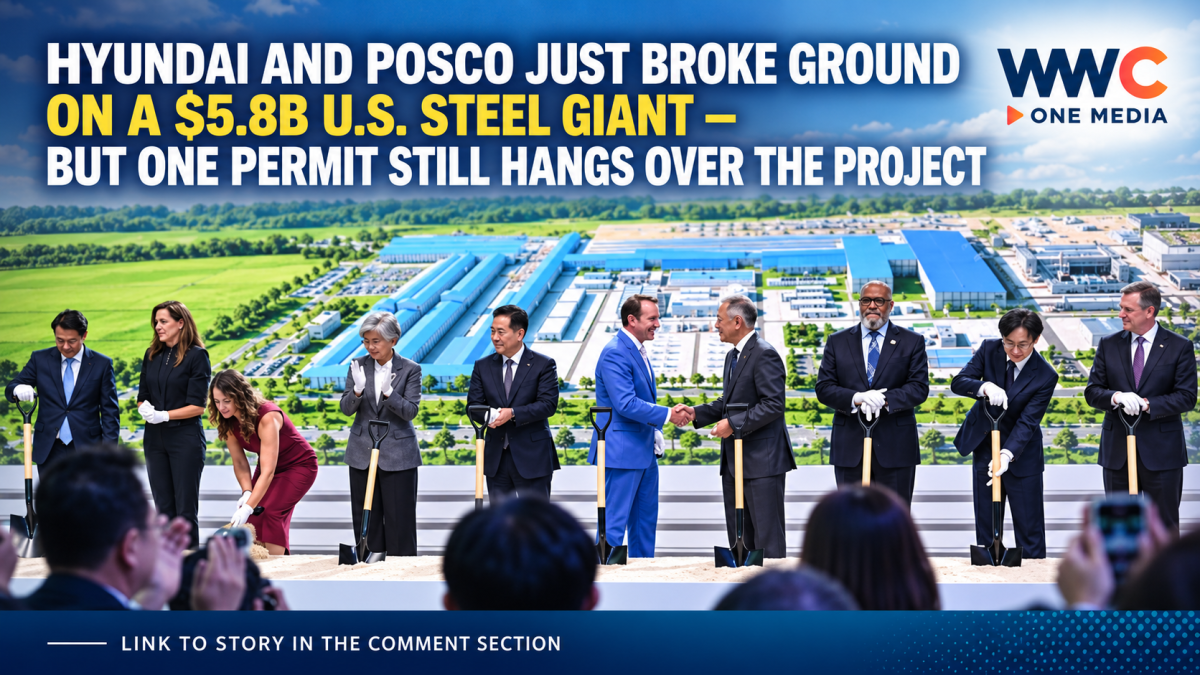
Hyundai Steel has officially broken ground on a $5.8 billion steel mill in Ascension Parish, Louisiana, joining forces with rival POSCO as well as Hyundai Motor and Kia to create what could become a critical new link in Hyundai Motor Group’s North American automotive supply chain.
The ceremonial groundbreaking took place on September 4, more than a year after Hyundai Motor Group first unveiled the project at the White House in March 2025. Commercial production is targeted for 2029.
But the project is about considerably more than building another steel factory.
It represents Hyundai’s push to bring more of the materials used in its American-made vehicles inside the United States at a time when tariffs, supply-chain security and increasingly protectionist trade policies are forcing global manufacturers to rethink where they produce everything from steel to automobiles.
A 2.7-Million-Ton Steel Powerhouse
The new company, Hyundai-POSCO Louisiana Steel, is expected to produce about 2.7 million metric tons of steel annually once operations begin.
Around 1.8 million tons of that capacity is expected to be automotive steel, while approximately 900,000 tons will serve other applications. The plant will supply Hyundai Motor Group’s expanding U.S. manufacturing network, including vehicle factories in Alabama and Georgia.
The ownership structure also reveals how strategically important the project has become.
Hyundai Steel will control 50% of the joint venture, POSCO will hold 20%, while Hyundai Motor and Kia will each own 15%. Hyundai Steel will lead construction, production and sales, while POSCO will contribute steelmaking expertise and strengthen its own position in the North American market.
That partnership is notable because Hyundai Steel and POSCO are fierce competitors at home in South Korea.
Overseas, however, they increasingly have a common problem: navigating a global steel market being reshaped by tariffs, oversupply and industrial policies designed to encourage domestic manufacturing.
Trump’s Steel Tariffs Changed the Equation
The Louisiana project was originally announced while Hyundai was already trying to localize more of its U.S. supply chain.
Then the trade environment became even tougher.
In June 2025, the United States increased tariffs on imported steel and aluminum to 50%, putting additional pressure on foreign producers, including Korean steelmakers. Reuters reported at the time that South Korea was the fourth-largest steel exporter to the U.S. and that both POSCO and Hyundai Steel were being hit by the tougher trade environment.
Reuters also described Hyundai’s planned Louisiana factory as part of the company’s response to U.S. tariffs.
Producing steel directly inside the United States therefore gives Hyundai a major strategic advantage: the company can reduce its reliance on imported automotive steel while creating a more tightly integrated domestic production chain linking steelmaking, components and vehicle assembly.
That doesn’t eliminate every trade risk. Korean Industry Minister Kim Jung-kwan used the groundbreaking ceremony to urge Washington to ease tariffs on equipment and materials that cannot readily be sourced in the United States, highlighting how even a heavily localized project remains exposed to global supply chains.
Hyundai’s $26 Billion American Expansion
The steel plant is also just one part of a much larger U.S. investment campaign.
Hyundai Motor Group says it plans to invest $26 billion in the United States between 2025 and 2028, covering steel, automotive manufacturing, robotics and other advanced industries.
That commitment represents an increase from the $21 billion investment plan announced in March 2025. Hyundai has said the broader program could create about 25,000 direct jobs.
Hyundai is also aiming to dramatically increase the share of vehicles it sells in America that are actually assembled there. By 2030, the automaker is targeting nearly 80% U.S. assembly for vehicles sold in the country, while also pushing U.S.-sourced supply-chain content toward roughly the same level.
The Louisiana steel mill fits directly into that strategy.
Instead of importing much of the steel required for Hyundai and Kia vehicles, the group would increasingly be able to produce the material close to its American factories.
Hyundai Says the Mill Could Cut Carbon Emissions by 70%
Another major feature of the Louisiana project is its use of electric-arc furnace, or EAF, technology.
Traditional blast furnaces rely heavily on iron ore and coal. Electric-arc furnaces instead use electricity to melt steel and can incorporate large amounts of recycled scrap.
Hyundai says its Louisiana production process could generate approximately 70% fewer carbon emissions than conventional blast-furnace steelmaking. That figure is a company estimate rather than an independently verified measurement of the future plant’s actual operating emissions.
Hyundai has described the facility as the first U.S. integrated steel mill specializing in automotive sheet production using electric-arc furnace technology.
If successful, the plant could give Hyundai and POSCO something increasingly valuable to automakers: a large domestic supply of lower-carbon automotive steel.
Thousands of Jobs — But Local Residents Want Answers
The economic numbers are significant.
The project is expected to create roughly 1,300 direct jobs and about 4,100 indirect jobs, according to company and Louisiana economic-development estimates. That could mean around 5,400 jobs connected directly or indirectly to the investment.
Yet the groundbreaking has not eliminated controversy surrounding the project.
Just days before the ceremony, hundreds of residents and community organizations attended a Louisiana Department of Environmental Quality hearing concerning the plant’s air permit.
Some residents raised concerns about emissions, traffic, local hiring and the cumulative environmental burden on communities around Donaldsonville and nearby areas. Hyundai representatives told the hearing that EAF technology would substantially reduce emissions compared with conventional steel production and said the company was working with colleges, schools and workforce organizations to prepare local residents for jobs.
Importantly, the ceremonial groundbreaking does not mean every regulatory hurdle has been cleared.
Local reporting said the project’s air-permit process was still underway, with the public-comment period scheduled to remain open until September 15, 2026, after which Louisiana regulators would consider the permit.
That makes permitting one of the key issues to watch as the project moves from ceremony to actual construction.
Why This Mill Matters Far Beyond Louisiana
The bigger story is what Hyundai is attempting to build around the factory.
Steel production in Louisiana, vehicle assembly in Alabama and Georgia, expanded U.S. parts sourcing, logistics infrastructure and future investments in robotics could eventually create a far more vertically integrated Hyundai manufacturing ecosystem inside America.
For Hyundai, that could mean greater control over costs, shorter supply chains and less exposure to imported-steel tariffs.
For POSCO, the joint venture creates a valuable manufacturing and sales foothold in a North American market where protectionist barriers have made exporting increasingly difficult. POSCO itself has said its investment strategy is designed partly to strengthen its presence in markets affected by trade barriers.
And for the United States, the project represents exactly the kind of foreign investment Washington’s industrial policies have increasingly sought to attract: large factories, domestic supply chains and thousands of manufacturing jobs.
The groundbreaking, however, is only the opening chapter.
Hyundai and POSCO still have to navigate permitting, construction costs, environmental scrutiny, workforce recruitment and a rapidly changing trade environment before the first commercial steel is expected to roll out in 2029.
If they succeed, the Louisiana plant may prove to be much more than a $5.8 billion steel mill.
It could become the foundation of Hyundai’s next-generation American manufacturing empire.
WWC ONE MEDIA M.J.E




Leave a Reply