
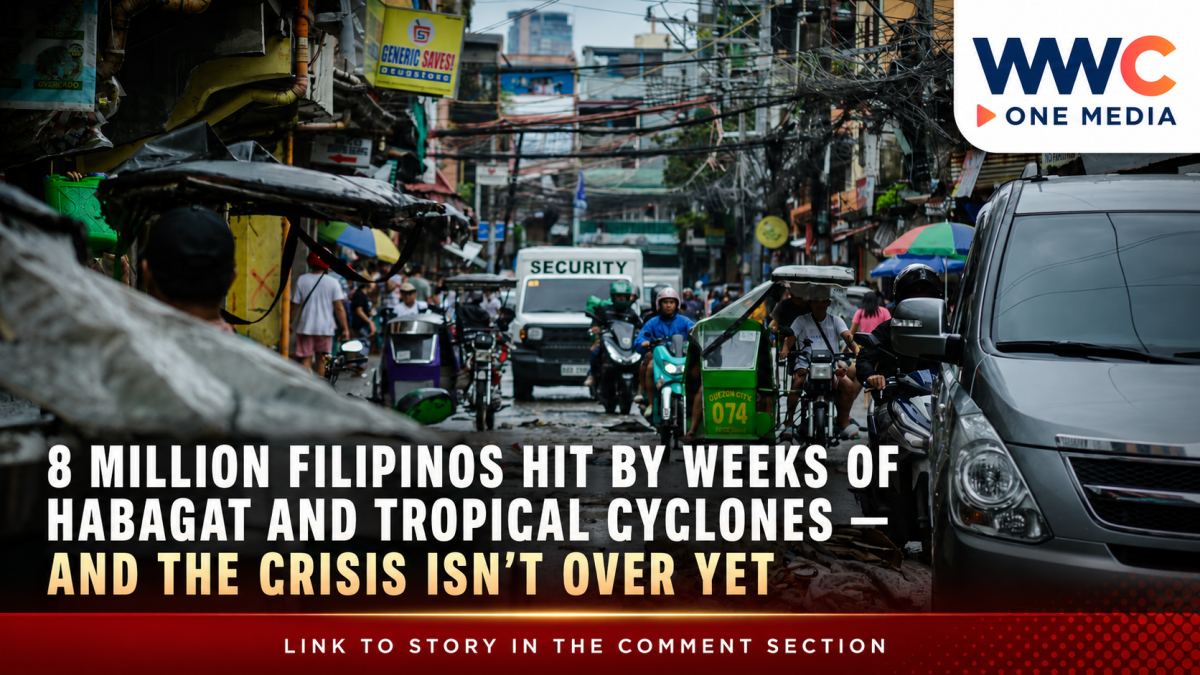
MANILA, Philippines — The number of Filipinos affected by weeks of relentless southwest monsoon rains and successive tropical cyclones has now crossed 8 million, underscoring the extraordinary scale of a weather crisis that continues to flood communities, damage infrastructure and threaten more parts of Luzon.
The National Disaster Risk Reduction and Management Council reported the new milestone on Saturday, August 29, according to ABS-CBN News. The latest figure represents another significant increase from approximately 7.5 million affected people on August 23 and 7.7 million by August 27.
What makes the figure more alarming is that the emergency is far from finished.
From 7.5 Million to More Than 8 Million in Less Than a Week
The crisis has been driven by the combined effects of the southwest monsoon, locally known as Habagat, and Tropical Cyclones Luis, Maymay and Neneng, which repeatedly soaked already saturated communities across Luzon and parts of the Visayas.
On August 23, NDRRMC data showed about 7.5 million individuals from roughly 2.1 million families had already been affected across 10 regions. At that point, authorities had recorded 29 reported deaths, 19 injuries and three missing people.
By August 25, the Office of Civil Defense said the affected population had climbed past 7.6 million, while 102 areas were under a state of calamity.
Two days later, the government’s detailed disaster count reached approximately 7.7 million people, or 2.2 million families, according to NDRRMC figures reported by The Philippine Star.
Saturday’s update putting the total above 8 million therefore marks another escalation in a disaster that has unfolded not in a single catastrophic landfall, but through repeated rains, flooding and landslides over several weeks.
Billions of Pesos in Damage
The human impact is only part of the story.
As of the detailed August 27 NDRRMC assessment, infrastructure losses had climbed to approximately ₱5.95 billion, while agricultural damage was estimated at another ₱1.91 billion.
More than 2,800 houses had also been damaged, including roughly 340 that were completely destroyed.
That puts documented infrastructure and agricultural losses alone at nearly ₱7.9 billion, even before accounting for many indirect economic costs such as interrupted businesses, transportation disruption, lost working days and continuing rehabilitation requirements.
The agricultural sector has been especially vulnerable. Earlier Department of Agriculture data showed tens of thousands of farmers and fisherfolk affected, with rice, corn, high-value crops, livestock, poultry and fisheries among the sectors suffering losses.
Deaths, Evacuations and States of Calamity
As of August 27, authorities had recorded 31 reported deaths, 19 injured people and three missing persons linked to the successive weather disturbances.
Fatalities were reported in areas including Benguet, Rizal, Batangas, Metro Manila, La Union and parts of Mindoro and Negros Occidental. Some casualty reports have been subject to government validation as disaster assessments continue.
Around 28,000 displaced people from approximately 8,200 families were staying in evacuation centers at the time, while 104 localities had been placed under a state of calamity.
That list could continue changing as flooding persists. On Saturday, the Pangasinan towns of Infanta and Lingayen were reported to have declared states of calamity following prolonged monsoon rains and flooding.
And the Rain Is Still Falling
Perhaps the most troubling part of Saturday’s 8-million milestone is that it came while dangerous weather was still affecting the country.
PAGASA warned Saturday that the southwest monsoon would continue bringing heavy rains across large sections of Luzon, with some areas facing the possibility of 100 to 200 millimeters of rainfall.
By late Saturday morning, Metro Manila, Zambales, Bataan, Pampanga, Bulacan and portions of Tarlac and Batangas were under a red rainfall warning, meaning serious flooding was expected in vulnerable locations.
Flooding was already affecting several Metro Manila roads Saturday afternoon, while the capital remained under the red rainfall warning.
PAGASA’s weekend outlook also indicated that enhanced Habagat conditions could continue affecting parts of the country through Monday and Tuesday, particularly western and northern sections of Luzon.
DSWD Goes on Red Alert
The continuing threat prompted the Department of Social Welfare and Development to shift to red alert, following an NDRRMC directive raising the country’s disaster-response alert status from blue to red effective 5 p.m. Friday, August 28.
DSWD said its field offices and relief resources were being placed on heightened readiness because prolonged rains and flooding could continue affecting Luzon and parts of the Visayas.
The move is significant because many affected communities have already endured repeated flooding and evacuations, meaning even additional rainfall that would normally be manageable can become more dangerous when soils are saturated, waterways remain swollen and drainage systems are overwhelmed.
A Disaster Measured in Weeks, Not Hours
The scale of the current emergency illustrates why the impact of Habagat cannot be measured only by whether a powerful typhoon directly crosses the Philippines.
Tropical cyclones hundreds of kilometers away can strengthen the southwest monsoon, pulling moisture toward the country and producing prolonged rainfall far from the cyclone’s actual center.
That pattern has repeatedly affected the Philippines throughout August.
PAGASA officially announced the start of the 2026 southwest monsoon season on May 30, warning that Habagat would bring occasional to frequent rains and thunderstorms, particularly over western sections of the country.
Months later, those seasonal rains—amplified repeatedly by tropical systems—have become one of the country’s biggest disaster stories of the year.
And with more than 8 million Filipinos now counted as affected while heavy rain continues to fall, the biggest question may no longer be how many people have already been hit.
It is how much higher the toll could climb before the weather finally gives battered communities enough time to recover.



Leave a Reply