
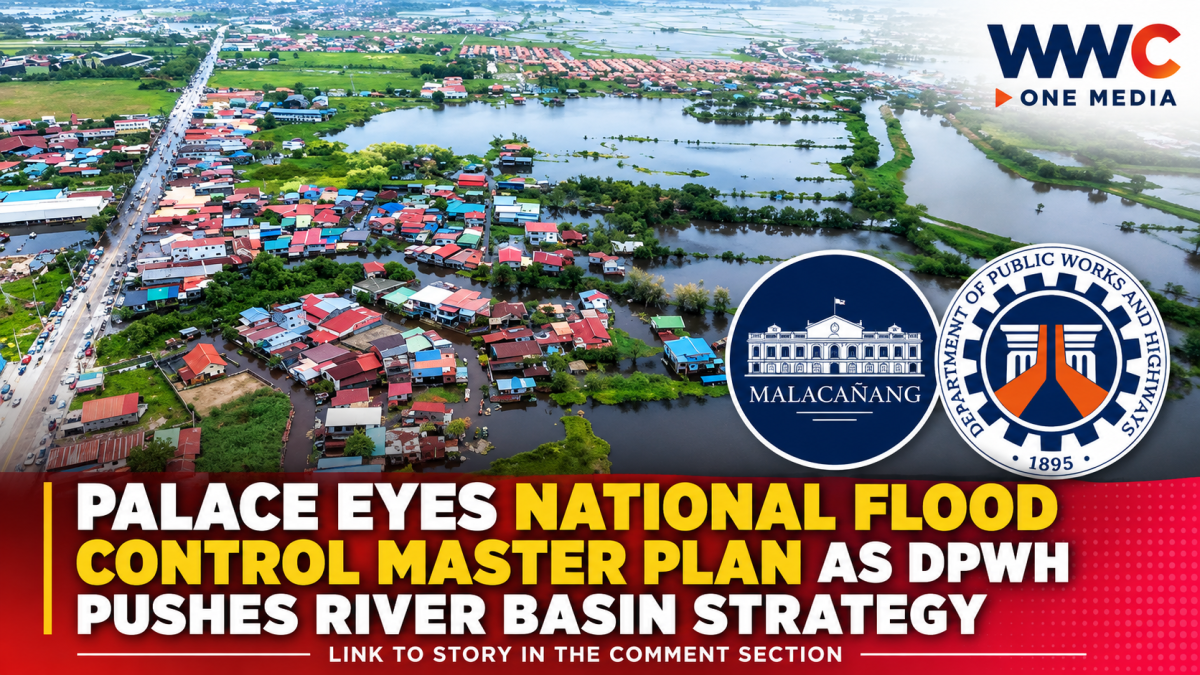
MANILA, Philippines — Malacañang is leaving the door open to a nationwide flood-control master plan as the Philippines confronts another season of widespread flooding, but the Marcos administration says the final strategy may still depend heavily on separate plans tailored to the country’s major river basins and urban centers.
The debate gained urgency after Public Works and Highways Secretary Vince Dizon acknowledged during the House Committee on Appropriations’ deliberations on the Department of Public Works and Highways’ proposed 2027 budget that the Philippines currently has no single consolidated national master plan covering flood control and drainage.
Instead, Dizon said the DPWH has traditionally relied on plans developed for individual major river basins and urban centers—an approach he said was recommended by foreign development partners because flooding conditions differ dramatically across the archipelago. Several of those plans, however, are either unfinished or need updating to account for changing conditions, including the growing risks associated with extreme rainfall and climate change.
Palace: National Plan Still on the Table
Palace Press Officer Claire Castro said the administration is not rejecting the idea of a national flood-control framework.
According to Malacañang, government planners must first determine whether one nationwide blueprint, multiple river-basin plans, or a combination of both would provide the most effective protection for communities repeatedly hit by flooding.
The Palace said the DPWH is currently pursuing a holistic river-basin approach, taking into account differences in geography, waterways, drainage systems and flood behavior from one area of the country to another.
That means a flood-control solution that works in Metro Manila may not necessarily work in Central Luzon, Cebu, Davao or communities near major river systems and coastal zones.
The 2012 Master Plan — And an Important Distinction
Questions about the lack of a national strategy have revived discussion of a major flood-management blueprint developed during the administration of former President Benigno Aquino III.
But the scope of that document is important.
The 2012 Flood Management Master Plan was designed for Metro Manila and surrounding areas, not for the entire Philippines. The World Bank said the plan was approved by the NEDA Board in 2012 and proposed measures including improvements to urban drainage and pumping stations, river-management projects, flood forecasting, stronger early-warning systems and measures addressing flooding around Laguna de Bay and the Marikina River system.
Administrative Order No. 32, signed by Aquino on October 1, 2012, also directed the DPWH to accelerate the preparation and implementation of a flood-management master plan.
More than a decade later, however, major parts of the country’s flood-control system remain the subject of debate over implementation, coordination, funding and effectiveness.
DPWH Shifts Toward Localized, Coordinated Solutions
Dizon has signaled that the DPWH wants projects to be based more closely on conditions on the ground and coordinated with local governments instead of relying on isolated infrastructure projects.
In Metro Manila, the department has cited recent work in Navotas—including the restoration of six previously non-operational pumping stations, repairs to dikes and improvements to a navigational gate—as an example of interventions it may replicate in other flood-prone communities.
The government is also examining flood-retarding basins and improved drainage coordination in Quezon City, while President Ferdinand Marcos Jr. has ordered the DPWH to work with the city government to align its flood-control planning with existing projects.
Outside Metro Manila, the DPWH has also moved toward reviving or funding localized master plans. In Davao City, for example, Dizon said the government intends to seek funding in 2027 for a flood-control master plan developed with assistance from the Japan International Cooperation Agency.
Billions More for Flood Management
The policy debate comes as the DPWH seeks a proposed ₱643.95-billion budget for 2027.
BusinessMirror reported that about ₱83.84 billion of the proposal is earmarked for locally funded flood-management projects, while around ₱19 billion is allocated for ongoing foreign-assisted flood-control projects.
The return of major flood-control funding is particularly sensitive after allegations involving ghost, substandard and ineffective projects prompted investigations and tighter scrutiny of public-works spending.
Malacañang said the Office of the Ombudsman and Department of Justice continue to investigate alleged irregularities involving flood-control projects, while the DPWH has been told to refer questionable projects for further investigation.
Dizon has also said projects proposed for funding will face stricter requirements, including master plans, engineered designs, feasibility studies and endorsements from local and regional development councils.
Flood Crisis Raises the Stakes
The discussion is unfolding as millions of Filipinos deal with the consequences of severe weather.
As of August 29, the National Disaster Risk Reduction and Management Council reported that roughly eight million people had been affected by the combined effects of the enhanced southwest monsoon and recent tropical cyclones.
That scale has intensified pressure on government agencies to move beyond individual flood-control structures and develop a system in which rivers, drainage networks, pumping stations, retention facilities, dams, coastal defenses and local government plans work together.
Sen. Panfilo Lacson has also questioned the effectiveness of past spending, citing approximately ₱1.939 trillion in DPWH flood-control expenditures from 2011 to 2025 while recurring flooding remained a national problem. The figure was raised as part of his call for clearer planning and accountability over future projects.
The Bigger Question
The issue is therefore no longer simply whether the Philippines should have a document called a “national flood-control master plan.”
The bigger challenge is whether national standards, river-basin engineering, local drainage systems and multibillion-peso infrastructure investments can finally be connected into one coherent strategy—and whether projects approved under that strategy can withstand both extreme weather and public scrutiny.
For Malacañang, the national option remains open.
For the DPWH, however, the immediate direction is increasingly clear: plan around the country’s major river systems, coordinate with local governments and require engineering-backed projects before taxpayers’ money is released.
With millions of Filipinos once again affected by floods, the success or failure of that approach will ultimately be measured not by the number of plans produced—but by whether communities stay above water when the next extreme rainfall arrives.

Leave a Reply