
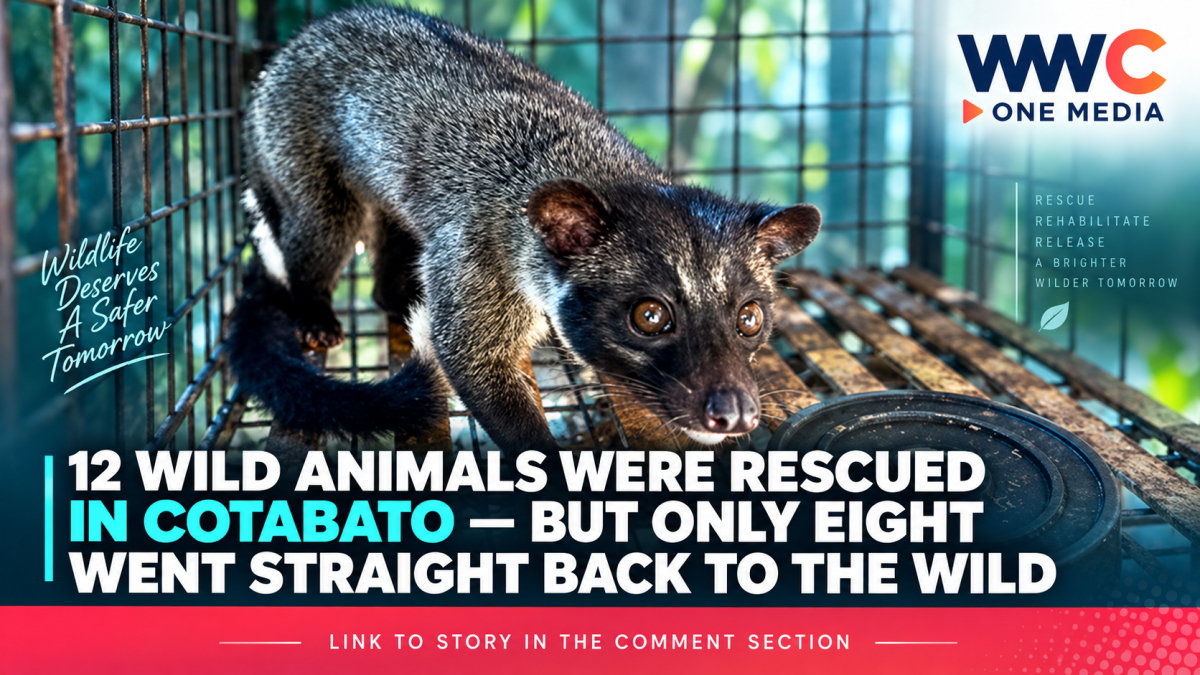
MAKILALA, Cotabato — Twelve wild animals that had ended up in human hands are getting another chance at life in the wild after residents voluntarily turned them over to environmental authorities—but four still have one final hurdle to clear before they can be released.
The animals were surrendered to the Department of Environment and Natural Resources-Provincial Environment and Natural Resources Office in Cotabato on September 10, triggering a coordinated rescue, veterinary examination and release operation involving DENR personnel, CENRO Matalam and the Makilala municipal environment office.
The group included two Philippine palm civets, two Philippine ducks, four white-eared brown doves, three spotted doves and one juvenile white-breasted waterhen. All 12 were transported to the Kidapawan City Veterinary Office, where veterinarians certified them as fit for release.
But their paths back to freedom did not all move at the same speed.
Eight animals were released almost immediately
Following the veterinary assessment, authorities released the four white-eared brown doves, three spotted doves and juvenile white-breasted waterhen back into suitable habitat.
That accounted for eight of the 12 rescued animals.
The remaining two Philippine ducks and two Philippine palm civets were transferred to PENRO Cotabato’s temporary wildlife rescue facility for additional observation ahead of their planned return to the wild.
That distinction is important because descriptions suggesting that all 12 animals have already been freed would be premature.
All 12 were declared fit for release, but as of the latest DENR account, only eight had actually been released.
The four others were still being monitored.
One civet was discovered on a rubber farm
One of the Philippine palm civets was found by Makilala resident Joel Gastones at a rubber farm.
A second civet had been temporarily cared for by Isagani Bagyo before being surrendered to authorities. Multiple reports say the residents coordinated with environmental officials after learning about restrictions governing the collection, possession and keeping of Philippine wildlife.
Philippine palm civets, locally known in some areas as musang, are nocturnal mammals found in the Philippines and elsewhere in Southeast Asia.
The Cotabato case is not the first recent instance of citizens turning civets over to DENR-12.
In February, two Philippine palm civets found feeding on planted corn in Glan, Sarangani were surrendered to authorities. After assessment, they were released into a forested area on February 27.
That earlier operation followed almost the same pattern: citizen encounters wildlife, authorities retrieve it, specialists assess its condition, and release follows once the animal is considered healthy enough.
The Philippine ducks add another conservation dimension
Among the 12 animals were two Philippine ducks (Anas luzonica), a species found naturally only in the Philippines.
The Philippine Red List classifies the Philippine duck as Vulnerable, noting pressures including hunting and loss or conversion of wetland habitat. Academic conservation research likewise describes it as a Philippine endemic affected by hunting and habitat change.
That makes the decision to keep the two ducks temporarily under observation more than a routine holding measure.
Wildlife release is not simply a matter of opening a cage. Authorities have to consider an animal’s physical condition and whether it can safely survive after being returned to its habitat.
Republic Act No. 9147 specifically provides for wildlife rescue centers to temporarily care for confiscated, abandoned or donated wildlife and directs authorities to establish procedures governing their eventual disposition.
The rescue also highlights what Filipinos should—and shouldn’t—do when they find wildlife
The DENR used the Makilala turnover to repeat a message that often accompanies wildlife rescues: finding a wild animal does not automatically give someone the right to keep it as a pet.
Republic Act No. 9147, the Wildlife Resources Conservation and Protection Act, regulates the collection, possession, transport and trade of wildlife.
The law does not mean that every form of wildlife possession is automatically illegal. Rather, possession is regulated and must meet legal requirements, including having the capability and appropriate facilities to maintain wildlife and ensuring that the animal was not obtained in violation of the law.
The law also identifies unauthorized collecting, hunting, possession and transportation of wildlife among prohibited acts and provides varying penalties depending on the offense and conservation status of the species involved.
For ordinary residents who encounter an injured, displaced or captured wild animal, DENR’s advice is much simpler: contact the nearest DENR office or authorized wildlife authority rather than attempting to keep the animal indefinitely.
Cotabato has seen this system work before
The latest rescue is part of a broader pattern of citizen-assisted wildlife recovery in the area.
In October 2025, a juvenile Philippine serpent eagle crash-landed inside a house in Kidapawan City. Residents reported the incident, PENRO Cotabato retrieved the bird, and veterinarians found it healthy enough for release the following day.
In another Kidapawan incident, a black-crowned night heron attacked by crows was rescued by a teacher and her husband and placed under temporary observation until it could recover sufficiently for release.
And in May 2026, another Philippine serpent eagle found trapped and weakened in Kidapawan was turned over to DENR, with authorities saying it would be released once recovered.
These cases illustrate why wildlife rescue often depends on the public acting as the first link in the chain.
DENR personnel cannot be everywhere wildlife encounters occur. A farmer, homeowner or passerby may be the first person to find a displaced animal—and what happens next can determine whether it ends up illegally kept, injured further or safely returned to the wild.
Rescue is only the first half of the story
The Makilala operation may sound small beside the Philippines’ much larger battles against habitat destruction, wildlife trafficking and biodiversity loss.
But it demonstrates conservation at its most immediate level.
Twelve animals entered government care.
All 12 passed veterinary examinations.
Eight have already returned to the wild.
Four—the two Philippine ducks and two Philippine palm civets—are still waiting.
For them, the rescue is complete.
The return to freedom is not quite finished yet.




Leave a Reply