
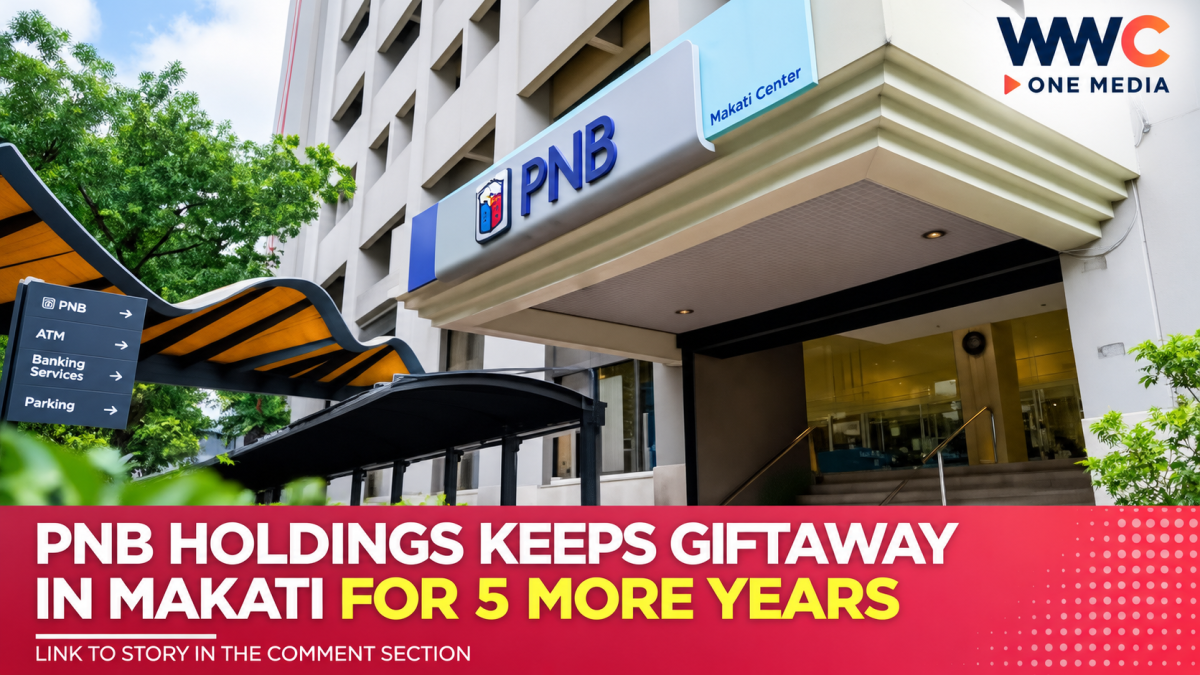
MANILA, Philippines — PNB Holdings Corp. has locked in another five years with digital rewards company Giftaway Inc. at one of its most important Makati properties, giving the real estate firm a fresh long-term tenant commitment just days before its planned stock-market debut.
Giftaway signed a new five-year lease for its headquarters at PNB Makati Center along Ayala Avenue, extending an occupancy that dates back to 2018. The Philippine technology company provides digital rewards, incentives and electronic gift solutions to corporate clients.
For PNB Holdings, however, the significance goes beyond keeping one technology company in the building.
PNB Makati Center produced 26% of the company’s revenue during the first half of 2026, making it PNB Holdings’ second-biggest revenue contributor behind PNB Financial Center in Pasay.
And the timing could hardly be more relevant.
PNB Holdings is scheduled to list its shares on the Philippine Stock Exchange on September 25, 2026, with an initial reference price of ₱1.20 per share and an indicative market capitalization of roughly ₱56.3 billion.
That means every major lease renewal now feeds into a bigger question investors will soon be asking:
How much recurring income can PNB Holdings extract from some of Metro Manila’s most valuable real estate?
Five more years at one of Makati’s established office addresses
The new agreement keeps Giftaway at PNB Makati Center through another long-term leasing cycle.
Giftaway has maintained its headquarters there since 2018, according to PNB Holdings and other reports covering the agreement.
The ceremonial signing involved PNB Holdings President Karlu T. Say, Chief Financial Officer Ponciano S. Carreon Jr., Giftaway Chief Executive Officer Alvin Edward C. Tan and Giftaway Head of Operations George Adrian M. Santos.
PNB Makati Center sits at 6754 Ayala Avenue and has 28,131 square meters of gross leasable area, according to PNB Holdings’ current property portfolio information.
The building has 12 floors plus penthouse and basement levels, approximately 2,641 square meters in a typical floor plate, seven passenger/freight elevators combined and full backup power. PNB Holdings estimates that more than 4,500 people use the property.
It is also an older building being repositioned rather than replaced.
Originally developed as the Allied Bank Center, the property opened in 1980 and was designed by Filipino architect Carlos D. Arguelles. PNB Holdings has pursued what it describes as adaptive reuse, modernizing systems and common areas while restructuring interior space for newer office, retail and flexible-work requirements.
That makes Giftaway’s decision to stay especially useful for the landlord: it suggests the decades-old property can continue retaining technology and corporate tenants despite competing against newer office towers.
But the most important lease number is missing
There is one major limitation to the announcement.
PNB Holdings did not disclose the financial terms of the Giftaway agreement.
The company has not publicly specified the amount of floor space covered by the new lease, the agreed rental rate, annual escalation provisions or the total peso value of the five-year contract in its announcement.
That means the lease can be described accurately as a long-term tenant retention win—but not as a specific multimillion- or billion-peso transaction without additional disclosure.
This matters because PNB Holdings is about to become publicly traded.
Investors examining a property company’s leasing performance generally care not only about whether tenants stay, but also about occupancy, rental rates, lease duration, escalation clauses and how much recurring revenue those contracts generate.
The new Giftaway agreement confirms the duration.
It does not yet reveal the economics.
PNB Makati Center generated roughly a quarter of H1 revenue
What is known is how important the building already is to PNB Holdings.
The company posted ₱634.3 million in consolidated revenue during the first six months of 2026, up 26% from ₱502.7 million a year earlier.
Net income increased 85.3% to ₱209.9 million, while gross profit jumped 58.5% to ₱326.9 million and EBITDA climbed 40.3% to ₱336.5 million.
PNB Financial Center accounted for 67% of revenue, while PNB Makati Center contributed another 26%.
Together, those two properties therefore generated about 93% of the company’s reported first-half revenue, based on PNB Holdings’ disclosed contribution percentages.
That concentration helps explain why a five-year tenant renewal at the Makati building deserves more attention than an ordinary office lease.
Keeping tenants in those two core assets directly supports the recurring income PNB Holdings needs while it develops longer-term plans for its property portfolio.
The balance sheet is unusually lightly leveraged
PNB Holdings entered the second half of 2026 with ₱50.894 billion in total assets, up from ₱50.456 billion at the end of 2025.
More than 90% of its asset base consists of the book value of prime real estate in Makati and Pasay, according to the company.
Cash and cash equivalents reached approximately ₱3.03 billion, up 30%, while the company reported a liabilities-to-equity ratio of just 0.02 and said it carried no interest-bearing loans as of the end of June.
That gives PNB Holdings considerable room to borrow in the future should management decide to fund redevelopment or acquisitions with debt.
And redevelopment is central to the company’s long-term pitch.
Three properties sit behind PNB Holdings’ market story
PNB Holdings’ portfolio revolves around three major Metro Manila properties:
PNB Financial Center in Pasay City, the PNB Makati Center on Ayala Avenue, and an approximately 8,000-square-meter Buendia-Paseo de Roxas property in Makati.
Together they provide more than 137,000 square meters of existing gross leasable area across more than 11 hectares of land, according to the company.
PNB Holdings has identified the Buendia-Paseo property as its most redevelopment-ready asset, while the much larger PNB Financial Center occupies roughly 10 hectares in Pasay’s Manila Bay corridor.
The company has said potential future redevelopment could span office, retail, commercial, hospitality and luxury real estate, although the timing and size of those projects remain subject to market conditions, approvals and financial feasibility.
Independent reporting around the listing has put the appraised value of the three-property portfolio at roughly ₱80.9 billion.
Against that backdrop, retaining existing tenants serves a practical purpose.
Redevelopment may create future value.
Rent-paying tenants generate cash now.
Why a five-year renewal matters in today’s office market
The broader Metro Manila office market is recovering unevenly rather than booming across the board.
Colliers Philippines reported that leasing activity slowed in the second quarter of 2026 as companies delayed commitments and reassessed expansion plans amid economic and geopolitical uncertainty.
Overall Metro Manila office vacancy remained around 19%, while leasing activity fell 24% quarter on quarter. Colliers said occupiers were increasingly prioritizing renewals, flexible arrangements and strategic locations.
That environment makes renewals especially valuable for landlords.
A long-term renewal avoids the risk of having to replace an outgoing tenant, spend on improvements for a new occupier or leave space vacant while searching for one.
The market remains competitive enough that tenants still have bargaining power.
PRIME Philippines data reported by GMA News earlier this year showed Makati office occupancy at 89.2% and said the market remained tenant-driven, with landlords often willing to negotiate more flexible commercial terms.
That does not mean PNB Holdings necessarily discounted Giftaway’s lease—the commercial terms were not disclosed.
But it does make the five-year commitment more meaningful.
Makati remains one of the stronger office locations
The broader market picture also contains an important distinction.
Metro Manila may still have substantial office vacancy, but conditions differ significantly among business districts and individual properties.
Makati remains one of the country’s deepest corporate office markets, supported by established transport links, financial institutions, multinational companies and a large concentration of professional services.
PNB Makati Center’s location directly on Ayala Avenue therefore gives the property an advantage that cannot easily be replicated in newer but more peripheral office districts.
PNB Holdings has been trying to capitalize on that location by repositioning the building.
Apart from traditional office tenants, the property accommodates flexible workspace, retail and other uses, part of the company’s wider push to transform older buildings into what it describes as more integrated workplace environments.
Giftaway’s decision to remain until the next leasing cycle provides another test of that strategy.
The listing is not an IPO
The timing of the Giftaway deal also requires one important clarification.
PNB Holdings’ September 25 market debut is a listing by way of introduction, not a traditional initial public offering.
No new shares are being offered to the public as part of the listing itself.
Instead, approximately 46.93 billion existing shares are expected to become listed, giving shareholders a market in which their holdings can be traded and providing price discovery for the company.
At the initial ₱1.20 reference price, PNB Holdings would start with an indicative market value of approximately ₱56.3 billion.
The price sits close to the bottom of the ₱1.18-to-₱1.89 per-share range cited in an independent fairness opinion used by the company.
PNB Holdings CFO Ponciano Carreon has said the listing fulfills a commitment associated with the property dividend declared to shareholders in 2021 and is intended to provide liquidity and price discovery.
In other words, PNB Holdings is not going public primarily to raise fresh cash on listing day.
That places even greater attention on what the company already owns—and how effectively it can turn those properties into recurring earnings.
Giftaway may be a small lease inside a much bigger test
By itself, a five-year office renewal is unlikely to transform a company with more than ₱50 billion in assets.
But its importance lies in what it represents.
PNB Holdings is approaching the public market with a portfolio concentrated in only a few highly valuable properties.
Its largest building, PNB Financial Center, produces most of its revenue.
Its Makati Center generates another significant share.
Its Buendia-Paseo site represents much of the redevelopment story investors may eventually be asked to value.
That leaves management balancing two objectives at once:
maximize income from the buildings it already operates while preparing selected properties for potentially much larger redevelopment opportunities.
Giftaway’s five-year commitment helps with the first objective.
The September 25 listing will begin testing investors’ confidence in the second.
And that is why the most interesting part of this office lease may not be that Giftaway decided to stay.
It is that PNB Holdings secured the commitment just before the market begins putting a daily price on the landlord itself.




Leave a Reply