
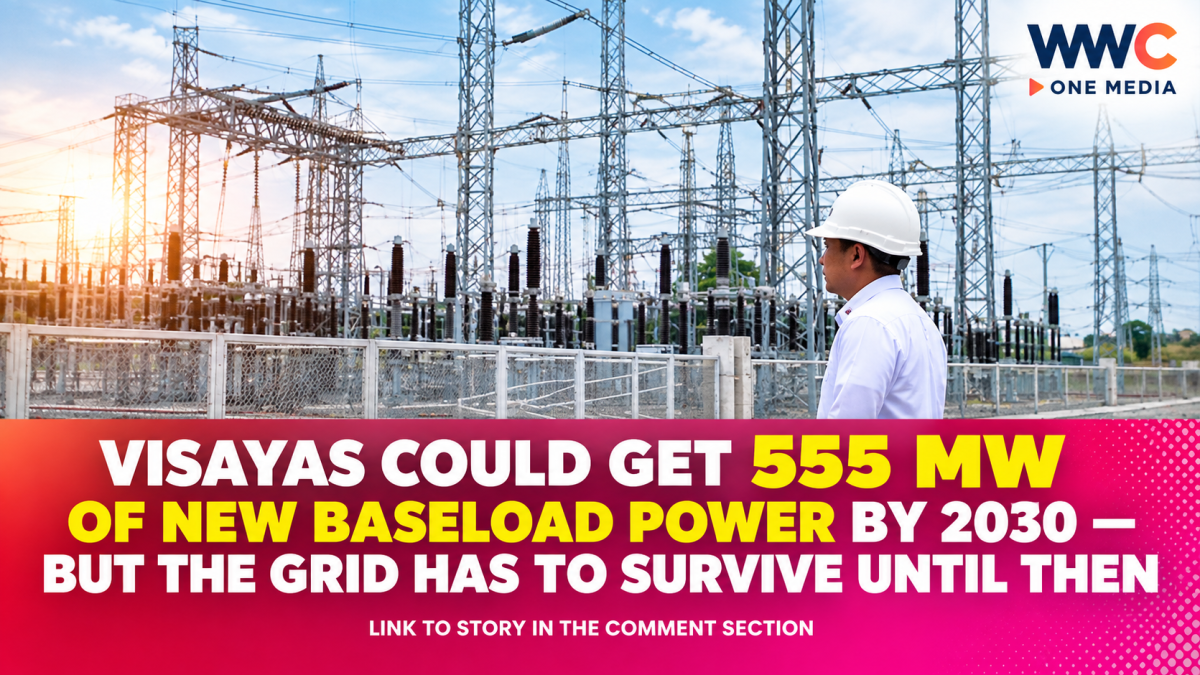
CEBU CITY, Philippines — The Department of Energy is mapping out hundreds of megawatts of new power plants, battery storage and transmission links for the Visayas, aiming for a significantly more stable electricity system by 2029.
But for businesses and households enduring recurring red alerts, yellow alerts and rotational outages today, the most difficult part of the plan may be getting through the next two years.
Energy Secretary Sharon Garin said the government wants the Visayas to become less dependent on electricity imported from Luzon and Mindanao by developing additional generation closer to where demand is growing.
The long-term plan includes 135 megawatts of new baseload capacity for Panay by 2028, another 270 MW in 2029 and 150 MW in 2030—potentially 555 MW of baseload additions across the three target years if the projects proceed as planned.
DOE is also pursuing flexible gas-fired generation that could help respond when large generating units suddenly fail or renewable-energy output drops.
The agency’s official September 15 announcement identifies 220 MW of gas-fired mid-merit capacity targeted for 2028, while InsiderPH reported that DOE is considering between 220 MW and 440 MW, subject to investors’ assessments.
The distinction is important: the bigger number remains a possibility rather than committed capacity.
Why 2029 has become a critical year
Garin said the combination of restored generating units, battery storage, temporary generators and permanent new plants should progressively improve conditions between 2026 and 2028, with the electricity situation in Panay, Negros and the wider Visayas expected to become “healthier” by 2029.
That is a target—not a guarantee.
The region entered September with an electricity system repeatedly operating with little room for error.
As of September 3, the Visayas had already recorded 93 yellow alerts and 30 red alerts in 2026, according to data cited in a congressional resolution reported by The Philippine Star. By September 15, BusinessMirror reported that the grid had experienced its 33rd red alert and 96th yellow alert based on DOE’s earlier count, while subsequent reporting put the cumulative totals still higher.
On September 15 alone, available capacity stood at 2,352 MW against projected peak demand of 2,492 MW, leaving a 140-MW deficit during the day’s tightest period.
The Philippine Star reported on September 16 that nearly 1,000 MW of generating capacity was unavailable, with dozens of units affected by forced outages or reduced output.
That is why the DOE’s strategy stretches far beyond simply building more power plants.
First job: get existing power plants running again
The fastest source of additional electricity is capacity that already exists but is unavailable.
DOE has therefore made restoring major generating units one of its immediate priorities.
The department said the return of plants operated by Therma Visayas Inc. and Panay Energy Development Corp. in the Visayas, along with generating units in Mindanao that can export electricity northward through the interconnected grid, should rebuild reserve margins and reduce the frequency of emergency alerts.
InsiderPH reported that the 82-MW Cebu Energy Development Corp. Unit 1 had returned to service, while the 169-MW Therma Visayas Unit 1 and 150-MW PEDC Unit 3 were among the major units scheduled for restoration during September and early October.
Timelines for forced-outage plants can change, however.
Therma Visayas Unit 2, for example, briefly returned before being taken offline again after overheating, prompting DOE and Energy Regulatory Commission engineers to inspect the unit.
That episode underlines the central weakness facing the grid: installed capacity is useful only when plants are actually available when demand peaks.
253 MW of batteries could become the bridge
DOE’s most immediate structural intervention is 253 MW of ancillary-service capacity, much of it through battery energy storage systems in Cebu, Leyte, Negros, Bohol and Panay.
Battery storage cannot create electricity on its own.
Instead, batteries can absorb electricity when supply is plentiful and release it rapidly when demand rises or a generating unit suddenly trips.
That ability is particularly relevant in the Visayas because the region has a growing share of solar and other renewable generation whose strongest production may occur during the daytime, while electricity demand can remain high into the late afternoon and evening.
Garin said DOE simulations indicate that deploying the full 253 MW could eliminate more than half of projected grid alerts and, under favorable operating conditions, potentially prevent some red alerts.
But the batteries also need commercial arrangements allowing NGCP to call on them as grid reserves.
BusinessMirror reported that NGCP committed to finalize outstanding ancillary-service contracts during September after the DOE pressed the grid operator to complete the agreements.
That means some of the hardware may exist before all of the contractual machinery needed to fully deploy it as reserve power is in place.
Power barges and diesel plants could add another 200 to 250 MW
DOE is also considering temporary generating capacity to bridge the gap before permanent plants arrive.
The department is looking at roughly 200 MW to 250 MW from power barges or available diesel generation, potentially deployed beginning late 2026 or in the first quarter of 2027.
Garin has said possible locations include areas such as Cebu, Panay and Bohol. The Freeman separately reported that the government was considering more than 200 MW of barge-based generation as part of its emergency stabilization effort.
These units can be installed faster than major baseload plants, but they are explicitly being treated as bridging measures rather than the long-term solution.
Diesel-fired generation is generally more exposed to fuel costs, while batteries can only discharge energy previously stored in them.
Permanent generation and stronger transmission therefore remain necessary.
Panay is being positioned for hundreds of megawatts of new supply
DOE’s longer-term roadmap gives Panay a central role.
The agency says energy investments could provide the island with 135 MW of additional baseload generation by 2028, 270 MW in 2029 and another 150 MW in 2030.
Unlike intermittent solar and wind farms, baseload generating facilities are designed to produce electricity continuously for extended periods.
The government also wants flexible mid-merit generation that can increase or decrease output more rapidly as conditions on the grid change.
DOE’s official plan identifies 220 MW of gas-fired mid-merit capacity by 2028, which would complement renewable generation rather than simply replace it.
That flexibility becomes increasingly important as more solar and wind enter the electricity mix.
When clouds reduce solar generation, winds weaken or a conventional plant trips unexpectedly, the system needs generation or storage capable of reacting quickly.
More power plants are useless if the grid cannot move the electricity
Generation is only half of the equation.
DOE is also pushing for additional transmission infrastructure, particularly the Mindoro-Panay Interconnection Project.
The project is intended to connect the Visayas to the proposed transmission route linking Batangas and Mindoro, creating another electricity path between Luzon and the Visayas.
InsiderPH reported that Garin urged NGCP to accelerate both the Batangas-Mindoro and Mindoro-Panay links, saying the additional route could improve redundancy and allow electricity to move more reliably between regional grids.
At first glance, that may appear inconsistent with DOE’s ambition to make the Visayas less dependent on imported electricity.
It is actually a different part of the same strategy.
More local generation reduces dependence. More interconnection reduces vulnerability.
A region with enough of its own generation but multiple transmission routes can import electricity during emergencies and export surplus electricity when conditions are favorable.
That is more resilient than relying heavily on imports simply to cover normal demand.
The power shortage has already reached consumers’ bills
The problem is no longer limited to grid alerts.
Electricity shortages have pushed the Visayas toward unusually high wholesale power prices.
The Independent Electricity Market Operator of the Philippines reported that the Visayas’ average Wholesale Electricity Spot Market price climbed to ₱18.59 per kilowatt-hour during the July 26-August 25 billing period, up sharply as outages tightened supply.
DOE Undersecretary Rowena Guevara had already linked persistent Visayas grid alerts with higher electricity costs, as utilities were forced to rely on more expensive generating sources and electricity imports.
The Energy Regulatory Commission has since approved a regional application of the Secondary Price Cap for the Visayas and Mindanao.
DOE said an ERC simulation showed that applying the mechanism to August conditions could have reduced the Visayas’ average spot-market price from ₱18.59/kWh to about ₱8.47/kWh, a 54% reduction.
That figure refers to simulated wholesale spot-market pricing, not a guaranteed 54% reduction in consumers’ final electricity bills, which also contain generation contracts, transmission, distribution, taxes and other charges.
Cebu businesses say reliable power is now an economic issue
The consequences extend beyond household inconvenience.
Business groups have warned that recurring brownouts and expensive electricity could weaken investment confidence and economic growth in Cebu and elsewhere in the Visayas.
Recent grid problems have disrupted commercial operations while forcing some businesses to rely more heavily on backup generation. The Freeman described the Visayas as a test of whether electricity infrastructure can keep pace with the region’s expansion.
This is why the DOE’s timeline matters economically.
New plants expected in 2028, 2029 and 2030 may improve long-term supply, but businesses are making investment and expansion decisions now.
And power systems do not receive credit for capacity that exists only on a planning document.
Projects must secure financing.
Plants must be built.
Transmission lines must be finished.
Batteries must be contracted and connected.
Existing generating units must stay operational.
The real test comes before 2029
The DOE’s roadmap gives the Visayas something it has badly needed: a clearer sequence of immediate, medium-term and permanent interventions.
In the short term, the government wants failed generating units restored.
Next come 253 MW of battery capacity and potentially 200 MW to 250 MW of temporary generation.
Beginning in 2028, permanent baseload and flexible gas capacity are expected to enter the system.
By 2029, DOE hopes the wider Visayas grid will finally be operating under healthier conditions.
But that target comes with a warning embedded in the government’s own numbers.
The Visayas is not planning new electricity supply from a position of comfortable reserves.
It is trying to build the next generation of power infrastructure while the existing grid is already struggling to keep the lights on.
And that makes the most important date in DOE’s plan not necessarily 2029.
It may be every peak-demand evening between now and then.




Leave a Reply