
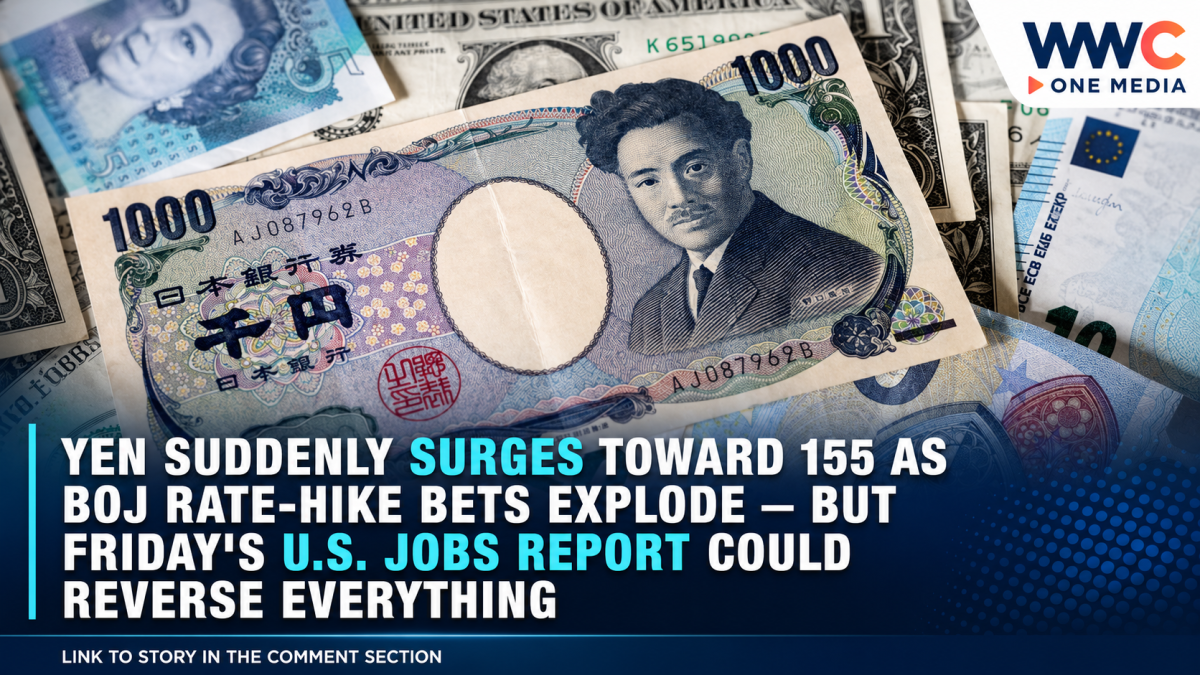
The Japanese yen was on track Friday for its strongest week since the dramatic Japan-U.S. currency intervention in late July, as investors rapidly reassessed how aggressively the Bank of Japan may tighten monetary policy.
The yen strengthened as far as 155.25 per U.S. dollar during Asian trading on September 4, coming close to the 155.20 level reached after the July intervention. It later gave back some of the move, trading around 155.71 per dollar in the morning session.
That still left the Japanese currency heading for a weekly gain of roughly 2.5%, its best performance in more than a month.
The sudden rally represents a remarkable reversal from late July, when the yen had weakened toward 164 per dollar before Japan and the United States carried out a rare coordinated intervention designed to halt the currency’s slide.
This time, however, there is no clear evidence that authorities have stepped directly into the foreign-exchange market.
Instead, investors appear to be making a much bigger bet: the Bank of Japan itself may be preparing to do more.
BOJ Rate-Hike Expectations Are Driving the Yen
The next Bank of Japan monetary-policy meeting is scheduled for September 17 and 18, according to the central bank’s official calendar.
Expectations for that meeting have shifted rapidly.
Reuters reported Thursday that markets were pricing roughly a 75% probability of a 25-basis-point BOJ rate increase in September, while traders were also considering the possibility of further tightening later in the year.
The Financial Times likewise reported a sharp repricing of Japanese interest-rate expectations as the yen climbed, with investors increasingly considering not simply one BOJ move but the possibility of a faster tightening cycle.
That matters enormously for the yen.
For years, Japan’s ultra-low interest rates encouraged investors to borrow cheaply in yen and move money into higher-yielding currencies and assets overseas — the classic yen carry trade.
Higher Japanese rates make that trade less attractive. And if the gap between Japanese and U.S. interest rates begins narrowing, investors have less incentive to remain heavily positioned against the yen.
That possibility is increasingly changing Wall Street forecasts.
MarketWatch reported Thursday that Bank of America had turned bullish on the Japanese currency, recommending investors buy the yen against the dollar and targeting approximately 149 yen per dollar. The bank cited Japan’s current-account surplus, expectations for faster BOJ tightening and the possibility of Japanese investors shifting more money back into domestic assets.
That does not guarantee the yen will reach 149. Currency forecasts are inherently uncertain. But the call illustrates just how dramatically sentiment toward Japan’s currency has changed since July.
Japan Is Still Warning Currency Traders
Tokyo is also keeping the threat of intervention alive.
Japan’s top currency diplomat, Atsushi Mimura, said Friday that authorities remained alert to foreign-exchange movements and continued to communicate closely with their U.S. counterparts.
His comments briefly pushed the dollar down toward 155.30 yen as traders weighed whether authorities could intervene again if volatility returned.
The distinction is important.
Japan historically intervenes because of what officials describe as excessive or disorderly currency moves rather than to defend one publicly declared exchange rate.
For now, traders appear to believe monetary policy — rather than another direct government operation — could provide the next major source of yen strength.
But the U.S. Dollar Has Its Own Huge Test
The other half of the USD/JPY trade is about to face an equally important test.
Currency markets are waiting for the August U.S. nonfarm payrolls report, one of the last major employment readings before the Federal Reserve meets on September 15 and 16. The Federal Reserve’s official calendar confirms the two-day meeting, with its policy announcement scheduled for September 16.
Ahead of the jobs report, the U.S. dollar index was roughly flat near 99.01 on Friday and was heading for a weekly loss of about 0.7%. The euro traded around $1.1625 while sterling was near $1.3527.
The jobs numbers could dramatically change expectations for U.S. interest rates.
A Reuters survey cited ahead of Friday’s release showed economists expecting roughly 56,000 new nonfarm jobs in August, with the unemployment rate remaining near 4.1%.
Private-sector figures released earlier in the week already suggested hiring may be losing momentum. ADP reported that U.S. private payrolls increased by only 38,000 in August, below economists’ expectations.
But the broader economic picture is complicated.
U.S. services activity strengthened in August, while a measure of prices paid by service businesses rose sharply, creating fresh concern that inflation remains stubborn even as hiring cools.
That combination — slower employment growth but persistent inflation — leaves the Federal Reserve with an uncomfortable choice.
Waller Just Changed the Fed Debate
Federal Reserve Governor Christopher Waller added another twist Thursday by signaling that he could support leaving interest rates unchanged at the September meeting if upcoming inflation data show price pressures continuing to ease.
Markets reacted immediately.
The probability of a September Fed rate increase fell from roughly 63% to about 50%, according to market pricing cited by Reuters, while Treasury yields declined and Wall Street stocks rallied.
That shift also took some support away from the U.S. dollar.
The Federal Reserve and Bank of Japan are therefore approaching their September meetings from almost opposite directions.
In Washington, traders are asking whether policymakers really need another rate increase.
In Tokyo, investors are asking whether the BOJ is finally ready to tighten faster.
If both expectations move in those directions simultaneously, the interest-rate gap that has supported the dollar against the yen could narrow — potentially giving the Japanese currency another powerful tailwind.
Oil Adds Another Wild Card
There is one more complication: energy.
Brent crude remained around $95.52 a barrel following renewed U.S.-Iran tensions and military strikes, keeping inflation risks firmly on investors’ radar.
Higher energy prices could make life more difficult for both central banks.
For the Federal Reserve, expensive oil could slow progress against inflation and strengthen the argument for tighter policy.
For Japan, which depends heavily on imported energy, a weak yen amplifies the domestic cost of oil and other commodities. That creates another reason policymakers may prefer to prevent the currency from falling too far.
Why Friday’s Payroll Report Could Change Everything
The yen’s rally now rests on two connected assumptions: that Japan is moving toward tighter monetary policy and that the United States may not tighten as aggressively as investors previously expected.
Friday’s payroll report could strengthen — or challenge — the second half of that trade.
A surprisingly strong jobs report, especially if accompanied by faster wage growth, could revive expectations of another Federal Reserve rate increase. That would potentially lift U.S. Treasury yields, strengthen the dollar and put renewed pressure on the yen.
A weak report could do the opposite, reinforcing expectations that the Fed will remain on hold while the BOJ moves toward another hike.
That is why the yen’s strongest week in more than a month may be less important than what comes next.
Japan’s currency has already staged a dramatic comeback from July’s intervention-era lows.
Now traders are about to find out whether this is merely another short-lived yen rebound — or the beginning of a much bigger shift in one of the world’s most important currency trades.

Leave a Reply