
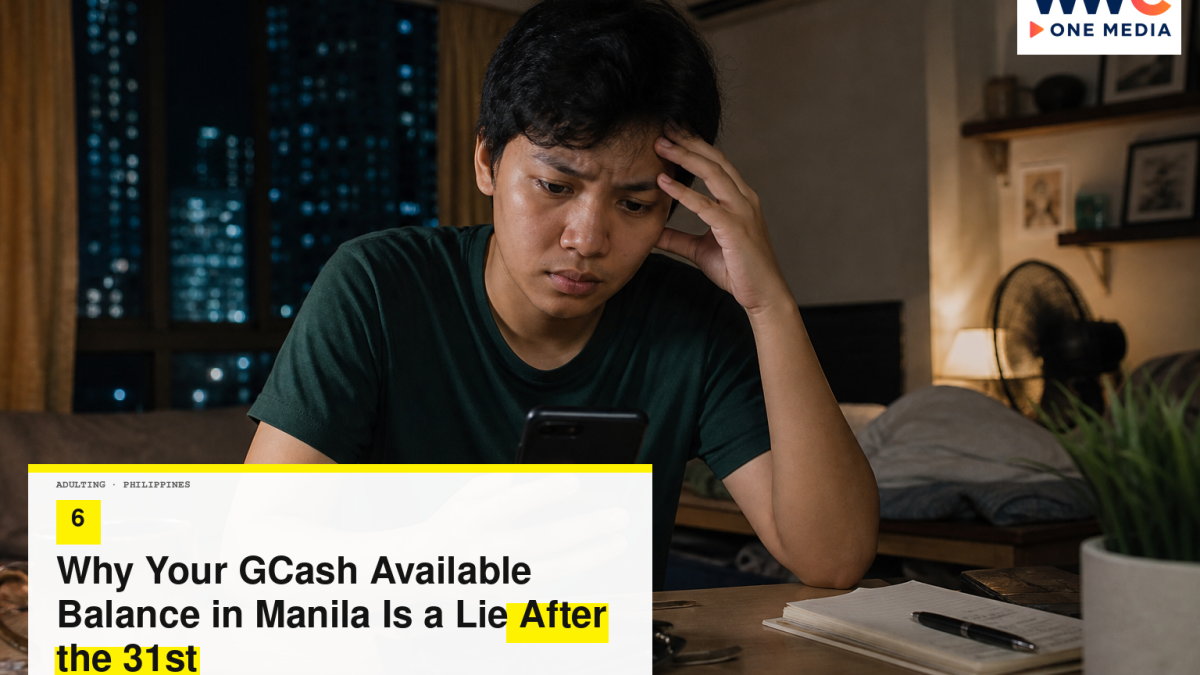
MANILA, Philippines — Your GCash available balance in Manila is a lie after the 31st because the number on the home screen is a billboard, not a month. Pending sits underneath it. Bills you scheduled in January are still in a menu you do not open. Merchant holds and transfers that have not finished still own part of the money. A loans UI can make a limit look like cash while you are on a jeep down España. Family requests land on the 1st because everyone else’s rent also landed. Load autopromos fire. A QR at a stall in Quiapo does not ask whether the 31st already promised this peso to Meralco. The available balance is late to the meeting. You are on time only if you read the other labels.
This is not a GCash fee table, not an official product manual, and not financial advice. Wallet labels move. Credit products get renamed. Promos expire. If a screen in your app uses a different word than the six habits below, believe the screen. The six are named holds and habits: pending, bills, holds, the loans UI, the GSave-or-bucket split that the home number ignores, and the 31st-to-1st autopulls that Manila life stacks on purpose. No invented rates. No fake peso averages. Example scenarios will be labeled as such.
Manila, here, is the city that still pays in taps: Taft, Pedro Gil, UN Avenue, Ermita, Malate, Intramuros, Recto, Divisoria, a 7-Eleven that is also a bills window, a jeep that will not take a card, a landlord in a walk-up who prefers GCash because banks are a weekday. After the 31st, the city does not get more expensive in one night. The promises post. The billboard number had not been told.
1. Pending: the GCash available balance that is already gone and still on the home screen
Pending is the first reason the available balance is a lie. You sent to a landlord in a Quiapo walk-up. You paid a bill. You transferred to a bank. You QR’d a palengke stall that had no signal. The UI still shows a number that includes money that is already spoken for, or it shows a number that has already subtracted it while a status says pending, and you cannot tell which without opening the transaction. Opening is the habit. The home screen is not a ledger.
After the 31st, pending multiplies because everyone else is also paying. Queues exist inside apps, not only at Bayad Center. A send that is pending at 11:40 p.m. on the 31st is not “done.” It is a state. States can fail, reverse, or sit. Sitting is how you double-pay because you panicked and sent again from a jeep on Taft that had just enough signal to be dangerous.
Check, in order:
- Transaction history for today and yesterday, not “recent” as a vibe.
- Any row that says pending, processing, for verification, or a similar status your build uses.
- Whether the available balance already dropped. If it dropped, do not send a second time.
- Whether the receiver actually got it. Ask them for a screenshot, not a “yes” in a chat that also contains a joke.
What not to do: screenshot the home number and send it to a parent as proof you still have money. The home number is the lie in the title. Send a screenshot of the transaction row. Rows have reference numbers. Reference numbers are how a dispute is a process instead of a feeling.
Manila texture: you are standing outside a 7-Eleven on Recto because the jeep conductor would not take a transfer, and you need cash. You cash in or cash out. That action also has a state. If the state is pending, you do not walk away from the window as if the story is over. Windows in Manila are full of people who walked away. Be the person who waits for the status to leave pending, or who writes the reference on Notes before the crowd pushes you into España.
Example scenario, labeled: on the 31st you send rent, the row stays pending, the available balance looks like you still have lunch. You buy lunch. The pending posts. The 1st is a conversation with a landlord and a growling stomach. The lie was not GCash “stealing.” The lie was the billboard. Pending was the truth.
2. Bills: the scheduled pull that does not care that your GCash available balance looked like a weekend
Bills is the second habit. Inside the app, a Bills area holds Meralco, a water concessionaire, a telco, a government payment, a credit card, a school, a name you added when you were being a good adult in January. Some are due on dates that cluster after the 31st. Some you scheduled. Some you only saved as a biller, which is not the same as scheduled, and you will mix those two up at 12:10 a.m. on the 1st while a jeep radio plays a song that is too hopeful.
The GCash available balance does not subtract a bill that has not pulled yet. That is normal. It is still a lie in the life sense: the money is not for Malate drinks if Meralco is due on the 2nd. Manila renters who get paid on the 15th and the 30th learn to treat the 30th as already spent. People who get paid on the 31st learn it later, usually once.
Open Bills and read:
- Saved billers vs scheduled vs due.
- Due dates that sit on the 1st through the 5th — the hangover window.
- The account numbers. A wrong Meralco account paid from a Manila wallet is a special genre of sad.
- Whether a failed bill from last month is still sitting there, waiting to be retried by a version of you that will not remember.
What not to do: treat a successful rent send as the end of the 31st. Rent is one biller in a city of billers. Water. Electric. Load. A condo portal in a different city if you actually live in a Taguig unit and work in Manila. The wallet does not know your geography. You do.
If you share a wallet’s bills with a partner, name who clicks. Double clicks are double pulls. Double pulls are how a water account gets a credit you will spend three Saturday mornings trying to understand. One clicker. One screenshot. One folder.
This is not a list of official due dates for Manila utilities. Due dates live on the actual bill. The habit is to put those dates next to the wallet, not to trust the available balance as if it had read your mail.
3. Holds: merchant holds, bank-transfer holds, the freeze that is not a freeze until you need a jeep
Holds are the third name. A merchant authorization, a bank transfer that is not instant, a cash-in that is still settling, a temporary block after a login that looked like you to a system and like a stranger to the security rule. The GCash available balance may drop, or it may not, depending on the hold type and the build. You will not debug this from a tweet. You will open the transaction and the help path the app actually shows.
Manila makes holds feel personal because the city is cash and tap at once. A QR at a stall in Divisoria. A transfer to a supplier in Quiapo. A Grab that authorized and then cancelled because the driver could not enter Intramuros the way the pin promised. Cancellations can leave a hold. Holds can take time to release. Time is a jeep you cannot board if you already spent the number in your head.
Habits:
- If a Grab or a QR looks like it failed, read the wallet before you retry.
- If you transferred to a bank, wait for the bank side too. Two screens. One story.
- If the app shows a limit, a verification, or a “try again later,” that is a hold-adjacent state. Do not stack retries.
- Keep reference numbers for anything larger than a snack. Larger is your own threshold. Pick one. Write it.
What not to do: dump your PIN, OTP, and a photo of your ID into a Facebook comment because a page said it would “release the hold.” Official help is in the app and on the company’s own channels. A page with a stolen logo is a Manila classic. The 31st is their busy season too.
If you use GCash for a small business stall along Recto or a side street in Sampaloc, holds are an operations issue, not a mood. End-of-day, match the stall’s notebook to the wallet history. Notebooks still win arguments that screenshots lose when the phone is dead. Dead phones are a Manila close-of-day tax. Bring a power bank. That is not cute. That is the ledger.
Example scenario only: a cancelled ride on Taft holds an amount, you think it bounced back because the home screen still looks fine, you pay a water bill, the hold releases late and the arithmetic of the 1st no longer fits in one jeepney sentence. The lie was speed. Holds are slow on purpose. Your weekend is not the timer.
4. Loans UI: GLoan, GCredit, Pay Later, and the limit that is not a GCash available balance
The loans UI is the fourth habit, and it is the one that makes a Manila 1st feel like you had a secret salary. A credit product on the home screen can look like money. It is a limit. Limits are not an available balance. After the 31st, people tap a credit tile because rent already pulled, bills are red, and the jeep still needs to be ridden toward a site in Makati or a class on Taft. The tap is easy. The due date is a second 31st you did not put on the calendar.
This piece will not name rates, penalties, or a ranking of which product is “safe.” Products change. Your app will show terms at the moment of application. Read those terms then, not here. The habit is naming:
- Which tile is cash you own vs a credit product.
- Whether a payment for that product is due in the same hangover window as rent.
- Whether the home screen is adding a limit into a number you are treating as spendable. If you cannot tell, assume it is not spendable.
- Whether a “pay later” at a merchant is already sitting in a different menu, with a different due date, pretending to be a purchase you already survived.
What not to do: pay rent with a credit tile because the available balance looked small and you wanted the landlord to stop texting. You have moved a landlord problem into a product problem. Sometimes a person does it anyway. If you do, write the due date that same night, in the same Notes as Meralco. Denial is how a loans UI becomes a personality.
Manila group chats will treat credit tiles like a joke. Jokes still pull. If you are helping a sibling in Tondo or a cousin in Sampaloc, do not send them a credit-tile tutorial as if it were a job. Send them a bills plan or nothing. This is not moral theater. It is a refusal to turn a limit into a family system.
If the UI shows a score, a “boost,” a promo that looks like cashback on a loan, walk away until you can read a sentence without a jeep bumping. Promos are designed to be read while you are tired. Tired is the 31st. The 1st is the invoice.
5. GSave and the other buckets: parked money that the home number treats as a rumor
The fifth habit is the split. GSave, or whatever the current bucket name is in your build, or a “goals” tile, or money you thought you parked. The GCash available balance on the home screen may exclude it, which is good, or a person may tap it back into spendable because a QR is waiting in a Malate convenience store. Parked is only parked if you do not unpark it for a mood.
After the 31st, moods are expensive. A family GC says “please.” A friend in Ermita says “one round.” A sale. An OTP for a transfer you already decided was for rent. The bucket is the adult. The home number is the child who wants merienda.
Habits:
- If you use a save bucket, park the 1st-through-5th bills before the 31st, not after.
- Do not keep the only buffer in the same spendable wallet you QR with at stalls.
- Name the bucket: rent, electric, mama, none of your business. Names reduce taps.
- If you unpark, log why in one line. You will not remember on the 8th.
What not to do: use the save bucket as a hiding place from yourself and then hide the hiding place by linking auto-reload, auto-invest, auto-anything you have not opened in six months. Automation is a tool. Unopened automation is how a 31st becomes a 1st without your consent. Open the menus. Turn off what you do not understand. Understanding is a Sunday. The jeep is not a seminar.
Manila cash culture will mock you for parking money in an app. Let them. A parked peso that survives Quiapo on a Saturday is a peso that can still be Meralco on Tuesday. Mockery is not a bill. The bill is the one you scheduled.
If your employer pays into GCash, the payday dump can look like wealth at 4:01 p.m. on the 31st. It is not wealth. It is a pipe. Move the named bills out of spendable before you leave the office, even if the office is a coworking space in Intramuros that smells like a tour group. Movement is the habit. The lie starts when the dump and the weekend share a wallet.
6. After the 31st: family GCs, load, subscriptions, and the autopulls that land on the 1st
The sixth habit is the calendar, not a single tile. After the 31st, Manila does a pile-on. Subscriptions that renew on the 1st. A telco promo. A streaming tile you forgot. A donation. A church. A class reunion GCash that is not optional in your family. A sibling who is short. A parent who is short. A landlord who is not short and still texts at 6 a.m. The GCash available balance cannot hold this pile. It can only look pretty until the pile posts.
Write a 31st-night pass, 10 minutes, not a new identity:
- Pending rows.
- Bills due in the next five days.
- Holds and failed QRs.
- Credit tiles: any due, any limit you were about to treat as cash.
- Buckets: is rent still parked.
- Upcoming: load auto-renew, subscriptions, the family GC you already know is coming.
What not to do: open GCash in a bar along Adriatico and decide you “still have” because the number is green. Green is a color. Color is not a month. If you are going to spend on the 31st, spend from a number you computed after the pass, not from the billboard.
Load deserves its own sentence in Manila. Jeep, OTP, maps, a hotspot when a cafe in Ermita sells you a drink for the Wi-Fi and the Wi-Fi is a rumor. Load will pull. Put it in the pass. A dead SIM on the 1st is how a pending row cannot even notify you.
If you are paid on the 15th and the 30th, the 31st is still a lie factory because the 30th money has already been assigned and the 1st still wants a snack. If you are paid on the 31st, do the pass before you leave the gate of the office, even if the gate is a mall on Taft and your friends are already at a table. Tables wait worse than portals. Portals post anyway.
Example scenario, labeled: payday hits, available balance looks like a person who can afford a night in Malate, rent is not yet pulled, a credit tile is glowing, a parent texts, a subscription renews at 00:01. By noon on the 1st the billboard has changed and the night cannot be refunded. The pass would have named the pile. The pile is the story. The night is a scene.
A Manila 10-minute pass that does not need a spreadsheet
You do not need a finance bro template. You need a standing place: the 7-Eleven counter after you already bought water, the last car of the LRT if you can get a seat, the studio floor in a walk-up in Sampaloc. Same six checks. Same order. Notes app: “Spendable after promises: [whatever you compute]. Do not use home screen.” The sentence is the product.
If you share bills with a roommate in a Malate walk-up, send the Notes line, not a speech about their GrabFood. Speeches start at 1 a.m. Lines close the 31st.
If your GCash is also your business till, run the pass twice: person, stall. Mixing them is how a supplier in Divisoria gets paid from rent. Separate wallets if you can. If you cannot, separate by naming, which is weaker, and still better than the billboard.
Objections Manila users throw at the 31st
“Available means available.” Available means unassigned by the app. Your life has assigned it. Those are different dictionaries.
“I’ll remember my bills.” You will not, on a jeep, at 00:20, with a promo tile.
“Credit is for emergencies.” After the 31st is not automatically an emergency. It is a calendar. Emergencies are hospitals, lost phones, a door you cannot open. A Friday night is a Friday night.
“GSave is a hassle.” Unparking is one tap. Hassle is the 8th, when Meralco is a red PDF and the billboard is cute.
“I don’t get paid on the 31st.” The lie still happens. The 31st is a cluster of due dates, not only a payday. Bills do not ask your employer.
“This app is supposed to be easy.” Easy is the tap. The month is still a month. Easy without a pass is how Manila wallets feel haunted on the 1st.
Bottom line
Your GCash available balance in Manila is a lie after the 31st because pending still owns a piece of it, bills have not pulled yet, holds sit on cancelled QRs and transfers, a loans UI can dress a limit up as cash, parked buckets only work if you do not unpark them for a mood, and the 1st still brings family GCs, load, and subscriptions that the billboard never counted. Open the six labels before the jeep reaches Pedro Gil. The city will still tap you. The number on the home screen does not have to be the adult in the room.



Leave a Reply