
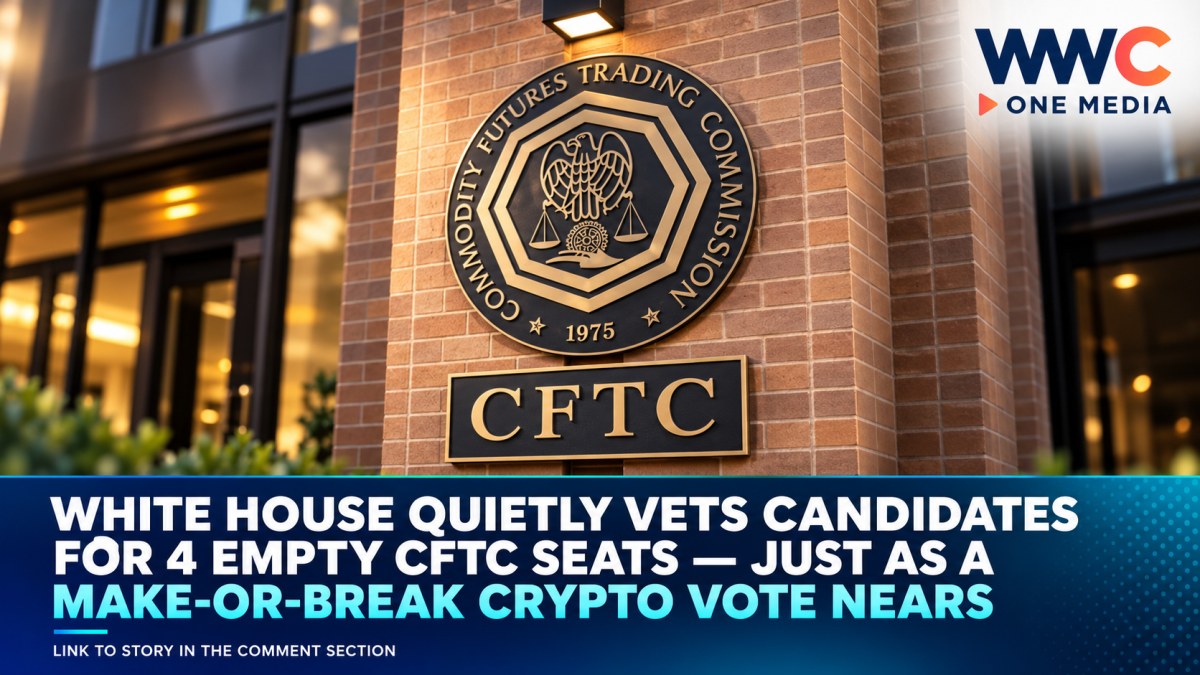
WASHINGTON — The White House has reportedly vetted candidates for all four vacant seats at one of America’s most important financial regulators, potentially opening a new front in the political battle over who will police the rapidly expanding U.S. cryptocurrency market.
CNBC reported Friday, September 4, citing three people familiar with the matter, that the Trump administration has reviewed potential candidates for the four open commissioner positions at the Commodity Futures Trading Commission, or CFTC.
But there is a major catch: vetting someone is not the same as nominating them.
As of September 5, the White House has not publicly announced nominees for those vacancies, and the CFTC is still operating with just one commissioner — Chairman Michael Selig. The agency normally has five presidentially appointed commissioners, and federal law prevents more than three from belonging to the same political party.
That unusual situation might have remained an obscure Washington staffing dispute.
Instead, it is becoming intertwined with one of the most consequential cryptocurrency bills Congress has considered.
The Timing Could Hardly Be More Important
The Senate is preparing for a key procedural vote on H.R. 3633, the Digital Asset Market Clarity Act, on September 15 at 2:15 p.m., according to the official Senate schedule.
The legislation is designed to establish clearer federal rules for digital assets and, crucially, better define the regulatory boundaries between the CFTC and the Securities and Exchange Commission.
That means the agency currently operating with four empty commissioner seats could ultimately receive a substantially more important role in overseeing parts of the cryptocurrency economy.
The House Financial Services Committee has described the legislation as an effort to resolve the long-running question of when a digital asset falls under SEC securities regulation and when it should instead be regulated as a commodity under the CFTC.
Suddenly, filling the CFTC’s empty seats is not simply a personnel matter.
It is becoming part of the fight over who will write the rules for America’s digital-asset markets.
Democrats Want a Full Commission
Lawmakers from both parties have already pushed the administration to rebuild the commission.
In May, Republican House Agriculture Committee Chairman Glenn “GT” Thompson and Democratic Ranking Member Angie Craig jointly urged President Donald Trump to nominate a full bipartisan slate of commissioners.
Their argument was straightforward: a complete commission would leave the CFTC better equipped to supervise U.S. derivatives markets and carry out an increasingly ambitious regulatory agenda.
CNBC reported that Democratic concerns over the vacancies have also become part of negotiations surrounding the CLARITY Act.
With Senate legislation generally needing 60 votes to overcome a filibuster, Republican leaders cannot necessarily move a major crypto-market-structure package through the chamber without Democratic support.
That gives the empty CFTC seats new political value.
Guaranteeing a functioning bipartisan commission could potentially become one of the concessions needed to attract enough votes to move the bill forward.
Some Potential Names Have Already Surfaced
The identities of the candidates most recently vetted by the White House have not been officially confirmed.
Earlier this year, however, Bloomberg reported that several people were being considered for CFTC positions.
Potential Democratic candidates reportedly included Matt MacKenzie of Optiver, Bill Rockwood, general counsel to Sen. Kirsten Gillibrand, and Ari Officer of Jump Trading.
Among possible Republican choices were Nathan Anonick, a Senate Agriculture Committee counsel involved in CFTC and derivatives policy, and attorney Chelsea Pizzola, who previously worked for former CFTC Chairman Heath Tarbert.
Those names should not be treated as the administration’s final slate. The White House has not publicly confirmed that they are the candidates currently undergoing consideration.
That distinction matters.
Washington vetting processes can end without a nomination, nominees can change, and even formally nominated commissioners still need Senate confirmation.
Why the CFTC Matters Far Beyond Traditional Futures Markets
For decades, the CFTC was primarily associated with futures, swaps and commodity derivatives.
That job is changing quickly.
Under Selig, the agency has increasingly focused on cryptocurrency, blockchain technology, artificial intelligence and prediction markets.
In March, the commission created an Innovation Task Force focused specifically on crypto assets, blockchain technologies, AI, autonomous systems and event-contract markets.
In May, Selig also highlighted the CFTC’s move toward permitting regulated cryptocurrency perpetual futures in the United States — products that historically generated enormous trading volumes on offshore crypto exchanges.
Prediction markets are becoming another pressure point.
A growing legal battle involving platforms such as Kalshi has raised fundamental questions about the line separating federally regulated event contracts from gambling traditionally regulated by states. New Jersey recently asked the U.S. Supreme Court to examine the issue after conflicting legal decisions intensified the jurisdictional dispute.
A commission making decisions on markets this consequential with only one sitting member inevitably raises questions about institutional capacity, bipartisan oversight and the durability of major policy decisions.
The CLARITY Act Still Faces Bigger Problems
Filling the vacancies alone would not guarantee passage of the crypto bill.
Reuters reported in August that the legislation faces significant disagreements involving ethics provisions, anti-money-laundering safeguards and protections for community banks, while Democrats have sought stronger enforcement provisions.
Political scrutiny has also intensified around President Trump’s family involvement in cryptocurrency businesses, creating another obstacle for lawmakers negotiating digital-asset legislation.
Sen. Cynthia Lummis released updated CLARITY Act language in July combining work from the Senate Banking and Agriculture committees and acknowledged that bipartisan negotiations were still necessary to get a final agreement across the finish line.
That makes September 15 especially important.
The scheduled vote is a cloture vote on the motion to proceed — essentially a test of whether enough senators are willing to advance the legislation for further debate.
It is not final passage.
Even if supporters clear that hurdle, additional negotiations and amendments could follow.
The Bigger Story
The four vacant CFTC seats may look like another Washington staffing problem.
They are increasingly something much bigger.
Congress is debating legislation that could reshape oversight of a multitrillion-dollar digital-asset industry at precisely the moment when the agency expected to shoulder much of that responsibility is functioning with only one commissioner.
The White House now appears to have candidates somewhere in the pipeline.
The unanswered question is whether President Trump will actually nominate them — and whether those nominations become part of the political bargain needed to rescue the biggest U.S. crypto-market-structure bill in years.
With the Senate’s September 15 vote approaching, Washington may soon find out.
WWC ONE MEDIA M.J.E

Leave a Reply