
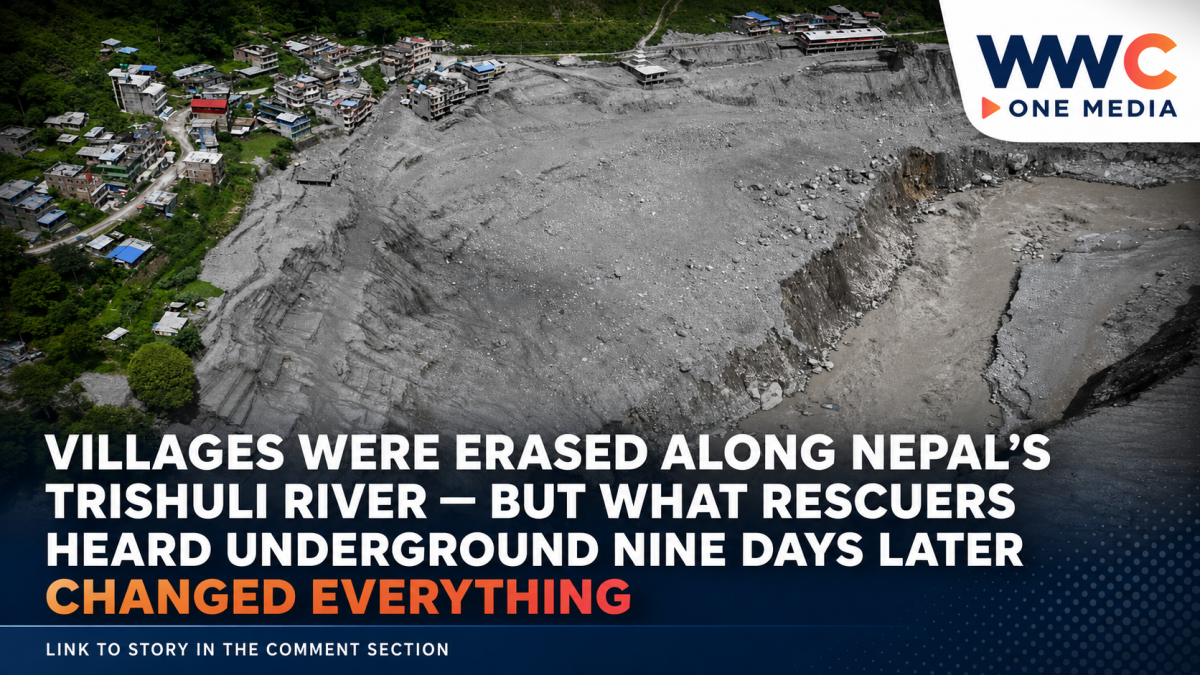
KATHMANDU, Nepal — September 4, 2026: More than a week after a catastrophic wall of water, mud, rock and ice tore through northern and central Nepal, the full scale of destruction along the Trishuli River is only now becoming visible.
From the air, entire stretches of the valley appear scraped apart. Roads vanish beneath mud. Bridges end abruptly at the water. Communities that once lined one of Nepal’s most important river corridors have been reduced to scattered buildings surrounded by vast fields of debris.
CNA, flying by helicopter along the Trishuli on September 3, reported that some high-altitude communities remained unreachable by road, leaving helicopters as one of the few ways to move rescuers and supplies into the worst-hit areas.
But the aerial destruction is now only one part of a much larger emergency.
Later figures cited by Nepal’s disaster authorities put the confirmed death toll from the August 26 floods at 1,259, with 5,083 people still missing as of Thursday evening, according to The Kathmandu Post. AP separately reported more than 5,000 missing. Earlier CNA and Reuters figures were lower because they reflected earlier reporting cutoffs.
Syabru Besi Was a Gateway to the Himalayas. Much of It Is Gone.
One of the clearest examples of the destruction is Syabru Besi, a riverside settlement that served as an important gateway to Nepal’s Langtang trekking region and a stop for travellers moving toward Tibet.
Before the disaster, roughly 250 houses and hotels lined the area. CNA reported that around 80 per cent have now disappeared.
Near Timure and Rasuwagadhi, close to the Chinese border, the flood also devastated infrastructure surrounding Nepal’s busiest overland trading route with China. Customs facilities and the dry port were damaged or destroyed, and the border connection was severed.
The disaster therefore goes far beyond destroyed homes. It has struck tourism, cross-border trade, transport networks and one of Nepal’s most important hydropower corridors at the same time.
Then, Nine Days After the Flood, Rescuers Heard Voices Underground
The most dramatic new development came on Friday.
Rescue teams pulled two workers alive from a hydropower tunnel at the Trishuli 3A site — nine days after the flood.
Officials said rescuers had first heard voices from inside the tunnel. Both men, identified as a mechanical foreman and mechanical supervisor, were brought out alive and flown to hospital in Kathmandu in stable condition. One survivor reportedly told rescuers that others were still alive farther inside.
That discovery dramatically changed the rescue equation.
According to AP, about 900 workers remain missing from 12 hydropower projects across Nepal, with roughly 500 believed to have been caught inside tunnels. At Trishuli 3A alone, the Independent Power Producers Association of Nepal said 557 workers remained missing, while about 115 were believed to have been inside the tunnel system.
CNA had earlier documented rescuers trying to reach buried tunnel entrances through layers of mud, water and giant boulders, with some teams attempting to create openings large enough to lower excavators into blocked access points.
The rescue of two men after nine days provides something families had been desperate for: evidence that protected sections of the underground system may have created survivable pockets.
What Actually Caused the Nepal Flood?
The disaster was initially associated with seismic activity near the Nepal-Tibet border, raising early questions about whether an earthquake had triggered the catastrophe.
Subsequent analysis pointed in a different direction.
Scientists believe a massive section of rock and glacial ice collapsed high on or near Langtang Lirung, sending an enormous avalanche into the mountain drainage system feeding the Bhote Koshi and Trishuli rivers.
The seismic signal initially treated as a possible earthquake was later interpreted by the US Geological Survey as being generated by the landslide itself. Satellite and visual analyses have strengthened the case for a huge rock-and-ice collapse rather than a conventional rain-driven flash flood or a simple glacial-lake outburst.
The precise chain of events is still being investigated, however, and scientists have been careful about declaring a single trigger.
Climate researchers have warned that rising temperatures, retreating glaciers and thawing high-altitude permafrost can destabilise Himalayan slopes. That makes climate change an important part of the wider risk picture, but scientists are still studying exactly how much warming contributed to this specific collapse.
The Amount of Debris Is Almost Difficult to Comprehend
A preliminary United Nations Development Programme assessment estimates that the Bhote Koshi-Trishuli disaster deposited at least 2.2 million tonnes of debris across the analysed areas.
That includes rock and sediment along with the remains of buildings, household possessions and vegetation.
UNDP said more than 10,000 people had already been rescued by September 1 and reported significant damage to Nepal’s electricity infrastructure, including hydropower projects along the affected corridor.
The economic damage is also beginning to come into focus.
Nepal’s disaster management authority chief told Reuters on September 4 that losses to property, housing and infrastructure were provisionally estimated at 387.5 billion Nepalese rupees, or about US$2.56 billion.
Authorities estimate that approximately 20,000 homes will need to be rebuilt, including at least 7,500 that were completely destroyed. Early recovery work involving roads, temporary shelters, drinking water and electricity restoration could cost another US$52.6 million during the first four months alone.
A Second Crisis Is Emerging After the Floodwater
The immediate torrent may have passed, but humanitarian agencies warn that another danger is growing inside evacuation centres and damaged communities.
UNICEF said on September 3 that at least 22,000 children urgently require safe drinking water, sanitation and hygiene assistance.
Damaged water networks, destroyed sanitation facilities and crowded temporary shelters are increasing the possibility of waterborne and infectious disease outbreaks.
For thousands of survivors, returning home may not even be possible.
Some settlements have lost their roads. Others have lost most of their buildings. Riverbanks have shifted, land has disappeared and critical infrastructure has been buried or swept downstream.
Nepal Now Faces Two Races Against Time
The first is happening underground.
Every hour matters for workers who may still be alive inside isolated sections of hydropower tunnels.
The second will last much longer: rebuilding homes, roads, bridges, power stations, water systems and livelihoods across a river valley that has effectively been redrawn by the disaster.
For now, helicopters continue moving over the shattered Trishuli corridor while excavators, soldiers and rescue crews work below.
And after two men emerged alive nine days after the flood, one question is driving the search:
How many more people could still be waiting in the darkness?

Leave a Reply