
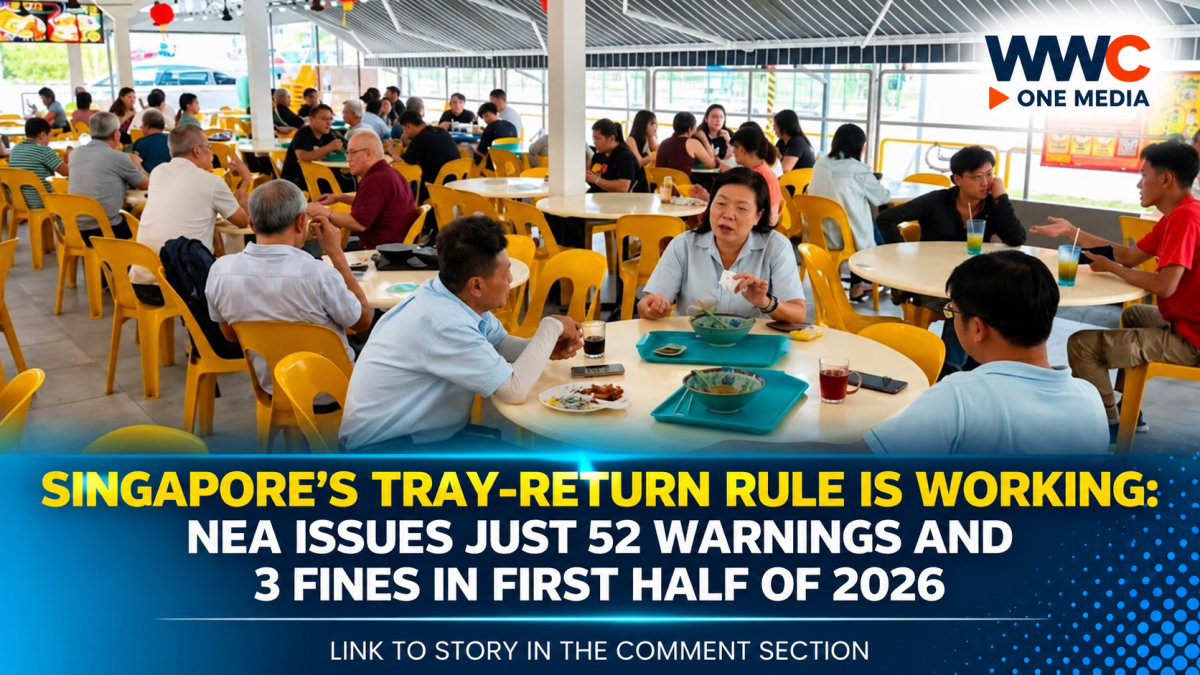
Singapore’s controversial tray-return and table-clearing rules appear to be changing diner behaviour, with enforcement cases plunging sharply in 2026.
The National Environment Agency (NEA) issued 52 warning letters and just three fines to diners for failing to return used trays and crockery or clear litter from their tables during the first half of 2026.
That represents a dramatic decline from previous years. In the first half of 2025, NEA issued 628 warning letters and seven fines, while the corresponding period in 2024 saw 2,984 warnings and seven fines. For the whole of 2025, there were 814 warning letters and 11 fines.
Tray-return compliance reaches 94%
The falling number of enforcement cases comes as Singapore’s hawker centres maintain a 94 per cent average Tray and Crockery Return Rate, according to NEA’s latest update.
That is a major improvement from 65 per cent in August 2021, before mandatory table-clearing enforcement began. The rate reached 93 per cent in April 2024 and has since stabilised at around 94 per cent.
Several hawker centres recorded particularly strong results during the first half of 2026, including Fernvale Hawker Centre and Market, Market Street Hawker Centre, and Chong Pang Market and Food Centre.
What happens if diners do not clear their tables?
The rules apply not only to returning trays and crockery, but also to removing table litter such as used tissues, drink cans and food remnants.
NEA and the Singapore Food Agency began enforcement at hawker centres in September 2021 and extended the requirements to coffeeshops and food courts in January 2022. Since June 2023, enforcement officers have been able to request diners’ particulars when they fail to comply.
Under the current system, first-time offenders receive a written warning, while repeat offenders can receive fines or face court action. A second offence can attract a S$300 composition fine.
The wider Environmental Public Health Act also provides for court fines of up to S$2,000 for a first conviction, S$4,000 for a second conviction and S$10,000 for a third or subsequent conviction, with Corrective Work Orders also possible in applicable littering cases.
There are exceptions
The rules are not intended to penalise diners who genuinely cannot clear their tables.
NEA says enforcement will not be taken against frail elderly people, persons with disabilities or children who are clearly unable to clear their tables. Family members or dining companions are expected to assist where appropriate.
There is also no enforcement against someone who cannot return a tray because the designated return rack is full, according to NEA’s enforcement guidance.
Cleanliness gains extend beyond tray returns
The latest figures show that Singapore’s broader cleanliness campaign is also producing results.
NEA said it issued about 5,300 fines for ground-littering offences during the first half of 2026, down from about 7,000 during the same period in 2025. More than 260 Corrective Work Orders were also issued at cleanliness hotspots.
Rat activity has also declined. The average number of rat burrows detected during each two-month surveillance cycle fell to around 3,400 in the first half of 2026, compared with about 5,400 during the same period last year.
At the same time, NEA and the Singapore Food Agency carried out about 490 enforcement actions against premises owners over rat-related lapses between January and June, including about 260 cases involving poor refuse management.
Why the numbers matter
The latest figures suggest the tray-return policy may be moving beyond simple punishment and toward a change in everyday behaviour.
When the initiative began, Singapore’s average tray and crockery return rate at hawker centres was only 65 per cent. Five years later, it is holding at 94 per cent, while the number of warnings issued has fallen dramatically.
That combination is significant: fewer people are being caught because more diners appear to be complying in the first place.
But the policy remains part of a broader public-hygiene strategy. NEA says keeping Singapore’s shared spaces clean requires cooperation between diners, cleaners, hawkers, premises operators and government agencies.
WWC ONE MEDIA J.M.D

Leave a Reply