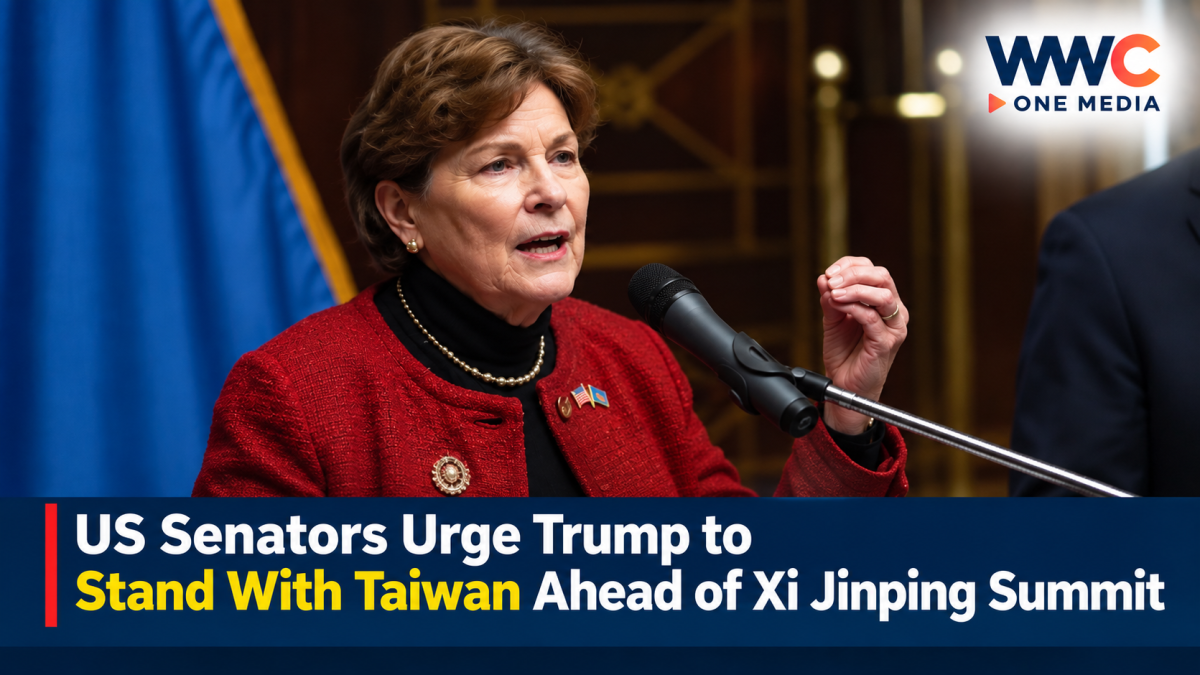
WASHINGTON/TAIPEI — A group of senior Democratic U.S. senators is urging President Donald Trump to maintain Washington’s support for Taiwan as Chinese President Xi Jinping prepares for a high-level meeting with Trump in Washington.
In a September 22 statement, Senators Jeanne Shaheen, Chris Coons, Patty Murray, Jack Reed, Mark Warner, Elizabeth Warren and Andy Kim called on Trump to preserve U.S. support for Taiwan’s defense and resist Chinese pressure over American policy toward Taipei.
The statement comes just one day before Xi’s scheduled arrival in the United States and as Taiwan-related issues are expected to feature prominently in discussions between the two leaders.
Taiwan arms sales become a central concern
One of the senators’ main concerns is U.S. military support for Taiwan.
The lawmakers urged Trump not to allow Beijing to determine whether Washington can provide defense support to Taiwan. Their intervention comes as Reuters reports that Xi is expected to raise U.S. arms sales to Taiwan during his meeting with Trump.
Three sources familiar with U.S.-China discussions told Reuters that Beijing is likely to invoke the 1982 U.S.-China joint communiqué and press Washington to halt arms sales to Taiwan. China has repeatedly opposed U.S. weapons sales to Taipei.
The 1982 communiqué stated that the United States intended to gradually reduce its arms sales to Taiwan. However, then-President Ronald Reagan issued a separate memorandum stating that any reduction was conditioned on China’s continued commitment to resolving differences with Taiwan peacefully.
Senators raise broader concerns about China
The senators’ statement goes beyond Taiwan.
They accused Chinese entities of providing Iran with satellite imagery, technology and battlefield intelligence and criticized China’s role in supporting Russia’s war effort in Ukraine. They also raised concerns about China’s efforts to obtain advanced semiconductor technology for artificial-intelligence development.
These are claims and policy arguments made by the senators, rather than independently established findings presented in their statement as a comprehensive assessment.
The lawmakers called for tighter restrictions on China’s access to advanced chips and semiconductor manufacturing equipment and urged Trump to address China’s relationship with Russia and Iran during his discussions with Xi.
Xi’s Taiwan agenda expected to draw attention
The Senate statement arrives as analysts expect Taiwan to be among the most sensitive subjects at the Trump-Xi meeting.
Bonnie Glaser of the German Marshall Fund told CNA that Xi is likely to focus particularly on U.S. arms sales to Taiwan. Former U.S. National Security Council China director Dennis Wilder similarly said Beijing would probably raise Taiwan during the summit.
Glaser noted that U.S. domestic law, including the Taiwan Relations Act, remains part of the framework governing Washington’s relationship with Taiwan.
Taiwan’s government rejects Beijing’s sovereignty claims, while China considers Taiwan part of its territory. The United States does not maintain formal diplomatic relations with Taiwan but maintains extensive unofficial relations and provides defense articles to Taipei under U.S. law and policy.
Trump-Xi meeting comes with multiple issues on the table
Taiwan is only one of several major issues expected to feature in the summit.
Reuters reports that the two leaders are also expected to discuss trade, Iran, artificial intelligence and other areas of U.S.-China relations. The countries are also dealing with questions surrounding their existing trade arrangements and China’s supply of rare earths.
CNA’s reporting similarly identifies trade, rare earths and AI as major subjects, while analysts expect the two governments to explore areas where cooperation remains possible despite continuing strategic competition.
Taiwan closely watches Washington-Beijing talks
Taiwan’s government has been monitoring the high-level U.S.-China exchanges while maintaining communication with Washington.
The timing is particularly significant because Reuters reports that China may seek changes to U.S. policy toward Taiwan at the same meeting where Washington and Beijing are attempting to manage broader tensions in their relationship.
For Taipei, the central issue is whether discussions between Washington and Beijing affect existing U.S. commitments and policies toward Taiwan.
For Washington and Beijing, Taiwan remains one of the most consequential disagreements in their relationship.
The senators’ intervention therefore adds another political voice to an already closely watched summit—but their statement does not determine the outcome of the Trump-Xi meeting, nor does it show that U.S. policy has changed.
The two leaders are scheduled to meet in Washington on September 24, with Taiwan, trade, technology and wider geopolitical issues all expected to be part of the diplomatic agenda.
WWC ONE MEDIA G,A