
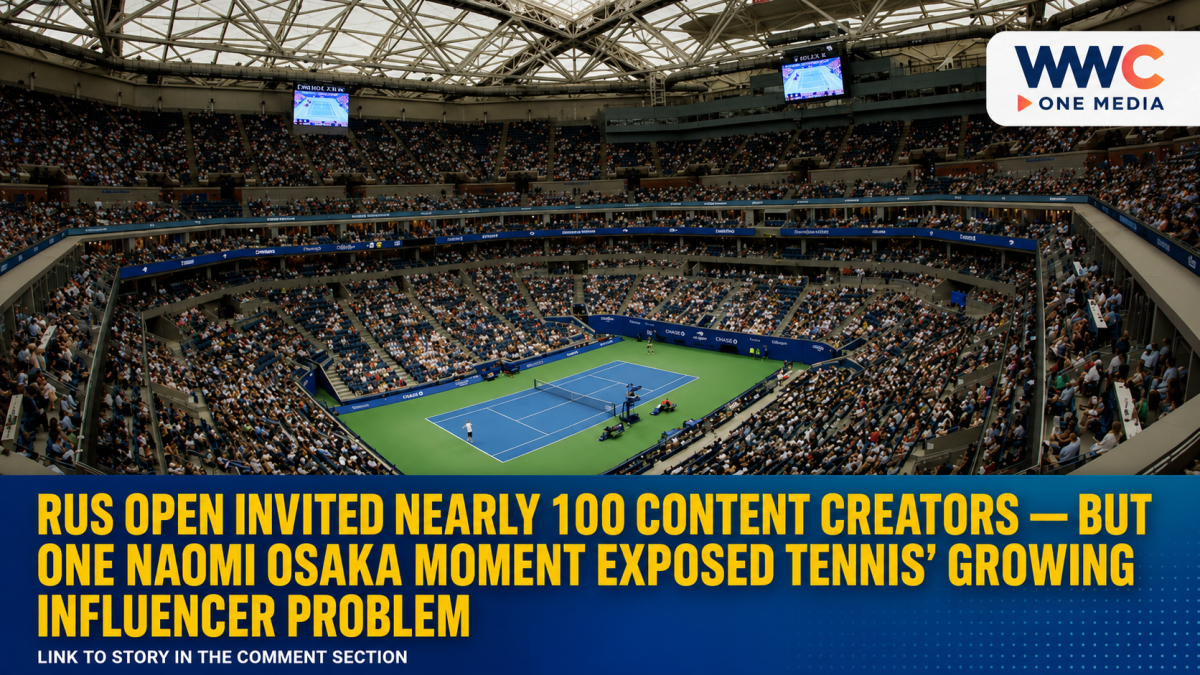
NEW YORK — The US Open wanted to become bigger than a tennis tournament. Now, after smartphones, bright lights and social-media shoots began colliding with actual match play, organizers are confronting the uncomfortable side of that success.
Nearly 100 content creators have received credentials for the 2026 US Open, almost twice the 54 accredited when the tournament launched its creator credential program in 2025. About 20 creators are focused specifically on the tournament’s booming food-and-drink scene, according to organizers cited by Reuters — a sign of just how much the Open now markets not only tennis, but the entire Flushing Meadows experience.
That strategy has helped turn the final Grand Slam of the season into one of New York’s biggest social and cultural events.
But this week, the push to make tennis more shareable collided with one of the sport’s oldest expectations: when a point is being played, spectators are supposed to let the players play.
Naomi Osaka Match Becomes Flashpoint
The controversy exploded during Naomi Osaka’s first-round match against Anastasia Zakharova at Arthur Ashe Stadium on Monday, August 31.
Videos from inside the stadium showed people in a hospitality suite moving around, filming content and using bright lighting while play was underway. The disturbance became significant enough for chair umpire Kader Nouni to intervene and ask the group to settle down.
CBS New York separately reported that voices from spectators filming during a point could be heard through the normally quiet stadium, while another video showed a spectator using a clip-on LED light.
The images quickly spread online, turning what might once have been a minor crowd warning into a wider debate about whether influencer culture has begun changing the atmosphere of elite tennis.
Osaka did not reject social media creators outright.
Instead, after advancing in the tournament, the former US Open champion made the distinction that increasingly matters: exposure can help tennis, but it cannot come at the expense of the competition.
“Obviously if you come to a sporting event, you have to respect the sport,” Osaka told reporters, while acknowledging that creators can introduce tennis to audiences who might otherwise never follow it.
Jessica Pegula: Promotion Has Its Limits
American star Jessica Pegula offered a similar view.
Pegula said she understood the value of creators showcasing the broader US Open experience, but said activity involving photographs and selfie lights can cross the line when professional players are trying to compete.
For the athletes, this is not simply entertainment content. It is their workplace, their ranking, their prize money and potentially their Grand Slam season.
Pegula described some of the behavior as disrespectful and suggested the trend may have gone too far.
Daniil Medvedev has taken a similarly balanced position, arguing that greater awareness of tennis is positive while recognizing that lights or other disturbances during points can become a genuine competitive problem.
And the Osaka incident was not the only moment drawing attention.
Reuters reported that another social-media user attracted criticism after posting photographs taken inside Arthur Ashe Stadium while Madison Keys was playing a point against Alina Korneeva — another example of content creation colliding with traditional tennis etiquette.
Importantly, however, public reports have not established that every spectator involved in these viral incidents was an officially credentialed US Open creator. That distinction matters: the tournament’s creator program is growing rapidly, but disruptive behavior by individual spectators should not automatically be attributed to every accredited creator.
The US Open Is Responding
The USTA is now reinforcing its expectations.
Digital signage around the grounds has reminded spectators not to use flash photography or other lighting during match play. The tournament has also been contacting ticket holders and suite guests and using video boards to reinforce the message.
US Open communications chief Brendan McIntyre told PEOPLE that organizers welcome the sport’s growing popularity but do not want fan activity interfering with competition. He also stressed that such incidents remain relatively infrequent and that chair umpires can address disruptive crowd behavior when necessary.
The tournament’s official guest code already prohibits conduct that obstructs other spectators and restricts unauthorized recording, commercial activity and behavior that creates a disruptive experience for players or guests.
So the question is not whether the US Open has rules.
It is whether those rules are keeping pace with a sporting event increasingly designed to be photographed, filmed and shared in real time.
Why Tennis Is Courting Creators in the First Place
The influencer boom did not happen accidentally.
Ahead of the tournament, USTA media operations director Jeanmarie Daly told Front Office Sports that close to 100 creators had been approved for 2026, nearly doubling the inaugural 2025 group.
The strategy is explicitly designed to reach audiences beyond traditional sports journalism.
And the numbers help explain why organizers are unlikely to abandon it.
According to USTA figures reported by Front Office Sports, the 2025 creator group generated more than 5.5 million social-media engagements. The tournament’s own social channels recorded about 3.1 billion interactions during last year’s event, while the 2025 US Open drew a record 1.14 million attendees.
That is valuable attention in an era when leagues and tournaments are competing not just against other sports, but against every form of entertainment on a smartphone.
The US Open has also deliberately expanded the event beyond conventional singles competition. The 2026 singles main draws again run for 15 days, while Fan Week and the revamped mixed doubles competition give fans and brands more opportunities to engage with the tournament before the main singles storylines peak.
Tennis Is Going All-In on the Creator Economy
The trend extends far beyond New York.
In June, the ATP expanded its partnership with TikTok after posts using #tennis increased more than 25% during 2025.
The partnership includes creator access, player-focused storytelling and an expanded “On Tour With” program designed to bring creators closer to major ATP events.
The ATP says the number of Top 100 players active on TikTok has nearly doubled since the partnership began.
The men’s tour has also expanded its work with Overtime. According to the ATP, its 2025 collaboration produced more than 80 million views, with 67% of viewers under 35 — precisely the type of younger audience traditional sports organizations are desperate to capture.
In other words, influencers are not outsiders suddenly invading tennis.
They are increasingly part of the sport’s growth strategy.
And that makes the US Open controversy more complicated.
The Bigger Question Facing the US Open
Tennis has always had to balance tradition with entertainment.
The US Open, more than any other Grand Slam, has embraced the spectacle: celebrity-filled suites, late-night matches, fashion, cocktails, food, music, brand activations and the unmistakable energy of New York.
Content creators fit naturally into that ecosystem.
They give sponsors exposure. They introduce players to new audiences. They turn food, fashion and behind-the-scenes moments into millions of views. And they can make tennis relevant to people who may never sit through a three-hour match on television.
The problem begins when creating the content becomes more important than the event being documented.
Bright lights during a serve, conversations during a point or elaborate photo sessions while players are competing do not simply break old-fashioned etiquette. They can interfere with athletes performing at the highest level of their profession.
That is the boundary the US Open is now being forced to define more clearly.
Creators are almost certainly here to stay.
The real challenge is making sure the race for the next viral video never becomes bigger than the tennis happening directly in front of the camera.

Leave a Reply