
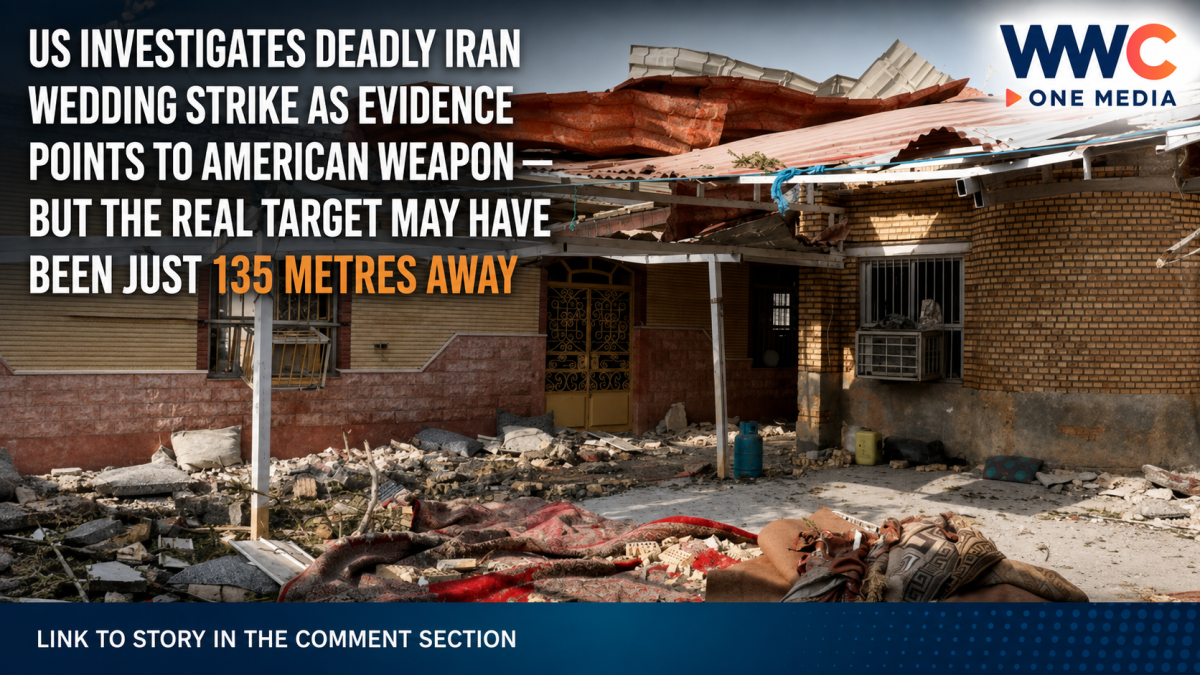
KUHESTAK, Iran — What was supposed to be a family wedding in a small coastal community overlooking the Strait of Hormuz ended in rubble, bloodied belongings and dozens of casualties — and now mounting evidence is putting the United States under scrutiny over exactly what its forces struck.
A visual investigation published by Reuters found that the explosion that tore through a home hosting the wedding in Kuhestak, southern Iran, on September 1 was most likely caused by a direct hit from a U.S. munition, rather than debris from another strike or an Iranian air-defence missile gone off course. Four military weapons specialists examined verified photographs and videos of the scene; all said the damage appeared consistent with a direct strike, while three assessed that the weapon was probably American.
The finding is significant because U.S. officials have so far stopped short of publicly accepting responsibility for hitting the wedding venue.
Vice President JD Vance said on September 3 that Washington was investigating the incident. The U.S. military has likewise said it is reviewing reports while maintaining that American forces do not intentionally target civilians.
A wedding was happening as strikes hit the coast
Dozens of people had reportedly gathered at a family home in Kuhestak when the strike hit. Images and video verified by Reuters showed a hole in the building’s roof, shattered rooms, wedding decorations and personal belongings scattered through the wreckage.
Initial Iranian reports said four people were killed and at least 68 wounded. The dead were reported to include women and children. Reuters subsequently reported that Iranian state television said a fifth victim, a 22-year-old woman, died in hospital, pushing the reported death toll to five.
There is an important detail still being disputed. Iranian state media initially included a 16-year-old among those killed at the wedding site, while a Baloch rights organisation told the Associated Press that the teenager may instead have been struck by shrapnel while riding near a communications tower targeted in the same attack. That discrepancy has not been independently resolved.
The possible intended target was remarkably close
One of the biggest clues may be the telecommunications tower located near the house.
Two U.S. officials told Reuters that American forces conducted strikes around Kuhestak that night and specifically targeted the town’s telecommunications tower. Satellite analysis put that structure roughly 135 metres from the wedding venue.
CENTCOM has independently confirmed that its September 1 operation struck Iranian military targets including air-defence sites, radar systems, maritime facilities, mine-laying capabilities and communications sites. The command said the attacks were carried out after what it described as attempted Iranian attacks against commercial shipping in the Strait of Hormuz and U.S. personnel.
That leaves investigators with a crucial unanswered question: Was the house mistakenly selected as a target, did a weapon aimed at nearby infrastructure miss, or was there another failure somewhere in the targeting chain?
Reuters reported that one weapons specialist said a munition could simply have missed its intended objective despite the sophistication of modern guidance systems.
Weapons evidence adds to the pressure on Washington
The Associated Press separately consulted weapons specialist N.R. Jenzen-Jones of Armament Research Services, who examined images of munition fragments that Iranian media said came from the scene.
He assessed that the remains pointed to an American air-delivered guided weapon. After initially considering a SLAM-ER cruise missile, he said the fragments appeared more likely to be associated with a Joint Standoff Weapon, or JSOW, although he could not exclude other possibilities or the use of multiple weapons. CENTCOM declined to comment to AP on that assessment.
Reuters also reported that weapons remnants shown by Iranian media appeared to include components associated with a JSOW. Crucially, however, Reuters said it could not independently verify that those particular fragments were recovered from the wedding house itself.
That distinction matters. The evidence increasingly supports American involvement, but it does not yet establish precisely which munition hit the house or why.
Iran pushes for international investigation
Iranian officials have accused Washington of committing a war crime, an allegation that has not been established by an independent judicial investigation.
The Iranian Red Crescent Society has asked the International Criminal Court to investigate the strike, arguing that the civilian nature of the location raises serious questions under international humanitarian law. The organisation called for an independent and impartial investigation.
Whether a civilian casualty incident constitutes a war crime depends on factors including what commanders knew, what military objective was being targeted, precautions taken before the attack and whether anticipated civilian harm was excessive relative to the expected military advantage. A civilian death by itself does not establish a war crime.
The strike comes at the most dangerous point of the US-Iran confrontation
The wedding attack was not an isolated explosion. It occurred during a major new exchange of fire between Washington and Tehran around the strategically vital Strait of Hormuz.
Reuters reported that U.S. forces struck Iranian air defences, radar, maritime assets, communications sites and mine-laying capabilities along Iran’s southern coast. Iran responded with attacks targeting U.S. facilities and American allies across the Gulf.
The Strait of Hormuz has become one of the conflict’s most important pressure points because of its role in global energy supplies. AP reported that roughly one-fifth of the world’s traded oil normally moved through the waterway before the conflict severely disrupted shipping.
That means a strike on one residential home in a relatively small Iranian coastal town could have consequences stretching far beyond Kuhestak.
The question Washington now has to answer
The evidence available so far does not show that American forces deliberately selected a wedding as a target.
But it increasingly challenges the possibility that the destruction was simply collateral damage from an unrelated projectile.
Reuters’ visual analysis, American officials’ acknowledgment that U.S. forces attacked nearby, CENTCOM’s confirmation that communications infrastructure was among its targets and AP’s examination of weapons fragments all point toward a more serious possibility: an American weapon directly struck the civilian property while U.S. forces were attacking another target only a short distance away.
The outstanding question is no longer simply whether a U.S. weapon was involved.
It is why that weapon hit a house filled with wedding guests — and whether the investigation Washington has now promised will make the answer public.




Leave a Reply