
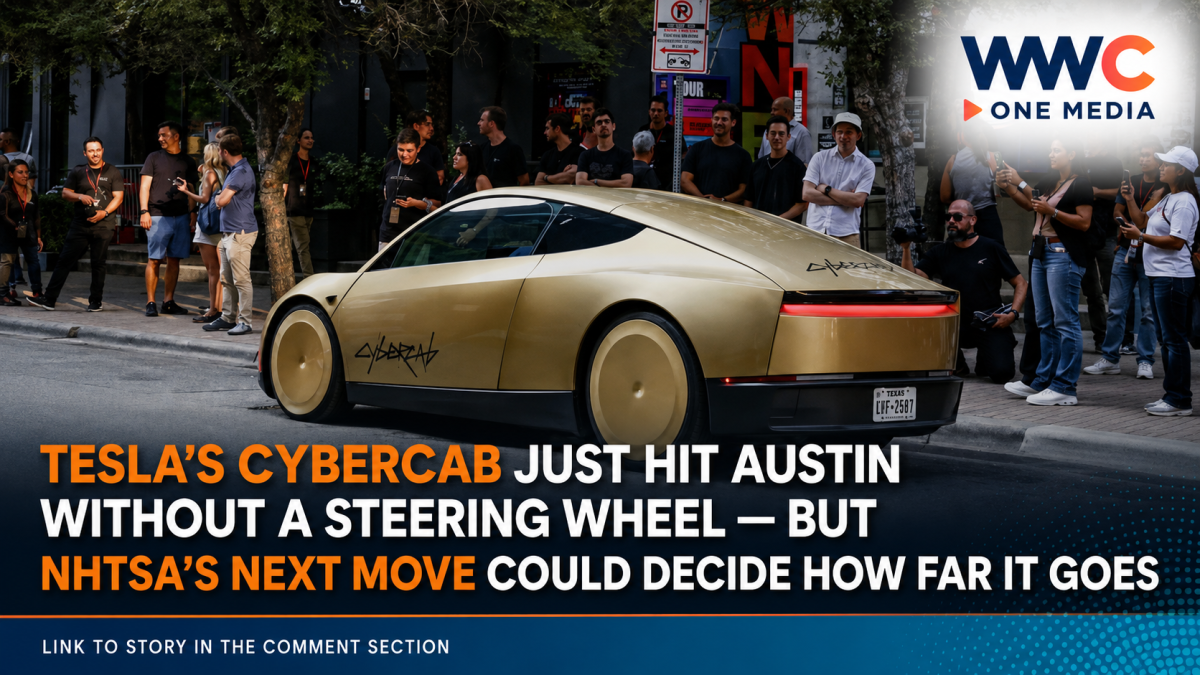
AUSTIN, Texas — Tesla has taken one of its biggest steps yet toward Elon Musk’s driverless future, putting its purpose-built Cybercab into limited passenger service in Austin. But almost immediately, the rollout drew attention from the top U.S. auto-safety regulator, raising a question that could determine how quickly Tesla can turn a handful of futuristic taxis into a nationwide network.
The National Highway Traffic Safety Administration, or NHTSA, confirmed that it is in contact with Tesla and is evaluating the Cybercab rollout after the company began offering rides in limited parts of Austin on September 3.
“NHTSA is in contact with Tesla and is evaluating the situation,” an agency spokesperson told Reuters. The regulator did not announce a formal investigation or provide additional details.
That distinction is important. Tesla has launched Cybercab service, but the federal government has not publicly announced a dedicated Cybercab defect investigation. For now, regulators appear to be assessing how the unusual vehicle fits within existing federal safety requirements.
Tesla’s Robotaxi Just Lost the Steering Wheel
The Cybercab is not simply another Tesla with self-driving software switched on.
It is a two-seat vehicle specifically designed for autonomous transportation, with no traditional steering wheel or pedals. Tesla says Cybercab rides are currently available only in limited areas of Austin, while its broader Robotaxi service also operates with Model Y vehicles in several cities in Texas and Florida.
That makes the Austin deployment a critical test of Musk’s long-running strategy: instead of gradually adding more automation to conventional cars, Tesla wants eventually to deploy vehicles designed from the beginning to operate without a human driver.
Reuters reported that Texas records showed 45 Cybercabs among 420 Tesla autonomous vehicles registered in the state immediately before the launch. By comparison, Alphabet-owned Waymo had 988 vehicles registered in Texas, highlighting how far Tesla still has to go if it wants to overtake the current U.S. robotaxi leader.
Tesla says Cybercab production started earlier in 2026, and the company previously disclosed that production vehicles had begun engineering test drives on public roads before deployment into its Robotaxi network.
The Federal Rulebook Was Written for Cars With Human Drivers
The problem for Tesla is that much of America’s vehicle-safety system was created around an assumption that cars have human drivers.
Federal Motor Vehicle Safety Standards traditionally include equipment and design requirements tied to human operation, including controls such as brake pedals and other driver-oriented hardware.
NHTSA is already rewriting portions of those rules.
In June 2026, the agency began a rulemaking process that could eliminate the requirement for manual brake pedals in vehicles designed to be driven exclusively by automated-driving systems. NHTSA stressed that other braking-performance rules, including stopping-distance requirements, would remain.
But proposed regulations are not the same as finalized rules.
That creates an unusual moment for Tesla: the company is rolling out a vehicle built for a regulatory future that Washington is still constructing.
Federal regulators also have an exemption process for vehicles that do not fully comply with existing standards. Under NHTSA’s streamlined Part 555 system, manufacturers may receive exemptions covering up to 2,500 vehicles per year if they demonstrate an equivalent level of safety and show that the exemption serves the public interest.
Bloomberg reported ahead of the Austin launch that Tesla had not filed such an exemption request for Cybercab as of September 2. Amazon-owned Zoox, by comparison, obtained an exemption connected to commercial deployment of its own purpose-built autonomous vehicle.
That regulatory difference could become crucial if Tesla tries to move rapidly from a limited Austin deployment to large-scale commercial service.
Tesla’s Safety Scrutiny Goes Beyond Cybercab
The Cybercab rollout is also occurring while Tesla’s broader self-driving technology remains under federal scrutiny.
NHTSA has been examining Tesla’s Full Self-Driving, or FSD, system after crashes involving reduced-visibility conditions such as sun glare, fog and airborne dust. The regulator later escalated that review, saying available incident data raised concerns about whether Tesla’s system reliably detects degraded camera visibility or warns drivers early enough.
Another NHTSA investigation is examining alleged traffic-law violations involving FSD, including incidents in which vehicles were reported to have proceeded through red lights or moved into opposing traffic lanes.
Those investigations involve Tesla’s FSD (Supervised) systems and should not automatically be treated as investigations of the Cybercab itself.
But they matter because Tesla is making an unusually aggressive technological bet.
Unlike competitors such as Waymo and Zoox, which combine cameras with technologies including radar and lidar, Tesla has built its autonomy strategy heavily around cameras and artificial intelligence. AP noted that proving this approach can operate safely without a human backup is one of the biggest challenges Tesla now faces.
Tesla Also Has a Public-Trust Problem to Solve
Even if Tesla clears every regulatory hurdle, another obstacle remains: convincing passengers to get inside.
A Pew Research Center survey cited by AP found that seven in ten U.S. adults surveyed were either “not too” or “not at all” comfortable riding in a driverless vehicle.
Cybercab makes that psychological test even more dramatic.
Passengers are not simply being asked to trust software while sitting in a familiar-looking car. They are stepping into a vehicle where the absence of a steering wheel and pedals makes one thing immediately clear: there is no conventional driver waiting to take control.
For Tesla, that is the product’s biggest selling point.
It may also be its biggest challenge.
Why Cybercab Matters So Much to Tesla
Tesla increasingly needs its autonomous-driving ambitions to become a major business, not merely a technology demonstration.
Reuters reported that investors see autonomy as central to Tesla’s future and to the enormous valuation attached to the company, particularly as its traditional electric-vehicle business faces stronger global competition. Musk has said Cybercab could eventually become Tesla’s highest-volume vehicle and form the backbone of a much larger ride-hailing network.
That makes Austin much more than another product launch.
Tesla is now attempting to prove three things at the same time: that a vehicle without traditional controls can operate safely, that regulators will allow the model to scale, and that ordinary passengers will trust it enough to climb inside.
The first Cybercabs are already moving.
The far more consequential question is what happens when Tesla tries to deploy thousands—or eventually hundreds of thousands—of them.
Because the technology may have reached the street before the regulatory battle has truly begun.




Leave a Reply