
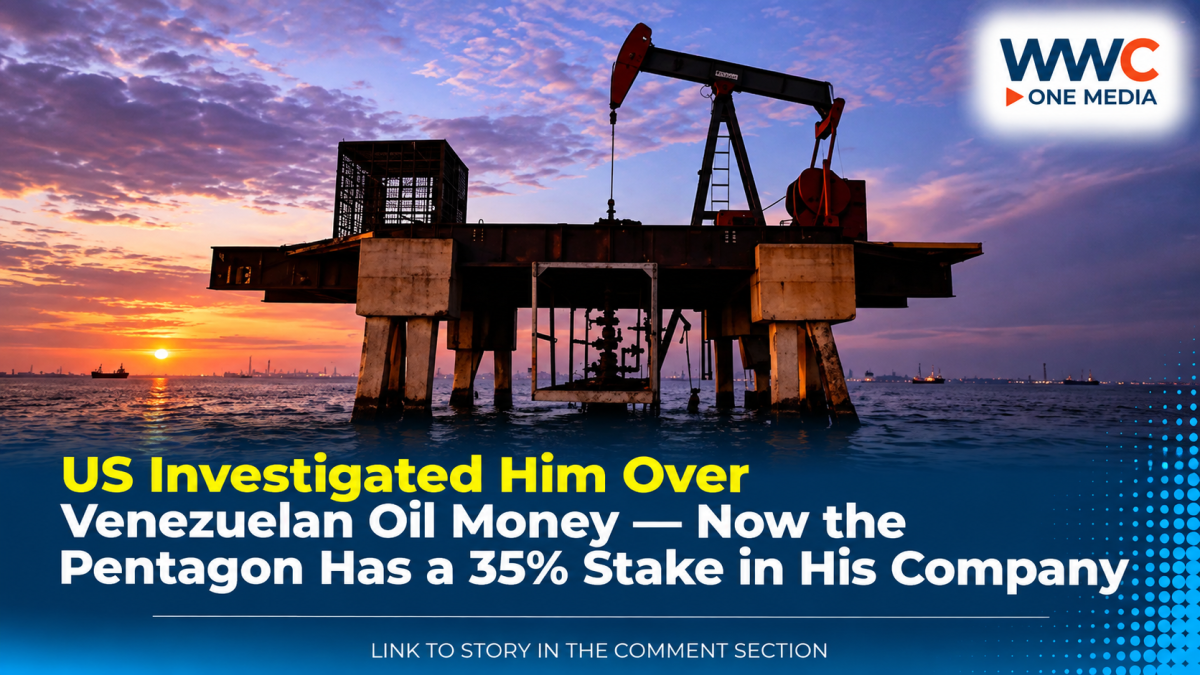
CARACAS/MIAMI — Until recently, Venezuelan billionaire Alejandro Betancourt was reportedly the subject of US money-laundering investigations involving funds allegedly embezzled from Venezuela’s state oil company.
Now, he has become one of Washington’s most important partners in a sweeping new agreement involving some of the world’s largest oil reserves.
The extraordinary reversal has placed Betancourt — a businessman with a long history of controversy, political connections and international legal scrutiny — at the centre of an unprecedented US-Venezuela energy deal that gives the Pentagon’s investment arm a 35 per cent stake in his company, North American Blue Energy Partners, or NABEP.
The deal is raising major questions in Washington and Caracas alike.
How did a billionaire previously investigated by US authorities over alleged money laundering become a key partner in one of the Trump administration’s most ambitious foreign energy projects?
And just how much of Venezuela’s oil wealth is now tied to his company?
From investigation to Washington’s key oil partner
Reuters reported that Betancourt had been investigated by US, Spanish and Swiss authorities over allegations involving funds allegedly embezzled from Venezuela’s state-owned oil company, PDVSA.
According to Reuters, Florida prosecutors paused a US money-laundering investigation into Betancourt earlier this year.
Importantly, Betancourt has not been charged in the United States and has consistently denied wrongdoing. Reporting also indicates that legal scrutiny outside the US has not entirely disappeared, with Swiss authorities continuing to pursue a criminal investigation connected to the businessman.
That distinction matters.
Betancourt has faced serious allegations and investigations, but an investigation is not the same as a criminal conviction or a formal finding of guilt.
Yet his new position has made his past impossible to ignore.
The Pentagon now has a stake in his company
The agreement involving Betancourt’s NABEP is unlike a conventional oil contract.
Under details reported by Reuters and confirmed in subsequent AP coverage, the Pentagon’s Office of Strategic Capital is set to hold a 35 per cent stake in NABEP.
The US government also secured the right to purchase 20 per cent of the venture’s oil production at cost, while receiving preferential access to the remaining output.
The joint venture has been granted long-term rights over 17 Venezuelan oil fields containing an estimated 65 billion barrels of reserves.
That represents roughly one-fifth of Venezuela’s vast crude resources, according to reporting on the agreement.
For Washington, the deal is being presented as a strategic energy opportunity.
For critics, it is an unprecedented arrangement that puts the Pentagon into a commercial relationship with a private businessman whose past has attracted international scrutiny.
How Betancourt became so important
Betancourt’s rise was not simply the result of a business negotiation.
Reuters reported that he played a key role in US strategy and planning leading up to the January operation that removed former Venezuelan president Nicolás Maduro from power and transferred him to New York to face US drug-trafficking charges, which Maduro denies.
According to Reuters, Betancourt provided information and assistance that helped make him a valuable intermediary between Washington and Venezuela’s new political leadership.
That relationship transformed him from a controversial oil businessman into a critical figure in the Trump administration’s plans for Venezuela.
One US official quoted in separate reporting described his importance in blunt terms, suggesting that the energy-security agreement would not have happened without him.
A controversial history in Venezuela’s oil industry
Betancourt built his fortune through business ventures connected to Venezuela’s energy sector.
His name has long been associated with the country’s politically connected business elite and the controversial world of government contracts that expanded during the Chávez and Maduro years.
Reuters reported that the investigations involving Betancourt examined funds allegedly connected to more than US$1 billion that investigators believed had been embezzled from PDVSA.
Betancourt has denied wrongdoing.
Recent reporting also noted that some of the allegations and investigations involving him stretch back nearly a decade, while US officials defending the new partnership have argued that NABEP and Betancourt were vetted before the agreement was finalized.
That has not silenced critics.
The question now facing the Trump administration is whether Betancourt’s current value as an intermediary outweighs concerns raised by his past.
Why Washington wants Venezuelan oil
The agreement comes as the US seeks to expand its access to strategic energy supplies.
Venezuela possesses the world’s largest proven crude oil reserves, although years of underinvestment, sanctions, political instability and deteriorating infrastructure have severely limited its production capacity.
The new agreement aims to revive production from 17 oil fields, with long-term investment potentially reaching tens of billions of dollars.
The Trump administration has portrayed the arrangement as a major energy-security victory that could give the United States greater access to Venezuelan heavy crude while helping rebuild the country’s oil industry.
But there is a major challenge.
Venezuela’s oil infrastructure is badly degraded, meaning any dramatic increase in production could take years and require massive investment.
Analysts have also warned that political uncertainty could make long-term planning difficult.
The deal has sparked legal and transparency concerns
The Betancourt agreement is controversial for another reason: how it was negotiated.
Reuters previously reported that lawyers and experts had raised questions about the structure, transparency and legality of the broader US-Venezuela oil arrangement.
The deal was negotiated largely outside public view and without the kind of competitive bidding normally associated with major energy concessions.
That has prompted calls for greater disclosure of the contracts and financial arrangements.
Critics have also questioned the Pentagon’s involvement in what is essentially a long-term commercial energy venture.
The administration, however, insists that the arrangement protects US strategic interests and does not require a direct cost to American taxpayers.
US says it will control the money flows
As scrutiny intensified, Energy Secretary Chris Wright said the United States would maintain strict oversight over the financial flows connected to the NABEP agreement.
The administration has argued that this oversight will help ensure transparency and sound business practices as the project moves forward.
But critics say financial oversight does not eliminate broader questions.
They want to know:
Why was Betancourt chosen?
What exactly was reviewed before the deal?
What happens to the previous investigations?
And how much control will the US government actually have over the project?
Those questions are likely to follow the agreement for years.
A billionaire’s extraordinary turnaround
Few stories better illustrate the rapidly changing relationship between Washington and Caracas.
Not long ago, Betancourt was reportedly being investigated by US authorities over alleged money laundering linked to Venezuela’s troubled oil industry.
Today, his company is part-owned by a Pentagon investment arm and positioned at the centre of a deal involving 65 billion barrels of Venezuelan oil reserves.
The turnaround is remarkable.
But it also carries political risk.
If the project succeeds, Betancourt could become one of the most influential figures in Venezuela’s post-Maduro energy sector.
If new evidence emerges from the investigations surrounding his past, the US government could find itself facing uncomfortable questions about one of its most unusual foreign energy partnerships.
The biggest question may still be unanswered
The Trump administration has made its choice.
It sees Betancourt as a businessman who understands Venezuela’s oil industry, has access to key players and can help turn a struggling petroleum sector into a strategic asset for the United States.
Critics see something else.
They see a billionaire who faced major international scrutiny now receiving an extraordinary role in a government-backed energy project.
For now, neither side can ignore the facts.
Betancourt has not been convicted of the alleged money-laundering activities and has denied wrongdoing. But his past investigations remain a major part of the story surrounding his sudden emergence as Washington’s most important private partner in Venezuela’s oil industry.
And as billions of barrels of crude move closer to the centre of US strategy, one question will continue to shadow the deal:
Did Washington find the only businessman capable of unlocking Venezuela’s oil — or did it take an extraordinary political gamble on one of the country’s most controversial billionaires?
Editorial accuracy note
Alejandro Betancourt should be described as a businessman who was investigated or faced investigations, not as someone convicted of money laundering. Reuters reported that a US investigation was paused and that he has not been charged in the United States. He denies wrongdoing. Recent reporting indicates a Swiss criminal investigation remains active.
The Pentagon’s involvement should also be described precisely: the Pentagon’s Office of Strategic Capital is taking a 35 per cent stake in NABEP, rather than saying the Pentagon directly bought Venezuelan oil fields. The broader venture involves long-term rights over 17 fields and an estimated 65 billion barrels of reserves.
The agreement remains controversial and has prompted calls for greater transparency, particularly over its legal structure and the role of US government agencies.
WWC ONE MEDIA J.M.D


Leave a Reply