
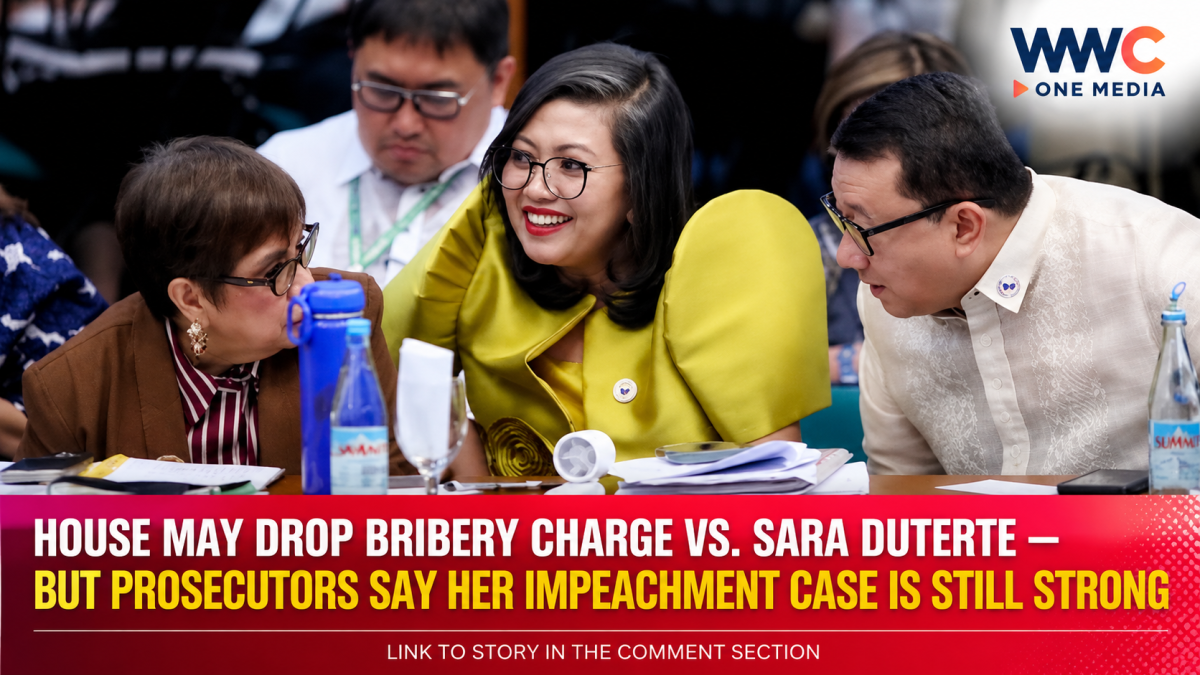
MANILA — The House prosecution panel is considering dropping the bribery article in Vice President Sara Duterte’s impeachment trial, but prosecutors insist the move should not be interpreted as an admission that the allegation is weak.
The issue has emerged as prosecutors try to shorten the Senate trial and concentrate their resources on what they consider the strongest remaining allegations against Duterte.
As of September 6, no final decision has been made to drop Article III, according to prosecution spokesperson Atty. Jay Tolosa. The panel is still weighing whether to proceed with the bribery allegations or move directly to the unexplained-wealth article.
Why prosecutors are considering dropping the bribery article
The bribery allegation is contained in Article III of the impeachment case.
It accuses Duterte of allegedly giving monetary gifts or payments to Department of Education officials to induce them to violate or circumvent procurement and related laws.
Prosecutors have said they are considering skipping the article primarily because of time and trial strategy, rather than because they believe the allegations cannot be proven.
Rep. Joel Chua, one of the House prosecutors, said the panel would not have included the bribery allegation in the Articles of Impeachment if it believed the evidence was insufficient. He described the possibility of dropping it as a matter of prioritization and an effort to prevent the trial from becoming unnecessarily prolonged.
That distinction is important.
Dropping an article from the prosecution’s presentation is not the same as a finding that the allegation is false or that Duterte has been cleared of it.
What happens if Article III is skipped?
The prosecution would move from the confidential-funds allegations to Article II, which deals with alleged unexplained wealth, incomplete or inaccurate asset declarations and alleged failure to divest from business interests.
The House prosecution team says it has recently obtained bank and tax records involving Duterte, her husband and their companies from the Senate impeachment court.
Rep. Terry Ridon described those records as an important remaining piece of evidence for the unexplained-wealth case.
The prosecution has also said it has obtained documents from the Bureau of Internal Revenue and the Anti-Money Laundering Council that could be used in presenting Article II.
That could make the unexplained-wealth allegations the next major battlefield in the Senate trial.
The bribery allegation is still being described as strong
Despite the possibility of dropping Article III, prosecutors have repeatedly rejected the idea that the bribery case is being abandoned because of weak evidence.
The allegation centers partly on testimony from former DepEd Undersecretary Gloria Jumamil-Mercado, who testified that she received nine envelopes containing P50,000 each, marked “HOPE.”
The label was understood to refer to her position as head of the procuring entity at DepEd in 2023. Jumamil-Mercado testified that Assistant Secretary Sunshine Fajarda told her the money came from Duterte.
Those allegations remain disputed and form part of the prosecution’s case rather than an established finding of wrongdoing.
Duterte has denied the allegations against her.
The bigger issue: prosecutors want to finish the trial faster
The proposed change comes as both the prosecution and Senate impeachment court face pressure to prevent the proceedings from stretching indefinitely.
The House prosecution team has said it wants to complete its presentation by October, with the defense potentially finishing its presentation by November and a possible verdict before the end of the year.
The Senate has also considered longer or whole-day sessions to accelerate the proceedings.
The prosecution previously said it expected to complete its presentation on the confidential-funds allegations by September 9.
What the impeachment case currently looks like
The prosecution has already presented evidence on two major articles.
Article IV concerns alleged grave threats and an alleged assassination plot involving President Ferdinand Marcos Jr., First Lady Liza Araneta-Marcos and then-House Speaker Martin Romualdez.
Article I concerns allegations involving the use, liquidation and alleged misuse of confidential funds associated with the Office of the Vice President and the Department of Education.
The remaining major articles are Article II on alleged unexplained wealth and Article III on alleged bribery.
The prosecution has completed its presentation on the threats-related article and is now focused on the confidential-funds allegations before potentially moving to unexplained wealth.
Abante: Dropping bribery would not necessarily weaken the case
Manila 6th District Rep. Benny Abante Jr., one of the lawmakers who sponsored the impeachment complaint, said he remains confident that removing the bribery article from the presentation would not substantially reduce the overall strength of the impeachment case.
He pointed instead to the evidence presented under other articles, particularly the allegations involving Duterte’s confidential funds and the threats-related article.
But legally and politically, the ultimate weight of the case will be determined by the Senate sitting as an impeachment court, not by individual House prosecutors or lawmakers.
A separate legal battle is adding pressure
The impeachment trial is unfolding alongside another legal case involving Duterte.
On September 4, a Philippine trial court issued a warrant over three counts of grave threats linked to Duterte’s 2024 remarks involving Marcos, his wife and Romualdez. Duterte subsequently posted bail and has denied the allegations.
Those allegations overlap with the subject matter of Article IV in the impeachment proceedings, making the developments particularly significant as the Senate continues its trial.
The political stakes are enormous
The impeachment proceedings could have consequences far beyond Duterte’s current position as vice president.
A conviction by the Senate impeachment court could remove her from office and carry serious consequences for her political future, including her ambitions for the 2028 presidential election.
That is why the decision over Article III matters.
If prosecutors drop the bribery article, the move could allow them to concentrate on the allegations they believe can be presented most efficiently and convincingly.
But it also means prosecutors would voluntarily leave one part of their original case without a full presentation of evidence.
For now, however, Article III remains on the table.
And the key question is no longer simply whether the bribery allegation is strong enough to survive.
It is whether prosecutors believe they can win the larger impeachment battle without spending additional trial time proving it.
That decision could shape the next phase of one of the Philippines’ most consequential political trials.
WWC ONE MEDIA M.J.E




Leave a Reply